

MBTI Criticisms: Valid Concerns and Unfair Attacks

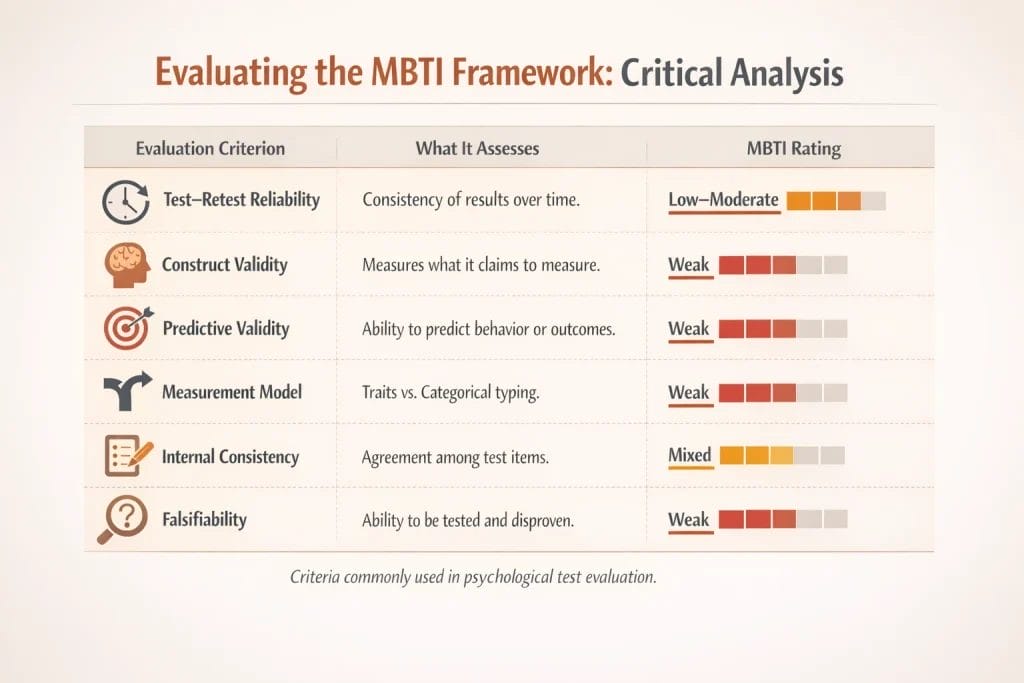
Between 39% and 76% of people receive a completely different personality type when they retake the MBTI just five weeks later. Yet over two million people take this assessment annually, and 88% of Fortune 500 companies have used it. Understanding which criticisms are valid—and which miss the mark—helps you decide how to use personality frameworks responsibly.
Key Takeaways
- Valid Scientific Criticisms: MBTI has real reliability problems—39-76% of people get different types when retesting within five weeks—and lacks predictive validity for job performance or life outcomes.
- Where Critics Overreach: Calling MBTI “meaningless” ignores its 0.74 correlation with Big Five Extraversion; it measures real personality aspects but less precisely than alternatives.
- Appropriate Use: MBTI works for self-reflection and team discussions but should never be used for hiring, clinical diagnosis, or high-stakes decisions.
Introduction
The Myers-Briggs Type Indicator sits at the centre of one of psychology’s strangest contradictions. Over two million people take the assessment each year. Around 88% of Fortune 500 companies have used it for team building or leadership development. Yet many academic psychologists dismiss it as “totally meaningless” or compare it unfavourably to horoscopes.
So which is it? A valuable tool for self-understanding, or an elaborate waste of time?
The honest answer is more nuanced than either camp typically admits. Some criticisms of the Myers-Briggs personality types deserve serious attention. The reliability concerns are real. The lack of predictive validity is well-documented. The commercial interests that shape MBTI research raise legitimate questions.
But other criticisms miss important context. Critics sometimes attack misuses of the test rather than the test itself. They occasionally ignore the correlations between MBTI and more respected personality models. And they rarely acknowledge the practical value that millions of users report experiencing.
This article examines both sides fairly. You will find an honest assessment of where the scientific criticisms hit home, where they overreach, and what this means for how you might use personality frameworks in your own life. The goal is not to defend or attack the MBTI, but to help you make an informed decision about its place in your self-understanding journey.
What Critics Actually Say About MBTI
Before evaluating whether the criticisms are fair, we need to understand what critics actually claim. The pushback against MBTI comes from several directions, and not all criticisms carry equal weight.
The Academic Critique
The most serious criticism comes from academic personality psychologists. In 1991, the National Academy of Sciences reviewed available MBTI research and concluded there was “not sufficient, well-designed research to justify the use of the MBTI in career counselling programs” (Druckman & Bjork, 1991). The committee noted a troubling gap between the test’s popularity and its scientific support.
This verdict has been echoed by prominent researchers. Adam Grant, an organisational psychologist at the University of Pennsylvania, has called the MBTI “the fad that won’t die,” arguing that “the traits measured by the test have almost no predictive power” for outcomes like job satisfaction or relationship success (Grant, 2013). Robert Hogan, a respected psychometric specialist, described the MBTI as “little more than an elaborate Chinese fortune cookie.”
These are not fringe voices. They represent mainstream opinion within academic psychology. When researchers study personality for a living, they overwhelmingly prefer alternative frameworks like the Big Five personality traits over the MBTI.
The Popular Media Critique
Beyond academia, journalists and popular science writers have amplified these concerns. Articles with titles like “The Myers-Briggs Is Totally Meaningless” appear regularly in major publications. These pieces often emphasise that Katharine Briggs and Isabel Myers were not trained psychologists, that the test was developed without standard scientific methods, and that it fails basic psychometric standards.
The popular critique tends to be more dismissive than the academic one. Where researchers acknowledge nuance and ongoing debate, journalists often present the case as settled: MBTI is pseudoscience, end of story.
What the Criticisms Actually Target
Understanding the specific claims helps us evaluate them fairly. Critics typically argue that:
- The test has poor reliability, meaning people often get different results when they retake it
- Personality does not actually divide into 16 distinct types
- MBTI scores do not predict important life outcomes
- The type descriptions are vague enough to apply to almost anyone
- Research supporting MBTI comes primarily from organisations with financial interests in its success
Each of these criticisms deserves examination. Some are well-supported by evidence. Others contain important grains of truth but are stated more strongly than the data warrants. And a few miss the mark entirely, attacking problems that MBTI’s own publishers acknowledge and warn against.
For a detailed comparison of how MBTI stacks up against more scientifically validated approaches, see our guide to MBTI vs Big Five personality tests.
The Reliability Problem: Why Your Type Keeps Changing
The most damaging criticism of MBTI concerns its reliability. In psychometric terms, reliability means consistency. A reliable test should give you similar results when you take it multiple times, assuming your personality has not genuinely changed.
What the Research Shows
The reliability data for MBTI is genuinely concerning. Multiple studies have found that a significant percentage of people receive a different four-letter type when they retake the assessment. Estimates vary, but research suggests that between 39% and 76% of test-takers are classified into a different type when retested after intervals as short as five weeks (Pittenger, 2005).
Think about what this means practically. If you take the MBTI today and get INTJ, there is a reasonable chance you will get ENTJ, INFJ, or another type if you take it again next month. This is not a minor technical problem. The entire value of knowing your “type” depends on that type being stable and meaningful.
For a deeper exploration of why results vary so much, see our article on MBTI test accuracy and why you keep getting different results.
Why This Happens
The reliability problem stems largely from how the MBTI handles measurement. The test forces people into binary categories: you are either Extraverted or Introverted, Thinking or Feeling. There is no middle ground in the final result, even though the underlying traits exist on a continuum.
This creates a specific mathematical problem. Most people score somewhere near the middle of each dimension, not at the extremes. When your score falls close to the dividing line, small fluctuations in how you answer questions can tip you from one category to the other.
Imagine you score at the 49th percentile on the Extraversion-Introversion scale one week. A few slightly different answers next time might push you to the 51st percentile. Your actual personality has not changed meaningfully, but your type classification has flipped from I to E.
Comparison with Alternatives
To put this in context, consider how alternative personality assessments perform. The Big Five personality model typically shows test-retest reliability coefficients between 0.80 and 0.90, even across intervals of years rather than weeks (Costa & McCrae, 1992). This means Big Five scores remain much more stable over time.
| Assessment | Test-Retest Reliability | Typical Retest Interval |
|---|---|---|
| Big Five (NEO-PI-R) | 0.80 – 0.90 | Years |
| MBTI (official) | 0.75 – 0.85 (continuous scores) | Weeks to months |
| MBTI (type classification) | Variable; 39-76% type change | 5 weeks |
The official MBTI publisher reports acceptable reliability for the continuous preference scores. The problem is that most people do not use continuous scores. They use the four-letter type, which is where the instability becomes most apparent.
What This Means for You
The reliability issue does not mean MBTI results are random or meaningless. If you consistently score strongly on a particular dimension, your classification on that dimension is likely stable. The problems are most acute for people whose scores fall near the middle of one or more dimensions.
This suggests a practical approach: pay more attention to your clear preferences and hold your borderline preferences more lightly. If you score strongly Introverted but only slightly Thinking, treat the I as more reliable information than the T.
The Missing Bimodal Distribution
Beyond reliability, there is a deeper theoretical problem with how MBTI categorises personality. The test assumes that people fall into distinct types. But when researchers analyse large samples of MBTI data, they find something that contradicts this assumption.
What Should Happen vs What Does Happen
If personality types were real and distinct categories, we would expect to see what statisticians call a bimodal distribution. Picture a graph showing how many people score at each point along the Extraversion-Introversion scale. If types were real, we should see two separate humps: one cluster of scores for true Extraverts and another cluster for true Introverts, with relatively few people in between.
Instead, researchers consistently find a normal distribution, the familiar bell curve. Most people cluster around the middle, with fewer people at the extremes. This pattern appears across all four MBTI dimensions (Bess & Harvey, 2002; McCrae & Costa, 1989).
Why This Matters
The normal distribution suggests that personality traits are continuous, not categorical. There is no natural dividing line between Extraverts and Introverts. The MBTI creates an artificial boundary at the midpoint and assigns everyone to one side or the other, even when the actual difference between two people might be trivially small.
Consider two hypothetical test-takers. One scores at the 49th percentile on Thinking-Feeling and gets classified as F (Feeling). Another scores at the 51st percentile and gets classified as T (Thinking). The MBTI treats these as different types, but their actual personalities might be nearly identical.
This is different from, say, blood types. People genuinely have Type A, Type B, Type AB, or Type O blood. These are discrete categories that exist in nature. The MBTI’s 16 types do not appear to work this way. They are imposed categories rather than discovered ones.
The Response from MBTI Supporters
Defenders of the MBTI make several counter-arguments. Some point out that the official MBTI is designed to measure preferences, not abilities or traits. The question is not how extraverted you are, but which mode of directing energy you prefer.
Others note that more recent versions of the MBTI use item response theory (IRT) in an attempt to reduce the number of people who score near the midpoint. However, independent research suggests this adjustment has not produced the expected bimodal distributions (Bess & Harvey, 2002).
The most honest response from MBTI advocates is that the lack of bimodality does not necessarily disprove type theory, but it does remove one potential source of evidence that types could have cited in their favour.
Does MBTI Predict Anything Useful?
Even if a personality test has imperfect reliability and questionable categorisation, it might still be valuable if it predicts important outcomes. This is where we ask the practical question: does knowing your MBTI type actually tell you anything useful about your life?
The Predictive Validity Problem
Predictive validity refers to how well test results forecast real-world outcomes. Can your MBTI type predict how well you will perform in a particular job? Whether you will be satisfied in your career? How happy you will be in your relationships?
The research is not encouraging. The 1991 National Academy of Sciences review found insufficient evidence that MBTI types predict job performance or career satisfaction. More recent studies have reached similar conclusions. A 2023 study of 529 Colombian students found only weak connections between MBTI preferences and leadership behaviours, with just 7 of 20 hypothesised relationships reaching statistical significance (Correa, 2023).
When meta-analyses compare MBTI to other personality measures, the Big Five consistently shows stronger relationships with important life outcomes. Conscientiousness predicts job performance across virtually all occupations. Neuroticism strongly predicts mental health outcomes. These relationships are robust and replicated across cultures.
The Missing Dimension
One reason MBTI may underperform in predicting important outcomes is that it lacks a dimension that is highly predictive: Neuroticism. The Big Five measures five broad traits: Openness, Conscientiousness, Extraversion, Agreeableness, and Neuroticism. The MBTI covers aspects related to four of these but has no equivalent of Neuroticism.
This matters because Neuroticism, which captures emotional stability versus instability, is one of the strongest predictors of mental health, relationship satisfaction, and workplace outcomes. Removing this dimension from a personality assessment significantly limits its predictive power.
Research from ClearerThinking (2024) estimated that removing Neuroticism from the Big Five reduces its predictive accuracy by approximately 22%. The MBTI essentially operates with this handicap built in.
What MBTI Was Designed For
Context matters here. The Myers-Briggs Company explicitly states that the MBTI “is not designed to predict job performance and should not be used in selection” (Myers-Briggs Company, 2023). Isabel Myers designed the instrument to help people understand and appreciate individual differences, not to predict who would succeed in particular roles.
When critics attack MBTI for poor predictive validity in hiring contexts, they are partly attacking a misuse that the test’s own publishers discourage. This does not excuse the weak predictive validity, but it does suggest that the criticism sometimes targets the wrong problem.
The Barnum Effect: Why Your Type Description Feels So Accurate
If MBTI has questionable reliability and weak predictive validity, why do so many people find their type descriptions compelling and accurate? Part of the answer lies in a well-documented psychological phenomenon called the Barnum effect.
What Is the Barnum Effect?
The Barnum effect, also known as the Forer effect, describes our tendency to accept vague, general personality descriptions as uniquely applicable to ourselves. The name comes from P.T. Barnum, the showman famous for saying he liked to have “a little something for everyone.”
The classic demonstration comes from psychologist Bertram Forer’s 1948 experiment. Forer gave his students a personality test and then provided each one with an identical personality description, actually assembled from newspaper horoscopes. When asked to rate how well the description fit them personally, students gave an average rating of 4.3 out of 5 (Forer, 1949).
The descriptions included statements like “You have a tendency to be critical of yourself” and “At times you are extroverted, affable, and sociable, while at other times you are introverted, wary, and reserved.” These apply to virtually everyone, yet people consistently perceive them as personally tailored insights.
How This Applies to MBTI
MBTI type descriptions share several features that make them susceptible to the Barnum effect.
First, all 16 type descriptions are written in positive, affirming language. You will not find MBTI materials describing any type as lazy, dishonest, or incompetent. Every type has strengths, preferred environments, and potential for growth. When you read flattering descriptions of yourself, you naturally tend to agree with them.
Second, the descriptions use hedging language that applies broadly. Phrases like “may sometimes” or “tends to” allow readers to match the description to their own experience. If an INFP description says “may struggle with practical details,” a reader can recall any instance of forgetting a practical detail and feel the description fits.
Third, the descriptions cover enough ground that most people can find something that resonates. A paragraph about your type might mention ten different characteristics. Even if only four truly describe you, those four feel like accurate insights while you unconsciously discount the other six.
For a detailed exploration of a specific type and its descriptions, see our complete guide to the INFP personality type.
Why This Does Not Make MBTI Worthless
Recognising the Barnum effect does not automatically invalidate personality type descriptions. Two important points deserve consideration.
First, the Barnum effect does not mean all personality descriptions are equally vague. Research shows that specific, unique descriptions are rated as less accurate by people they do not actually fit. If MBTI descriptions were pure Barnum statements, people should rate any random type’s description as fitting them well. In practice, many people find their own type’s description more accurate than other types’ descriptions.
Second, even if personality descriptions partly rely on broadly applicable statements, they can still prompt useful self-reflection. Reading about your type’s potential blind spots might draw attention to patterns you had not considered, regardless of whether those patterns are scientifically validated as type-specific.
The Barnum effect is worth understanding because it explains why personal validation is not strong evidence for a personality system’s accuracy. Your feeling that a description fits you well does not prove the underlying system is scientifically sound. But neither does recognising this effect mean you should dismiss all insights you have gained from personality frameworks.
Follow the Money: Commercial Interests and Research Bias
Beyond the methodological criticisms, there are concerns about the ecosystem that surrounds MBTI research and application. When evaluating any body of research, it is worth asking who funded it and who benefits from the conclusions.
The Business of Personality Testing
The MBTI is big business. The Myers-Briggs Company generates substantial revenue from assessment sales, training programmes, and practitioner certifications. Certification to administer the official MBTI costs over $2,500. Corporate training programmes can cost significantly more. One estimate suggested the personality testing industry overall generates $400 million annually (Paul, 2004).
This commercial success creates an incentive structure worth understanding. Organisations that profit from MBTI sales have a financial interest in research that supports the test’s validity and utility. This does not mean their research is fraudulent, but it does mean we should apply appropriate scepticism.
Where the Research Comes From
Critics point out that a substantial portion of published MBTI research comes from sources with financial ties to the assessment. The Center for Applications of Psychological Type (CAPT), founded by Isabel Myers herself, produces research and publishes the Journal of Psychological Type. This in-house journal has published hundreds of studies on MBTI-related topics.
Estimates suggest that between one-third and one-half of all published MBTI research originates from CAPT or appears in publications edited by MBTI advocates (Pittenger, 2005). This concentration of research within interested parties limits the independent verification that scientific claims typically require.
The Myers-Briggs Company has published its own validity studies, particularly in the MBTI Manual, which has gone through four editions since 1962. These studies often show more favourable results than independent research, which raises questions about publication bias, where positive findings get published while negative findings remain in file drawers.
The Disconnect Between Warnings and Practice
One curious aspect of the MBTI controversy is the gap between official guidance and actual use. The Myers-Briggs Company explicitly states that using MBTI for hiring or selection is unethical and potentially illegal. Their ethical guidelines warn that “It is unethical and in many cases illegal to require job applicants to take the Indicator if the results will be used to screen out applicants.”
Yet MBTI is frequently used in corporate contexts that come close to selection, including identifying “high-potential” employees, assembling teams, and making development decisions that affect career trajectories. When the test’s own publishers warn against common applications, it suggests a disconnect between what the research supports and how the tool is actually deployed.
Evaluating MBTI Research Critically
This does not mean all MBTI research should be dismissed. Some studies are well-designed and conducted by researchers without financial conflicts. The key is applying appropriate critical thinking:
Consider who funded the research and where it was published. Look for replication by independent researchers. Pay attention to effect sizes, not just statistical significance. And remember that the absence of negative findings in a body of research is itself a finding worth noting.
Where Critics Get It Wrong
Having examined the legitimate criticisms, intellectual honesty requires acknowledging where critics overstate their case or miss important context. The MBTI is not beyond criticism, but some attacks are themselves flawed.
The “Totally Meaningless” Overstatement
When prominent critics call MBTI “totally meaningless” or compare it to astrology, they are engaging in rhetorical overstatement. The comparison to astrology, in particular, does not withstand scrutiny.
Astrology proposes that celestial bodies influence human personality based on birth timing, a claim with no plausible causal mechanism and no empirical support. The MBTI, whatever its flaws, is based on Carl Jung’s theory of psychological types, which emerged from clinical observation of how people process information and make decisions. Jung was a trained psychiatrist with decades of clinical experience. Briggs and Myers, while not credentialed psychologists, spent years testing and refining their instrument.
More importantly, research shows substantial correlations between MBTI dimensions and the Big Five traits that critics favour. McCrae and Costa (1989) found that MBTI’s Extraversion-Introversion correlates at approximately 0.74 with Big Five Extraversion. The Sensing-Intuition dimension correlates at about 0.72 with Big Five Openness to Experience. These are strong correlations.
If the MBTI dimensions were “totally meaningless,” they could not correlate so highly with dimensions that researchers consider scientifically valid. The more accurate statement is that MBTI measures real aspects of personality but does so less precisely than alternative instruments.
Ignoring the Practical Value
Academic critics sometimes dismiss MBTI without acknowledging why it became so popular in the first place. The framework provides something that more rigorous alternatives often lack: accessibility and immediate practical value.
The Big Five is scientifically superior, but try telling someone they are “high in Neuroticism” and watch their reaction. MBTI’s vocabulary is designed to be affirming and non-judgmental. Every type has strengths. No type is better than another. This makes the framework easier to discuss in workplace and personal contexts without people feeling labelled or attacked.
The four-letter codes are also memorable in a way that continuous trait scores are not. Saying “I’m an INTJ” conveys more information in casual conversation than saying “I’m in the 75th percentile on Conscientiousness and the 30th percentile on Agreeableness.”
None of this makes MBTI scientifically valid. But it explains why the framework has value for purposes like team-building conversations, where the goal is sparking discussion about differences rather than making precise predictions.
The Historical Gender Bias
Critics rarely acknowledge that some early rejection of the MBTI reflected the biases of 1940s academia more than the test’s actual merits. When Katharine Briggs and Isabel Myers first developed the MBTI, they faced, as Peter Myers described in his mother’s book, “double-barreled opposition from the academic community.”
Part of this opposition stemmed from neither woman having advanced degrees in psychology. But part of it also reflected the academic establishment’s reluctance to take seriously the work of two women without formal credentials, regardless of the work’s merits. Isabel Myers later conducted research at the University of Pennsylvania, Caltech, and other institutions, and the test gained support from credentialed psychologists including Donald MacKinnon at UC Berkeley.
This historical context does not validate the MBTI’s scientific standing, but it does suggest that some early criticism was not purely about methodology.
Attacking Misuse Rather Than the Tool
Many criticisms of MBTI target applications that the test’s own publishers discourage. When critics say MBTI should not be used for hiring, they are saying the same thing the Myers-Briggs Company says. When they warn that MBTI should not be treated as a fixed, deterministic label, they are echoing official MBTI training.
A fair critique would distinguish between problems inherent to the MBTI framework and problems with how it is commonly misused. The test might be a reasonable tool for self-reflection while simultaneously being inappropriate for personnel selection. Attacking the test because companies misuse it conflates two different issues.
Appropriate Uses: Where MBTI Actually Works
Given the genuine limitations and the overstated criticisms, where does this leave someone trying to decide whether to engage with MBTI? The answer lies in matching the tool to appropriate purposes.
Self-Reflection and Personal Awareness
MBTI works best as a starting point for self-reflection rather than a definitive personality verdict. Reading about your type can prompt useful questions: Do I actually prefer processing ideas internally before speaking? Do I focus more on concrete details or abstract patterns?
Even if the type categories are imperfect, the dimensions point toward meaningful aspects of personality. Thinking about where you fall on Extraversion-Introversion or Thinking-Feeling can generate insights regardless of whether you land precisely in the right four-letter category.
The key is holding your type lightly, as a hypothesis to explore rather than a label to adopt. If certain aspects of your type description do not resonate, that is useful information too. For more on how personality frameworks can support personal development, see our guide to personality development strategies.
Team Communication and Appreciation of Differences
In workplace settings, MBTI often serves as a conversation starter about different working styles. A team that discusses their types is really discussing how they prefer to communicate, make decisions, and organise their work.
This application does not require MBTI to be a precise scientific instrument. It requires the framework to generate productive conversations, which it often does. When team members understand that colleagues process information differently, not better or worse, they may communicate more patiently and collaborate more effectively.
The MBTI in relationships framework applies similar principles to personal connections, helping people understand and appreciate different approaches to communication and decision-making.
Career Exploration
MBTI can help people explore career options by pointing toward work environments that might suit their preferences. Someone who scores strongly Introverted might consider whether jobs requiring constant social interaction will drain their energy. Someone with a strong Perceiving preference might explore careers that offer flexibility over rigid structure.
The crucial word is “explore.” MBTI should prompt career research and reflection, not dictate career choices. No personality type should be told they cannot succeed in a particular field. Individual variation within types is enormous.
What Does Not Work
| Appropriate Uses | Inappropriate Uses |
|---|---|
| Self-reflection and personal insight | Hiring and personnel selection |
| Team communication exercises | Predicting job performance |
| Career exploration and brainstorming | Clinical or psychiatric diagnosis |
| Appreciating different perspectives | Determining relationship compatibility |
| Starting conversations about preferences | Limiting someone’s perceived potential |
When MBTI Causes Real Harm
While many MBTI applications are harmless or helpful, some uses cause genuine problems. Understanding these harms helps explain why critics feel so strongly about the test’s limitations.
Hiring and Selection Decisions
Using MBTI to make hiring decisions is both inappropriate and potentially illegal. The test lacks the predictive validity needed to justify excluding candidates based on type. In the United States, the Equal Employment Opportunity Commission requires that any factor used in hiring decisions be properly validated for that purpose. MBTI does not meet this standard.
Beyond legal issues, type-based hiring perpetuates the false idea that certain personalities cannot succeed in certain roles. The most successful teams often include diverse personality types. An organisation that hired only one type would likely develop significant blind spots.
The Myers-Briggs Company’s own ethical guidelines prohibit this use, yet organisations continue to deploy MBTI in selection-adjacent contexts.
Limiting Beliefs and Self-Fulfilling Prophecies
When people internalise their type as a fixed identity, it can become a self-imposed limitation. An INFP who decides they “aren’t good with details” may avoid developing organisational skills they could actually cultivate. An ESTJ who believes they “aren’t creative” may dismiss innovative ideas they could have contributed.
MBTI type descriptions are meant to highlight preferences, not capabilities. You might prefer working with abstract ideas over concrete details, but preference does not equal inability. The danger comes when type descriptions become excuses rather than insights.
For a deeper exploration of how personality intersects with mental wellbeing, including common misconceptions, see our article on MBTI and mental health.
Clinical Misapplication
The MBTI was designed to assess normal personality variation. It should not be used for clinical diagnosis or to identify psychological disorders. Yet some practitioners use type language in therapeutic contexts without appropriate training or understanding of these limitations.
MBTI type is not the same as clinical conditions. Being Introverted is not social anxiety. Preferring Thinking over Feeling is not lack of empathy. Confusing personality preferences with clinical symptoms can lead to inappropriate treatment or failure to address genuine mental health concerns.
The Stereotyping Trap
Perhaps the most common harm from MBTI is subtle stereotyping. Once someone knows your type, they may filter your behaviour through type expectations. An INTJ’s direct communication might be dismissed as “typical INTJ coldness” rather than evaluated on its merits. An ENFP’s enthusiasm might be patronised as “typical ENFP excitement” rather than taken seriously.
This kind of type-based assumption is exactly what Isabel Myers hoped to prevent. She designed the framework to help people appreciate differences, not to sort people into boxes. But human psychology tends toward categorisation, and MBTI provides convenient categories.
The Value of Imperfect Frameworks
After examining what is wrong with MBTI and what value it might still offer, we can step back and consider a broader question: what should we expect from personality frameworks at all?
No Model Captures Everything
All personality models are simplifications. The Big Five is more scientifically valid than MBTI, but it does not capture everything meaningful about personality either. Researchers continue debating whether five factors are the right number, whether cultural biases affect the model, and whether traits tell us enough about motivation and values.
Personality is enormously complex. It involves biology, development, culture, situation, and choice. Any model that claims to capture this complexity in a handful of dimensions or types is necessarily incomplete.
This does not mean all models are equally valid. Scientific standards matter. Reliability and validity are important. But it does mean we should approach all personality frameworks with appropriate humility.
Utility Can Exist Without Perfect Validity
Consider how maps work. Every map distorts reality in some way. The familiar Mercator projection makes Greenland appear larger than Africa when Africa is actually 14 times bigger. Yet Mercator maps remain useful for navigation because they preserve directional relationships.
Personality frameworks can work similarly. MBTI may distort the complexity of personality by forcing continuous traits into discrete categories. But if those categories help people reflect on their preferences, communicate with others, or appreciate differences, the framework has utility despite its imperfections.
The key is matching the tool to the purpose. You would not use a Mercator map to compare continent sizes. Similarly, you should not use MBTI to make high-stakes predictions. But both tools remain useful when applied to appropriate purposes.
The Gateway Effect
For many people, MBTI is their first serious encounter with personality psychology. The accessible language, memorable types, and immediate personal relevance draw people in. Some of these people later explore more rigorous frameworks like the Big Five, which they might never have encountered if MBTI had not sparked their initial interest.
For a broader overview of the field, including various frameworks and their applications, see our introduction to personality psychology.
This gateway effect is worth something. If MBTI helps people become curious about personality science, leading some to engage with better-validated models, that is a contribution to psychological literacy even if MBTI itself has limitations.
The Future of Personality Assessment
Where does personality science go from here? The field is evolving, and several trends suggest what assessment might look like in coming years.
The Big Five’s Continued Dominance in Research
In academic research, the Big Five is firmly established as the primary framework for studying personality. This is unlikely to change in the near future. Decades of validation research, cross-cultural replication, and demonstrated predictive validity give the Big Five a strong foundation that alternative models have not matched.
For those interested in exploring the scientifically validated alternative to MBTI, our comprehensive guide to Big Five personality traits provides detailed information about each dimension.
Newer models like HEXACO, which adds a sixth dimension called Honesty-Humility, build on the Big Five foundation rather than replacing it. Research continues refining our understanding of trait structure, but the basic framework appears stable.
Technology and Personalisation
Personality assessment is increasingly incorporating technology. Adaptive testing, where questions adjust based on previous answers, can provide more precise measurement with fewer items. Digital platforms allow for continuous feedback and longitudinal tracking of personality development.
Some researchers are exploring whether personality can be inferred from behavioural data like social media activity, communication patterns, or even smartphone usage. These approaches raise ethical concerns about privacy and consent, but they may eventually complement or replace traditional self-report questionnaires.
Toward Responsible Use
Perhaps the most important trend is growing awareness of appropriate use cases. Organisations are increasingly recognising that personality assessments should not be used for selection without proper validation. Professional guidelines emphasise that personality results should be just one input among many in decision-making.
For those seeking to understand how different personality frameworks compare and which might suit various purposes, our guide to MBTI vs Big Five vs Enneagram provides a comprehensive comparison.
The MBTI’s continued popularity suggests that people find value in personality frameworks despite their limitations. The challenge for the field is channelling this interest toward more scientifically grounded tools and more appropriate applications.
What This Means for You
As personality science evolves, the key insight remains: personality frameworks are tools for understanding, not boxes for categorisation. The best use of any personality assessment, whether MBTI, Big Five, Enneagram, or another system, is as a prompt for self-reflection and interpersonal understanding.
Use these tools to ask better questions about yourself and others. Hold your conclusions lightly. Remember that every person is more complex than any personality profile can capture. And if a framework helps you understand yourself or communicate better with others, it has value regardless of its scientific pedigree, as long as you do not extend that value to applications the tool cannot support.
Conclusion
The MBTI occupies an unusual position in psychology: enormously popular yet scientifically contentious. Having examined the evidence, we can reach some clear conclusions.
The legitimate criticisms deserve acknowledgment. The test’s reliability problems are real and well-documented. The lack of bimodal distributions undermines the theoretical foundation of discrete types. The weak predictive validity limits how the assessment can be responsibly applied. And the commercial interests surrounding MBTI research warrant appropriate scepticism.
At the same time, critics sometimes overstate their case. Calling the MBTI “totally meaningless” ignores the strong correlations between its dimensions and the Big Five traits that researchers consider valid. Comparing it to astrology dismisses the clinical observations and decades of refinement that underpin the framework. And attacking the test for misuses that its own publishers prohibit conflates two separate problems.
The balanced position recognises both the limitations and the value. MBTI works well as a conversation starter, a prompt for self-reflection, and a vocabulary for discussing differences. It works poorly as a selection tool, a predictive instrument, or a substitute for evidence-based personality science.
If you find value in exploring your type, continue doing so with appropriate humility. Hold your type lightly. Remain open to the possibility that you might not fit neatly into any category. And never use type as a reason to limit yourself or others.
For those seeking more scientifically validated approaches to personality, the Big Five offers a well-researched alternative. But whatever framework you choose, remember that all personality models simplify an enormously complex reality. The goal is not to find the perfect box to fit yourself into, but to develop greater self-awareness and appreciation for human differences.
Frequently Asked Questions
Are there any criticisms of the MBTI?
Yes, the MBTI faces substantial scientific criticism. The main concerns include poor test-retest reliability (39-76% of people get different types when retaking it), lack of predictive validity for job performance or life outcomes, and the absence of bimodal distributions that would support discrete personality types. The 1991 National Academy of Sciences review found insufficient evidence to justify using MBTI for career counselling. However, critics sometimes overstate these concerns, and the framework retains value for self-reflection and team discussions.
What are the disadvantages of MBTI?
The primary disadvantages include unreliable results that change upon retesting, binary categorisation that ignores personality continuums, weak predictive power for outcomes like job success, susceptibility to the Barnum effect making descriptions seem more accurate than they are, and the missing Neuroticism dimension that limits its comprehensiveness. Additionally, research funding often comes from organisations with financial interests in positive findings. These limitations make MBTI inappropriate for hiring decisions or high-stakes applications.
Why do people not like Myers-Briggs?
Psychologists and researchers dislike MBTI primarily because it fails standard scientific criteria for reliability and validity. The test was developed by non-psychologists without rigorous methodology. Academic critics note that personality exists on continuums rather than in discrete types, that results are unstable over time, and that the assessment does not predict important life outcomes. Some also object to the commercial industry around MBTI and the gap between official guidance warning against selection use and actual corporate practices.
Why is the Myers-Briggs Type Indicator popular despite its criticisms?
MBTI remains popular because it offers accessible, memorable, and non-judgmental personality vocabulary. Unlike scientific alternatives that use terms like “high Neuroticism,” MBTI describes all types positively. The four-letter codes are easy to remember and share. The framework generates engaging conversations about differences without making people feel labelled negatively. Many users report genuine insights from exploring their type, regardless of scientific validity. Its popularity also reflects effective marketing by the Myers-Briggs Company and widespread corporate adoption.
Is MBTI better than the Big Five?
The Big Five is more scientifically valid than MBTI. It shows better test-retest reliability, stronger predictive validity for life outcomes, and includes the important Neuroticism dimension that MBTI lacks. Research overwhelmingly favours the Big Five in academic settings. However, MBTI may be more practical for casual use because its vocabulary is more accessible and affirming. The frameworks serve different purposes: Big Five excels at scientific measurement while MBTI facilitates self-reflection and discussion.
Is MBTI considered pseudoscience?
MBTI occupies a grey area rather than being definitively pseudoscience. Unlike astrology, it is based on Carl Jung’s clinical observations and shows meaningful correlations with validated personality measures. The MBTI’s Extraversion dimension correlates at 0.74 with Big Five Extraversion. However, it lacks the empirical support expected of scientific instruments, fails reliability standards, and its type categories are not supported by statistical distributions. Most academic psychologists consider it less rigorous than alternatives but not entirely without merit.
Can your MBTI type change?
Research shows that MBTI type classifications are unstable. Between 39% and 76% of people receive a different four-letter type when retaking the test within five weeks. This happens because most people score near the middle of each dimension, where small answer variations can flip their classification. Your underlying personality preferences are more stable than the categorical type assigned. If you strongly score on a particular dimension, that classification is more reliable than borderline preferences.
Should employers use MBTI for hiring?
No. The Myers-Briggs Company explicitly states that using MBTI for hiring or selection is unethical and potentially illegal. The assessment lacks predictive validity for job performance and does not meet legal standards for employment testing. Using personality type to screen candidates could expose organisations to discrimination claims. MBTI may be appropriate for team development or communication training with existing employees, but never for making hiring decisions or excluding candidates.
What is the Barnum effect in MBTI?
The Barnum effect describes our tendency to accept vague personality descriptions as uniquely accurate for ourselves. MBTI descriptions are susceptible to this because they use positive language, hedging phrases like “may sometimes,” and broad statements that apply to many people. Psychologist Bertram Forer demonstrated in 1949 that people rate generic horoscope descriptions as highly accurate for themselves. This explains why type descriptions feel personally tailored even when they contain broadly applicable content.
What personality test do psychologists recommend?
Most academic psychologists recommend the Big Five (also called OCEAN or Five-Factor Model) as the most scientifically supported personality framework. It measures Openness, Conscientiousness, Extraversion, Agreeableness, and Neuroticism on continuous scales rather than discrete types. The Big Five shows strong reliability, cross-cultural validity, and predictive power for important life outcomes. Common validated assessments include the NEO-PI-R and the Big Five Inventory. However, the best test depends on your purpose and context.
References
- Bess, T. L., & Harvey, R. J. (2002). Bimodal score distributions and the Myers-Briggs Type Indicator: Fact or artifact? Journal of Personality Assessment, 78(1), 176-186.
- ClearerThinking. (2024). Personality assessment accuracy study. ClearerThinking.org.
- Correa, J. C. (2023). How good is the Myers-Briggs Type Indicator for predicting leadership-related behaviors? Leadership & Organization Development Journal, 44(5), 623-637.
- Costa, P. T., & McCrae, R. R. (1992). Revised NEO Personality Inventory (NEO-PI-R) and NEO Five-Factor Inventory (NEO-FFI) professional manual. Psychological Assessment Resources.
- Druckman, D., & Bjork, R. A. (Eds.). (1991). In the mind’s eye: Enhancing human performance. National Academy Press.
- Forer, B. R. (1949). The fallacy of personal validation: A classroom demonstration of gullibility. Journal of Abnormal and Social Psychology, 44(1), 118-123.
- Grant, A. (2013, September 18). Goodbye to MBTI, the fad that won’t die. Psychology Today.
- McCrae, R. R., & Costa, P. T. (1989). Reinterpreting the Myers-Briggs Type Indicator from the perspective of the five-factor model of personality. Journal of Personality, 57(1), 17-40.
- Myers-Briggs Company. (2023). MBTI facts. The Myers-Briggs Company.
- Paul, A. M. (2004). The cult of personality testing: How personality tests are leading us to miseducate our children, mismanage our companies, and misunderstand ourselves. Free Press.
- Pittenger, D. J. (2005). Cautionary comments regarding the Myers-Briggs Type Indicator. Consulting Psychology Journal: Practice and Research, 57(3), 210-221.
- Stein, R., & Swan, A. B. (2019). Evaluating the validity of Myers-Briggs Type Indicator theory: A teaching tool and window into intuitive psychology. Social and Personality Psychology Compass, 13(2), e12434.
Further Reading and Research
Recommended Articles
- Boyle, G. J. (1995). Myers-Briggs Type Indicator (MBTI): Some psychometric limitations. Australian Psychologist, 30(1), 71-74.
- John, O. P., & Srivastava, S. (1999). The Big Five trait taxonomy: History, measurement, and theoretical perspectives. In L. A. Pervin & O. P. John (Eds.), Handbook of personality: Theory and research (2nd ed., pp. 102-138). Guilford Press.
- Furnham, A. (1996). The big five versus the big four: The relationship between the Myers-Briggs Type Indicator (MBTI) and NEO-PI five factor model of personality. Personality and Individual Differences, 21(2), 303-307.
Suggested Books
- Paul, A. M. (2004). The cult of personality testing: How personality tests are leading us to miseducate our children, mismanage our companies, and misunderstand ourselves. Free Press.
- A comprehensive investigation into the personality testing industry, including detailed history of the MBTI’s development and the commercial interests that sustain it.
- Emre, M. (2018). The personality brokers: The strange history of Myers-Briggs and the birth of personality testing. Doubleday.
- An award-winning account of how Katharine Briggs and Isabel Myers created the MBTI, exploring the personal, cultural, and commercial forces that shaped modern personality assessment.
- John, O. P., Robins, R. W., & Pervin, L. A. (Eds.). (2008). Handbook of personality: Theory and research (3rd ed.). Guilford Press.
- The definitive academic reference on personality psychology, covering major theories, research methods, and the scientific foundations of trait-based approaches including the Big Five.
Recommended Websites
- The Myers-Briggs Company
- The official publisher of the MBTI assessment, providing information about proper administration, ethical guidelines, and the company’s own research supporting the instrument.
- American Psychological Association (https://www.apa.org/)
- The leading professional organisation for psychologists, offering research summaries, ethical guidelines for assessment, and evidence-based resources on personality psychology.
- Personality-Project.org (https://personality-project.org/)
- An academic resource maintained by personality researcher William Revelle, providing technical information about psychometric methods, personality structure, and open-source personality assessment tools.
To cite this article please use:
Early Years TV MBTI Criticisms: Valid Concerns and Unfair Attacks. Available at: https://www.earlyyears.tv/mbti-framework-critical-analysis/ (Accessed: 16 October 2026).
Kathy Brodie
Kathy Brodie is an Early Years Professional, Trainer and Author of multiple books on Early Years Education and Child Development. She is the founder of Early Years TV and the Early Years Summit.
