

Free MBTI Function Stack Test: Discover Your True Cognitive Profile

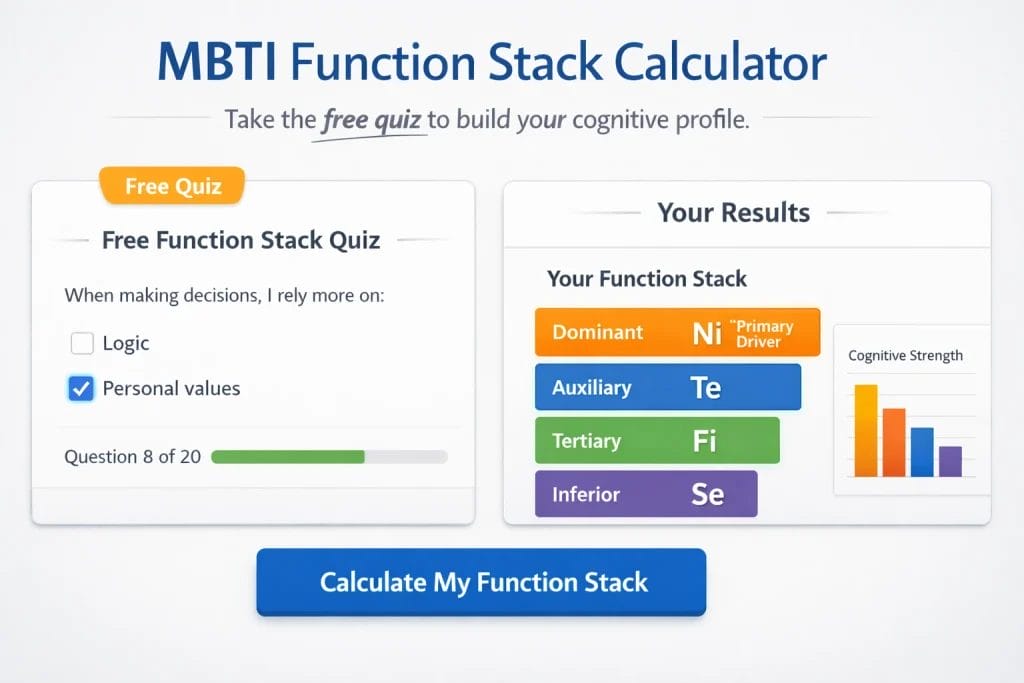
While 88% of Fortune 500 companies use Myers-Briggs assessments, most people never discover their actual cognitive function stack—the mental processes that explain not just what you prefer, but why you think the way you do.
Key Takeaways:
- What is your cognitive function stack? Your function stack reveals the four mental processes you prefer in order: dominant (most trusted), auxiliary (supporting), tertiary (developing), and inferior (growth area).
- How do cognitive functions differ from basic personality types? While four-letter codes tell you what you prefer, cognitive functions explain why you think that way and how your mind actually processes information and makes decisions.
- Can this assessment help with career and relationships? Understanding your function stack provides insights for choosing work environments that energize you, improving communication with different personality types, and developing areas of personal growth.
Introduction
Ready to discover the real foundation behind your personality type? While basic Myers-Briggs tests give you a four-letter code like INFP or ENTJ, they miss the most important part: how your mind actually works. Our free MBTI Function Stack Assessment reveals the specific cognitive processes that drive your thinking, decision-making, and problem-solving patterns.
Unlike surface-level personality quizzes, this comprehensive assessment identifies your complete cognitive function hierarchy—from your dominant mental process down to your area of greatest growth potential. In just 10 minutes, you’ll discover not only what your preferences are, but why you have them and how to develop them for personal and professional success.
This evidence-based assessment draws from Carl Jung’s psychological theory and modern cognitive function research to provide insights that go far beyond basic Myers-Briggs personality types. Best of all, it’s completely free and provides detailed explanations to help you understand and apply your results immediately.
Take Our Free MBTI Function Stack Assessment
⚡ Skip to the assessment tool below if you want to discover your cognitive profile immediately
Our interactive assessment uses 32 carefully designed behavioral scenarios to identify your natural cognitive preferences and calculate your complete function stack. Unlike basic personality quizzes that rely on self-reporting, this tool analyzes how you actually approach real-world situations to determine your authentic mental processing patterns.
Assessment Features:
- Evidence-based methodology using behavioral scenarios rather than direct preferences
- 10-minute completion time with automatic progress saving
- Detailed results including your complete four-function hierarchy
- Educational explanations for each function in your stack
- Confidence scoring to validate result accuracy
- Mobile-optimized design for convenience
The assessment is located in the interactive section below. For best results, answer based on your natural tendencies rather than learned behaviors, and consider patterns across your entire life rather than recent experiences.
MBTI Function Stack Calculator
Discover your cognitive function hierarchy through behavioral preferences
What You’ll Discover:
- Dominant Function: Your most trusted mental process
- Auxiliary Function: Your supporting cognitive strength
- Tertiary Function: Your developing area of growth
- Inferior Function: Your area of aspiration and stress
📋 Assessment Guidelines:
- Answer based on your natural preferences, not learned behaviors
- Consider patterns across your entire life, not recent experiences
- Trust your initial instincts rather than overthinking
- There are no right or wrong answers
Time required: Approximately 8-10 minutes
Questions: 32 behavioral scenarios
Understanding Your Assessment Results: The Science Behind Cognitive Functions
Now that you’ve taken the assessment (or are preparing to), let’s explore what your results actually mean. Cognitive functions represent the fundamental building blocks of how your mind processes information and makes decisions. Unlike the simple preferences suggested by four-letter personality codes, cognitive functions describe specific mental mechanisms that operate below your conscious awareness.
Carl Jung originally identified eight distinct cognitive functions in his 1921 work Psychological Types. These functions fall into two main categories: how you gather information (Perceiving functions) and how you make decisions (Judging functions). Each category contains both introverted and extraverted variations, creating the complete set of eight functions that form the foundation of all personality types.
Your assessment results show which of these eight functions you prefer and in what order—this is your cognitive function stack. Understanding each function helps you interpret your results and apply them for personal development, career decisions, and relationship improvement.
The Eight Cognitive Functions
Perceiving Functions (Information Gathering):
Extraverted Sensing (Se) focuses on immediate sensory experience and present-moment awareness. People who rely heavily on Se notice environmental details, respond quickly to changing situations, and feel energized by hands-on activities. They excel at reading body language, adapting to unexpected circumstances, and finding practical solutions to immediate problems.
Introverted Sensing (Si) processes information by comparing current experiences to past memories and established patterns. Si-dominant individuals notice when something differs from their expectations, value consistency and tradition, and build detailed internal databases of sensory experiences. They excel at maintaining routines, remembering important details, and learning from previous experiences.
Extraverted Intuition (Ne) generates possibilities and connections between seemingly unrelated ideas. Ne users see potential in everything, enjoy brainstorming sessions, and naturally spot patterns and relationships others miss. They excel at innovation, creative problem-solving, and helping others see new perspectives on familiar situations.
Introverted Intuition (Ni) synthesizes complex information into singular insights and future-focused visions. Ni-dominant people often experience “aha moments” where understanding suddenly crystallizes, and they naturally anticipate how situations will develop over time. They excel at strategic planning, understanding underlying meanings, and developing comprehensive frameworks for complex problems.
Judging Functions (Decision Making):
Extraverted Thinking (Te) organizes the external world according to logical principles and measurable outcomes. Te users focus on efficiency, systematic approaches, and objective criteria when making decisions. They excel at project management, strategic planning, and creating organized systems that deliver results.
Introverted Thinking (Ti) analyzes information according to internal logical frameworks and seeks precise understanding. Ti-dominant individuals prioritize accuracy over speed, prefer to understand the underlying principles before taking action, and naturally critique ideas for logical consistency. They excel at theoretical analysis, troubleshooting complex problems, and developing elegant solutions.
Extraverted Feeling (Fe) considers the emotional needs and values of groups when making decisions. Fe users naturally attune to social harmony, read emotional atmospheres accurately, and prioritize collective well-being. They excel at diplomacy, team building, and creating inclusive environments where everyone feels valued.
Introverted Feeling (Fi) evaluates decisions according to personal values and authentic emotional responses. Fi-dominant people maintain strong internal value systems, seek authentic self-expression, and make decisions based on what feels personally meaningful. They excel at understanding individual motivations, maintaining personal integrity, and advocating for causes they believe in.
| Function | Orientation | Primary Focus | Key Strengths |
|---|---|---|---|
| Se | Extraverted Perceiving | Present-moment awareness | Adaptability, practical action |
| Si | Introverted Perceiving | Past experience comparison | Consistency, detailed memory |
| Ne | Extraverted Perceiving | Future possibilities | Innovation, creative connections |
| Ni | Introverted Perceiving | Singular insights | Strategic vision, pattern recognition |
| Te | Extraverted Judging | External organization | Efficiency, systematic results |
| Ti | Introverted Judging | Internal analysis | Logical precision, theoretical understanding |
| Fe | Extraverted Judging | Group harmony | Social awareness, collaborative decisions |
| Fi | Introverted Judging | Personal values | Authentic expression, individual understanding |
The power of cognitive functions lies not in using just one, but in how they work together as an integrated system. Every person uses all eight functions to some degree, but each individual has a preferred “stack” of four functions that operate as their primary mental toolkit.
Research by Dr. Dario Nardi using EEG brain scanning has shown that people do demonstrate consistent patterns of brain activation that align with their reported cognitive preferences (Nardi, 2011). While personality psychology continues to evolve, these findings suggest that cognitive functions represent real differences in how people process information, not just arbitrary categories.
How to Interpret Your Function Stack Results
Your assessment results reveal your personal function stack—the specific order in which you prefer to use four of the eight cognitive functions. This hierarchy determines your natural problem-solving approach, stress responses, and development patterns throughout life. Let’s break down what each position means and how to understand your results.
The Four Stack Positions
Dominant Function (Position 1) represents your most trusted and developed mental process. This function operates largely unconsciously and feels as natural as breathing. You rely on your dominant function when facing important decisions, use it most confidently under stress, and develop it extensively during childhood and adolescence. Most people can identify their dominant function relatively easily because it represents their most obvious strengths and preferences.
Auxiliary Function (Position 2) serves as your supporting mental process and provides balance to your dominant function. If your dominant function is a Perceiving function (Se, Si, Ne, Ni), your auxiliary will be a Judging function (Te, Ti, Fe, Fi), and vice versa. The auxiliary function typically develops during your late teens and early twenties, helping you become more well-rounded and effective in different situations.
Tertiary Function (Position 3) emerges as a point of development and potential vulnerability during your thirties and forties. This function can provide creative solutions and new perspectives, but it can also become a source of stress if overused or developed prematurely. The tertiary function has the same attitude (introverted or extraverted) as your dominant function, which can sometimes create internal tension.
Inferior Function (Position 4) represents your least developed and most unconscious mental process. This function often operates differently from the other three, appearing in times of stress, creativity, or major life transitions. While the inferior function can feel awkward or overwhelming when it emerges, learning to integrate it healthily becomes a crucial part of personal development in midlife and beyond.
| Stack Position | Alternative Names | Development Period | Primary Characteristics |
|---|---|---|---|
| Dominant | Hero, Leading | Childhood-Adolescence | Most trusted, operates unconsciously |
| Auxiliary | Supporting, Parent | Late teens-Twenties | Provides balance, conscious development |
| Tertiary | Relief, Child | Thirties-Forties | Creative potential, stress vulnerability |
| Inferior | Aspirational | Midlife onward | Unconscious emergence, integration challenge |
Stack Formation Rules
Function stacks follow specific rules that ensure psychological balance and prevent contradictory mental processes from operating in the same preference hierarchy. These rules, first articulated by Harold Grant in the 1980s, help explain why certain function combinations create stable personality patterns while others would create internal conflicts.
Alternating Attitudes Rule: Functions alternate between introverted and extraverted orientations throughout the stack. If your dominant function is extraverted, your auxiliary function will be introverted, your tertiary function will be extraverted, and your inferior function will be introverted. This alternation ensures you maintain both internal processing and external engagement capabilities.
Judging-Perceiving Balance Rule: Your stack will contain exactly two Judging functions (thinking or feeling) and two Perceiving functions (sensing or intuition). This balance ensures you have both information-gathering and decision-making capabilities, though you’ll naturally prefer one category over the other.
Function Opposition Rule: Your inferior function represents the opposite of your dominant function along both the thinking-feeling and sensing-intuition spectrums. If your dominant function is Extraverted Thinking (Te), your inferior function will be Introverted Feeling (Fi). This opposition creates natural tension that drives psychological growth throughout life.
Understanding these rules helps explain why certain personality descriptions resonate while others feel foreign, and why some personal development advice works better than others for different personality types. Your function stack represents your mental “default settings”—the approaches you naturally gravitate toward when facing new situations or stress.
How to Calculate Your Function Stack
Calculating your cognitive function stack requires more than just identifying your four-letter Myers-Briggs type. While your type code provides important clues, determining your actual function stack involves understanding which mental processes you naturally use and in what order of preference.
Step-by-Step Determination Process
Validating Your Assessment Results
If you’d like to double-check your assessment results or explore alternative approaches, you can manually work through the function identification process below. This step-by-step method helps you verify that your test results align with your self-awareness and provides additional insight into how cognitive function typing works.
Step 1: Confirm Your Dominant Function
Review your assessment results and consider whether your identified dominant function feels accurate. Your dominant function should represent your most natural and trusted mental process—the one you’ve relied on consistently since childhood and that feels most effortless when operating optimally.
Step 2: Verify Your Auxiliary Function
Your auxiliary function should feel like a natural complement to your dominant function, providing balance and support. It typically has the opposite attitude (introverted vs. extraverted) from your dominant function and belongs to the opposite category (Perceiving vs. Judging).
Step 3: Review Your Complete Stack
Your assessment provides your complete four-function hierarchy. Each function should feel recognizable, though your tertiary and inferior functions may be less obvious since they develop later in life or operate more unconsciously.
If Your Results Don’t Feel Right:
Sometimes assessment results don’t immediately resonate, which is completely normal. Consider retaking the assessment at a different time, or explore the manual identification process below. Remember that personality development is ongoing, and your function usage may vary based on stress, age, and life circumstances.
Alternative Assessment Methods
While our main assessment tool provides comprehensive results, you may want to explore alternative approaches to validate or deepen your understanding. Here are additional methods for identifying your cognitive function stack:
Self-Reflection Method: Use the guided questions above to manually work through function identification based on your natural behavioral patterns and preferences.
Behavioral Observation: Ask trusted friends or family members which cognitive functions they observe in your everyday behavior. Others often notice patterns we take for granted.
Developmental Analysis: Consider how your preferences have remained consistent or changed throughout different life stages. Your dominant function should show consistency from childhood through adulthood.
Stress Response Review: Examine how you behave under pressure. Stress often reveals our inferior function through either its primitive emergence or our desperate avoidance of it.
Professional Assessment: For the most comprehensive analysis, consider taking the official MBTI assessment through a certified practitioner, which provides additional validity measures and professional interpretation.
Cross-Reference Multiple Sources: Compare results from our assessment with other reputable cognitive function tests to identify consistent patterns and resolve discrepancies.
Common Behavioral Indicators
Dominant Function Indicators:
- Feels effortless and natural when operating well
- Used unconsciously in most situations
- Represents your core strengths and preferred approach
- What others consistently notice about your thinking style
- The mental process you return to under pressure
Auxiliary Function Indicators:
- Provides balance and support to your dominant function
- Developed consciously during late teens and early twenties
- Helps you adapt to different situations and relationships
- Often represents learned skills that complement natural abilities
- Used deliberately to manage external demands
Tertiary Function Indicators:
- Emerges as a creative outlet or stress response
- Can feel exciting but also unpredictable or overwhelming
- Often appears during major life transitions or periods of growth
- May manifest as new interests or unexpected behaviors in midlife
- Provides fresh perspectives but can create internal tension
Inferior Function Indicators:
- Feels awkward, exhausting, or overwhelming when accessed directly
- Often appears during times of severe stress or fatigue
- May manifest as creative breakthroughs or spiritual experiences
- Represents both a vulnerability and a source of aspiration
- Integration becomes a major developmental task in later life
Individual MBTI type guides provide detailed examples of how these functions manifest for specific personality types, helping you recognize your own patterns and preferences.
Complete MBTI Function Stack Reference
Understanding the function stacks for all 16 personality types provides crucial context for determining your own cognitive profile and understanding others’ mental processes. Each type’s unique combination of functions creates distinct patterns of strengths, challenges, and development paths.
Analyst Types (NT)
INTJ (Ni-Te-Fi-Se): Architect types lead with Introverted Intuition, creating comprehensive visions and strategic frameworks. Their auxiliary Extraverted Thinking helps them organize resources to implement their insights efficiently. The tertiary Introverted Feeling emerges in midlife as a focus on personal values and individual development, while their inferior Extraverted Sensing can manifest as stress-related impulsiveness or, when integrated, practical implementation skills.
INTP (Ti-Ne-Si-Fe): Thinker types lead with Introverted Thinking, seeking logical precision and theoretical understanding. Their auxiliary Extraverted Intuition generates multiple possibilities and connections for analysis. The tertiary Introverted Sensing provides stability and reference points, while their inferior Extraverted Feeling represents both their greatest vulnerability and their aspiration toward harmonious relationships.
ENTJ (Te-Ni-Se-Fi): Commander types lead with Extraverted Thinking, naturally organizing people and resources to achieve measurable results. Their auxiliary Introverted Intuition provides strategic vision and long-term planning capabilities. The tertiary Extraverted Sensing can manifest as competitive drive or stress-related indulgence, while their inferior Introverted Feeling represents personal values and authentic expression.
ENTP (Ne-Ti-Fe-Si): Innovator types lead with Extraverted Intuition, constantly generating new possibilities and spotting potential in situations and people. Their auxiliary Introverted Thinking helps them analyze and refine their ideas logically. The tertiary Extraverted Feeling facilitates social connection and persuasion, while their inferior Introverted Sensing represents stability and attention to detail.
Diplomat Types (NF)
INFJ (Ni-Fe-Ti-Se): Advocate types lead with Introverted Intuition, developing comprehensive insights about people and situations. Their auxiliary Extraverted Feeling helps them understand and respond to others’ emotional needs. The tertiary Introverted Thinking provides analytical capabilities, while their inferior Extraverted Sensing can manifest as stress-related sensory overindulgence or, when healthy, present-moment awareness.
INFP (Fi-Ne-Si-Te): Mediator types lead with Introverted Feeling, maintaining strong personal values and seeking authentic self-expression. Their auxiliary Extraverted Intuition explores possibilities aligned with their values. The tertiary Introverted Sensing provides personal history and stability, while their inferior Extraverted Thinking represents organizational and systematic capabilities.
ENFJ (Fe-Ni-Se-Ti): Protagonist types lead with Extraverted Feeling, naturally attuning to group dynamics and individual emotional needs. Their auxiliary Introverted Intuition helps them understand people’s underlying motivations and potential. The tertiary Extraverted Sensing facilitates charismatic presentation and awareness of environmental factors, while their inferior Introverted Thinking represents analytical precision.
ENFP (Ne-Fi-Te-Si): Campaigner types lead with Extraverted Intuition, seeing potential and possibilities in people and situations. Their auxiliary Introverted Feeling helps them evaluate these possibilities according to personal values. The tertiary Extraverted Thinking provides organizational capabilities when needed, while their inferior Introverted Sensing represents stability and routine.
Sentinel Types (SJ)
ISTJ (Si-Te-Fi-Ne): Logistician types lead with Introverted Sensing, building detailed mental databases of experiences and maintaining consistency. Their auxiliary Extraverted Thinking helps them organize information systematically and achieve concrete results. The tertiary Introverted Feeling emerges as personal values and individual consideration, while their inferior Extraverted Intuition represents creative possibilities.
ISFJ (Si-Fe-Ti-Ne): Protector types lead with Introverted Sensing, maintaining detailed awareness of others’ needs and preferences. Their auxiliary Extraverted Feeling helps them respond supportively to group and individual emotional needs. The tertiary Introverted Thinking provides analytical capabilities, while their inferior Extraverted Intuition represents creative potential and new possibilities.
ESTJ (Te-Si-Ne-Fi): Executive types lead with Extraverted Thinking, naturally organizing people and processes to achieve measurable outcomes. Their auxiliary Introverted Sensing provides attention to detail and reference to proven methods. The tertiary Extraverted Intuition can manifest as strategic innovation, while their inferior Introverted Feeling represents personal values and individual consideration.
ESFJ (Fe-Si-Ne-Ti): Consul types lead with Extraverted Feeling, maintaining group harmony and attending to individual emotional needs. Their auxiliary Introverted Sensing helps them remember important personal details and maintain consistent support. The tertiary Extraverted Intuition provides creative solutions for people problems, while their inferior Introverted Thinking represents analytical precision.
Explorer Types (SP)
ISTP (Ti-Se-Ni-Fe): Virtuoso types lead with Introverted Thinking, seeking to understand how things work and finding elegant solutions to practical problems. Their auxiliary Extraverted Sensing keeps them grounded in present realities and responsive to immediate needs. The tertiary Introverted Intuition can provide sudden insights, while their inferior Extraverted Feeling represents relationship harmony and emotional expression.
ISFP (Fi-Se-Ni-Te): Adventurer types lead with Introverted Feeling, maintaining strong personal values and seeking authentic experiences. Their auxiliary Extraverted Sensing helps them respond to immediate opportunities and environmental beauty. The tertiary Introverted Intuition provides deeper insights and future awareness, while their inferior Extraverted Thinking represents organizational capabilities.
ESTP (Se-Ti-Fe-Ni): Entrepreneur types lead with Extraverted Sensing, staying highly attuned to immediate opportunities and environmental changes. Their auxiliary Introverted Thinking helps them analyze situations quickly and find practical solutions. The tertiary Extraverted Feeling facilitates social connection and persuasion, while their inferior Introverted Intuition represents long-term vision and deeper meaning.
ESFP (Se-Fi-Te-Ni): Entertainer types lead with Extraverted Sensing, maintaining awareness of immediate opportunities and environmental energy. Their auxiliary Introverted Feeling helps them evaluate experiences according to personal values and emotional authenticity. The tertiary Extraverted Thinking provides organizational capabilities when needed, while their inferior Introverted Intuition represents strategic vision and deeper insights.
| Type | Dominant | Auxiliary | Tertiary | Inferior |
|---|---|---|---|---|
| NT Types | ||||
| INTJ | Ni | Te | Fi | Se |
| INTP | Ti | Ne | Si | Fe |
| ENTJ | Te | Ni | Se | Fi |
| ENTP | Ne | Ti | Fe | Si |
| NF Types | ||||
| INFJ | Ni | Fe | Ti | Se |
| INFP | Fi | Ne | Si | Te |
| ENFJ | Fe | Ni | Se | Ti |
| ENFP | Ne | Fi | Te | Si |
| SJ Types | ||||
| ISTJ | Si | Te | Fi | Ne |
| ISFJ | Si | Fe | Ti | Ne |
| ESTJ | Te | Si | Ne | Fi |
| ESFJ | Fe | Si | Ne | Ti |
| SP Types | ||||
| ISTP | Ti | Se | Ni | Fe |
| ISFP | Fi | Se | Ni | Te |
| ESTP | Se | Ti | Fe | Ni |
| ESFP | Se | Fi | Te | Ni |
This reference chart serves as a quick verification tool for your calculated function stack. If you’ve identified yourself as a particular type through online tests, you can use this chart to understand which specific cognitive functions should feel most natural and which might require more conscious development.
Common Function Stack Confusions
Even with a solid understanding of cognitive functions, many people struggle to accurately identify their personal stack due to common misconceptions, overlapping function presentations, and the influence of learned behaviors that can mask natural preferences.
Ti vs Te: The Thinking Function Distinction
One of the most frequent sources of confusion involves distinguishing between Introverted Thinking (Ti) and Extraverted Thinking (Te). Both functions prioritize logical analysis, but they approach reasoning in fundamentally different ways that can dramatically affect your learning style, work preferences, and decision-making process.
Ti-dominant individuals prioritize understanding the underlying principles and logical consistency of information before taking action. They prefer to work alone or in small groups, need time to analyze situations thoroughly, and often restructure information according to their own logical frameworks. Ti users frequently ask “Does this make sense internally?” and “What are the underlying principles at work here?” They excel in theoretical analysis, troubleshooting complex problems, and developing elegant solutions that may not be immediately obvious to others.
Te-dominant individuals prioritize organizing external resources and achieving measurable results efficiently. They prefer collaborative environments with clear objectives, focus on practical implementation over theoretical perfection, and naturally structure projects and people to maximize productivity. Te users frequently ask “What concrete results will this achieve?” and “How can we organize this more efficiently?” They excel in project management, strategic planning, and creating systems that deliver consistent outcomes.
The confusion often arises because both types can appear analytical and logical, but their motivations and methods differ significantly. Ti seeks internal logical consistency while Te seeks external logical organization.
Ni vs Ne: The Intuitive Function Distinction
Similarly, distinguishing between Introverted Intuition (Ni) and Extraverted Intuition (Ne) requires understanding fundamental differences in how these functions process possibilities and make connections.
Ni-dominant individuals synthesize complex information into singular, comprehensive insights and focus on developing clear future visions. They prefer depth over breadth, often experiencing sudden “aha moments” where understanding crystallizes, and naturally anticipate how current situations will develop over time. Ni users frequently ask “Where is this heading?” and “What’s the underlying pattern here?” They excel at strategic long-term planning, understanding complex systems, and developing frameworks that integrate multiple variables.
Ne-dominant individuals generate multiple possibilities and explore connections between seemingly unrelated ideas and concepts. They prefer breadth over depth, enjoy brainstorming and exploring “what if” scenarios, and naturally see potential applications and creative solutions others might miss. Ne users frequently ask “What else could this become?” and “How might these ideas connect?” They excel at innovation, creative problem-solving, and helping others see new perspectives on familiar situations.
The key distinction lies in convergence versus divergence: Ni converges multiple inputs into singular insights while Ne diverges from single inputs into multiple possibilities.
Why Tests Give Different Results
Online personality tests frequently produce inconsistent results because they often conflate learned behaviors with natural cognitive preferences, use questions that can be interpreted multiple ways, or fail to account for the developmental nature of function usage across the lifespan.
Learned vs. Natural Behaviors: Many tests ask about current behaviors rather than natural preferences. Someone with strong Ti might have learned Te-like organizational skills for professional success, leading to mistyping. Similarly, someone with dominant Fe might have developed Fi-like independence due to life circumstances. The key lies in identifying which mental processes feel effortless and energizing versus which require conscious effort and energy.
Developmental Factors: Your function usage changes significantly throughout life as different functions develop and integrate. A young person might not yet have developed their auxiliary function, making them appear more one-dimensional than they actually are. Conversely, someone in midlife might be developing their tertiary function, creating temporary confusion about their natural preferences.
Cultural and Gender Biases: Many assessment tools contain subtle biases that can influence results. Questions about leadership might bias toward Te preferences, while questions about empathy might bias toward Fe preferences. These biases can particularly affect individuals who don’t conform to traditional gender or cultural expectations for their personality type.
Validation Strategies
Multiple Assessment Approaches: Rather than relying on a single test, use multiple assessment methods including behavioral observation, values clarification, stress response analysis, and function-specific exercises. Comprehensive personality assessments often provide more accurate results than quick online quizzes.
Longitudinal Self-Observation: Track your natural responses, energy patterns, and preferences over time across different situations. Notice which mental processes feel effortless and energizing versus which require conscious effort and leave you feeling drained.
Feedback from Others: Ask trusted friends and family members which cognitive functions they observe in your natural behavior. Others often notice patterns we take for granted in ourselves.
Function-Specific Development: Try deliberately developing different functions and notice which feel more natural and sustainable. Functions lower in your stack will typically require more effort and energy to maintain over time.
The Science Behind Cognitive Functions
While MBTI and cognitive function theory have gained widespread popularity, it’s important to understand both the supporting evidence and the limitations of this framework when making decisions about its practical applications.
Current Research and Evidence
Dr. Dario Nardi’s neuroscience research using EEG brain mapping provides the most compelling empirical support for cognitive function theory (Nardi, 2011). His studies with over 1,000 participants found that individuals who identify with specific function preferences do demonstrate distinct patterns of brain activation when engaged in relevant cognitive tasks. For example, people who identify as Ti-dominant show increased activity in brain regions associated with analysis and logical reasoning, while Fe-dominant individuals show heightened activation in areas related to social cognition and emotional processing.
Nardi’s research suggests that cognitive functions represent real neurological differences in how people process information, not merely psychological preferences or learned behaviors. However, this research remains limited in scope and has not yet been fully replicated by independent research teams using different methodologies.
The Center for Applications of Psychological Type (CAPT) maintains ongoing research databases tracking MBTI usage and effectiveness in organizational and educational settings. Their data suggests that teams with diverse cognitive function profiles often outperform homogeneous teams on complex problem-solving tasks, and that individuals who understand their function stack report higher job satisfaction and more effective stress management strategies (Myers et al., 1998).
Scientific Limitations and Critiques
Multiple systematic reviews have identified significant limitations in MBTI research methodology and predictive validity (Pittenger, 2005; Stein & Swan, 2019). The primary concerns include:
Test-Retest Reliability: Studies find that 39-76% of people receive different four-letter type codes when retaking the official MBTI assessment after five weeks, suggesting that the instrument may not measure stable personality traits (Hunsley et al., 2003). However, proponents argue that this reflects natural development and situational factors rather than measurement errors.
Predictive Validity: Research has not consistently demonstrated that MBTI types predict job performance, relationship satisfaction, or other important life outcomes better than chance or simpler assessment methods (Barbuto, 1997). The Big Five personality model shows superior predictive validity across multiple domains.
Theoretical Foundation: While based on Jung’s psychological theories, the specific 16-type system was developed through rational construction rather than empirical validation. Some critics argue that the binary nature of the preferences (thinking OR feeling rather than degrees of both) oversimplifies the complexity of human personality.
Cultural Bias: Most MBTI research has been conducted with Western, educated populations, raising questions about cross-cultural validity and applicability to diverse communities.
Balanced Perspective on Practical Applications
Despite these limitations, cognitive function theory offers several practical benefits when used appropriately:
Self-Reflection Framework: Function theory provides a structured vocabulary for understanding different thinking styles and information processing preferences. Many people find this framework helpful for identifying patterns in their behavior and making sense of interpersonal differences.
Communication Enhancement: Understanding that others might process information differently can improve communication effectiveness and reduce interpersonal conflicts. Teams that discuss cognitive preferences often report better collaboration and mutual understanding.
Personal Development: The developmental model of function integration provides a useful framework for identifying growth areas and understanding how personality changes across the lifespan. Many people find the concept of developing their “inferior function” particularly valuable for midlife growth.
Career Guidance: While not predictive of specific job success, function preferences can help individuals identify work environments and roles that align with their natural information processing styles and energy patterns.
The key lies in treating cognitive functions as a useful model for understanding mental processes rather than as definitive categories or predictive measures. Like any psychological framework, its value depends on how thoughtfully and appropriately it’s applied to real-world situations.
Make the Most of Your Free Assessment Results
Your assessment results provide a foundation for understanding your cognitive patterns, but the real value comes from applying these insights to improve your daily life. Here’s how to get the most from your function stack knowledge.
Understanding your cognitive function stack provides a roadmap for personal development that goes far beyond simple self-awareness. By recognizing how your mental processes naturally operate and develop across the lifespan, you can make more informed decisions about career paths, relationships, stress management, and personal growth strategies.
Function Development Across the Lifespan
Childhood and Adolescence (Dominant Function Development): During the first two decades of life, your dominant function naturally develops through exploration, practice, and refinement. This period involves discovering your core strengths and learning to trust your natural information processing style. Educational approaches that align with your dominant function often feel more engaging and effective during this period.
Young Adulthood (Auxiliary Function Integration): The late teens through early thirties typically involve conscious development of your auxiliary function as you learn to balance your dominant function’s natural strengths with complementary capabilities. This period often coincides with career establishment and relationship formation, making auxiliary function development crucial for life success.
Midlife (Tertiary Function Emergence): The thirties and forties frequently bring increased interest in your tertiary function as a source of creative expression and personal renewal. This can manifest as new hobbies, career changes, or relationship priorities that differ significantly from earlier patterns. Understanding this natural development helps you embrace rather than resist these emerging interests.
Later Life (Inferior Function Integration): The second half of life often involves confronting and integrating your inferior function as a source of wisdom, creativity, and spiritual development. This challenging but rewarding process requires patience and self-compassion as you learn to value mental processes that may feel foreign or overwhelming.
Stress and Function Loops
When under significant stress, people often fall into predictable patterns based on their function stack that can actually worsen their situation if not understood and managed appropriately.
Dominant-Tertiary Function Loops occur when stress causes you to rely exclusively on your first and third functions while bypassing your auxiliary function. For example, an INFJ (Ni-Fe-Ti-Se) under stress might become trapped in a Ni-Ti loop, endlessly analyzing problems without considering the emotional needs and social dynamics that their Fe auxiliary would normally address.
These loops feel productive because they use familiar mental processes, but they lack the balance and perspective that your auxiliary function provides. Breaking out of loops typically requires consciously engaging your auxiliary function, even when it feels difficult or counterintuitive.
Inferior Function Grip States represent another common stress response where your inferior function takes control in primitive, underdeveloped ways. For the same INFJ example, severe stress might trigger their inferior Se, manifesting as impulsive sensory indulgence, reckless behavior, or obsessive focus on physical details they normally ignore.
Grip states often feel completely unlike your normal personality, which can be frightening but also provides opportunities for growth when handled with awareness and self-compassion.
Practical Growth Strategies
Strength Development: Focus on refining and applying your dominant and auxiliary functions in increasingly sophisticated ways. Seek environments and challenges that allow these functions to operate optimally while building expertise and confidence.
Balanced Integration: Consciously practice using your less preferred functions in low-stakes situations to build familiarity and capability. This doesn’t mean forcing yourself to become someone you’re not, but rather developing a fuller range of responses to life’s challenges.
Stress Management: Learn to recognize the early warning signs of function loops and grip states, and develop specific strategies for re-engaging your auxiliary function during difficult periods. This might include stress reduction techniques tailored to your particular function stack.
Relationship Enhancement: Use function awareness to improve communication with others by recognizing and adapting to different information processing styles. Understanding that others might need different types of information or decision-making approaches can dramatically improve personal and professional relationships.
Career Alignment: While personality type doesn’t determine career success, aligning your work environment with your function preferences can improve job satisfaction and reduce burnout. Consider factors like pace, collaboration style, problem-solving approach, and value alignment when making career decisions.
The goal of function development isn’t to become perfectly balanced across all eight functions, but rather to develop conscious competence in your natural stack while building appreciation for the mental processes that others bring to collaborative efforts. This approach honors your authentic nature while expanding your capabilities and understanding.
By viewing personal growth through the lens of cognitive function development, you can make more informed decisions about where to invest your energy for maximum personal satisfaction and effectiveness. This framework provides both validation for your natural strengths and guidance for areas where conscious development can enhance your overall life experience.
Conclusion
Understanding your cognitive function stack transforms personality typing from simple categorization into practical self-awareness. Our free assessment reveals the specific mental processes that drive your decision-making, problem-solving, and interpersonal style, providing insights that extend far beyond basic four-letter personality codes.
Whether you’re seeking career clarity, relationship improvement, or personal development, your function stack serves as a roadmap for leveraging natural strengths while developing areas of growth. The eight cognitive functions represent universal mental processes, but your unique hierarchy creates your individual approach to navigating life’s challenges and opportunities.
Remember that personality development continues throughout life. Your assessment results provide a foundation for understanding your current patterns while leaving room for growth, adaptation, and the integration of less-developed functions as you mature and face new experiences.
Frequently Asked Questions
What is an MBTI function stack test?
An MBTI function stack test identifies your hierarchy of cognitive functions—the four mental processes you prefer in order of development and strength. Unlike basic personality quizzes that only give you a four-letter type, function stack assessments reveal how your mind actually processes information and makes decisions, providing deeper insight into your thinking patterns.
How are MBTI function stacks explained simply?
MBTI function stacks consist of four cognitive functions in order: Dominant (most trusted), Auxiliary (supporting balance), Tertiary (developing area), and Inferior (growth challenge). Each function represents either how you gather information (Sensing/Intuition) or make decisions (Thinking/Feeling), with introverted and extraverted orientations creating eight total functions.
What should I include in an MBTI function stack cheat sheet?
A comprehensive function stack cheat sheet should list all eight functions with brief descriptions, show all 16 types with their four-function hierarchies, explain the alternating introversion/extraversion pattern, include function development timelines across life stages, and provide behavioral indicators for identifying each function in yourself and others.
Where can I find a reliable MBTI function stack chart?
The most reliable function stack charts show all 16 personality types with their complete four-function hierarchies, including dominant, auxiliary, tertiary, and inferior positions. Look for charts that follow established psychological principles with Te/Ti, Fe/Fi, Se/Si, and Ne/Ni as the eight functions, ensuring alternating introversion/extraversion patterns.
What is the INTJ function stack?
The INTJ function stack is Ni-Te-Fi-Se: Introverted Intuition (dominant) for strategic insights and future vision, Extraverted Thinking (auxiliary) for logical organization and efficiency, Introverted Feeling (tertiary) for personal values emerging in midlife, and Extraverted Sensing (inferior) representing present-moment awareness and practical implementation as a growth area.
What is the ENTJ function stack?
The ENTJ function stack is Te-Ni-Se-Fi: Extraverted Thinking (dominant) for organizing people and resources to achieve results, Introverted Intuition (auxiliary) for strategic planning and vision, Extraverted Sensing (tertiary) for competitive drive and environmental awareness, and Introverted Feeling (inferior) representing personal values and authentic expression.
What is the INFJ function stack?
The INFJ function stack is Ni-Fe-Ti-Se: Introverted Intuition (dominant) for comprehensive insights about people and situations, Extraverted Feeling (auxiliary) for understanding and responding to others’ emotional needs, Introverted Thinking (tertiary) for analytical capabilities, and Extraverted Sensing (inferior) representing present-moment awareness and sensory engagement.
What is the INTP function stack?
The INTP function stack is Ti-Ne-Si-Fe: Introverted Thinking (dominant) for logical precision and theoretical understanding, Extraverted Intuition (auxiliary) for generating possibilities and creative connections, Introverted Sensing (tertiary) for stability and reference points, and Extraverted Feeling (inferior) representing relationship harmony and emotional expression.
How accurate are online MBTI function tests?
Online MBTI function tests vary significantly in accuracy depending on their methodology, question design, and theoretical foundation. Well-designed assessments using behavioral scenarios rather than direct preferences, multiple validation measures, and transparent scoring algorithms can provide reliable insights for self-reflection, though they shouldn’t replace professional psychological evaluation.
Can your MBTI function stack change over time?
Your core function stack typically remains consistent throughout life, representing your natural mental preferences. However, function development continues across the lifespan—tertiary functions emerge in your thirties, inferior functions integrate in midlife, and life circumstances can influence which functions you access most frequently, creating apparent changes in personality expression.
References
Barbuto, J. E. (1997). A critique of the Myers-Briggs Type Indicator and its operationalization of Carl Jung’s psychological types. Psychological Reports, 80(2), 611-625.
Hunsley, J., Lee, C. M., & Wood, J. M. (2003). Controversial and questionable assessment techniques. In S. O. Lilienfeld, S. J. Lynn, & J. M. Lohr (Eds.), Science and pseudoscience in clinical psychology (pp. 39-76). Guilford Press.
Myers, I. B., McCaulley, M. H., Quenk, N. L., & Hammer, A. L. (1998). MBTI manual: A guide to the development and use of the Myers-Briggs Type Indicator (3rd ed.). Consulting Psychologists Press.
Nardi, D. (2011). Neuroscience of personality: Brain savvy insights for all types of people. Radiance House.
Pittenger, D. J. (2005). Cautionary comments regarding the Myers-Briggs Type Indicator. Consulting Psychology Journal: Practice and Research, 57(3), 210-221.
Stein, R., & Swan, A. B. (2019). Evaluating the validity of Myers-Briggs Type Indicator theory: A teaching tool and window into intuitive psychology. Social and Personality Psychology Compass, 13(2), e12434.
Further Reading and Research
Recommended Articles
- Reynierse, J. H. (2009). The case against type dynamics and type development. Journal of Psychological Type, 69(1), 1-13.
- McCrae, R. R., & Costa, P. T. (1989). Reinterpreting the Myers-Briggs Type Indicator from the perspective of the five-factor model of personality. Journal of Personality, 57(1), 17-40.
- Capraro, R. M., & Capraro, M. M. (2002). Myers-Briggs Type Indicator score reliability across studies: A meta-analytic reliability generalization study. Educational and Psychological Measurement, 62(4), 590-602.
Suggested Books
- Jung, C. G. (1971). Psychological Types. Princeton University Press.
- Jung’s original work introducing the concept of psychological types and the eight cognitive functions that form the foundation of modern personality typing systems.
- Berens, L. V., & Nardi, D. (2004). The 16 Personality Types: Descriptions for Self-Discovery. Telos Publications.
- Comprehensive descriptions of all 16 personality types with practical applications for personal development, career guidance, and relationship understanding.
- Quenk, N. L. (2009). Essentials of Myers-Briggs Type Indicator Assessment. Wiley.
- Professional guide to MBTI administration, interpretation, and application with detailed coverage of type dynamics and development across the lifespan.
Recommended Websites
- The Myers & Briggs Foundation
- Official source for MBTI information including type descriptions, research updates, certified practitioner directories, and educational resources for understanding personality type theory.
- Personality Junkie (personalityjunkie.com)
- Educational website offering in-depth articles on cognitive functions, type development, career guidance, and practical applications of personality psychology for personal growth.
- 16Personalities (www.16personalities.com)
- Popular personality assessment platform providing free testing, detailed type descriptions, and community features for exploring personality differences and applications.
Kathy Brodie
Kathy Brodie is an Early Years Professional, Trainer and Author of multiple books on Early Years Education and Child Development. She is the founder of Early Years TV and the Early Years Summit.

To cite this article please use:
Early Years TV Free MBTI Function Stack Test: Discover Your True Cognitive Profile. Available at: https://www.earlyyears.tv/free-mbti-function-stack-test-assessment/ (Accessed: 11 October 2026).