

MBTI Love Languages: How Each Type Shows and Receives Love

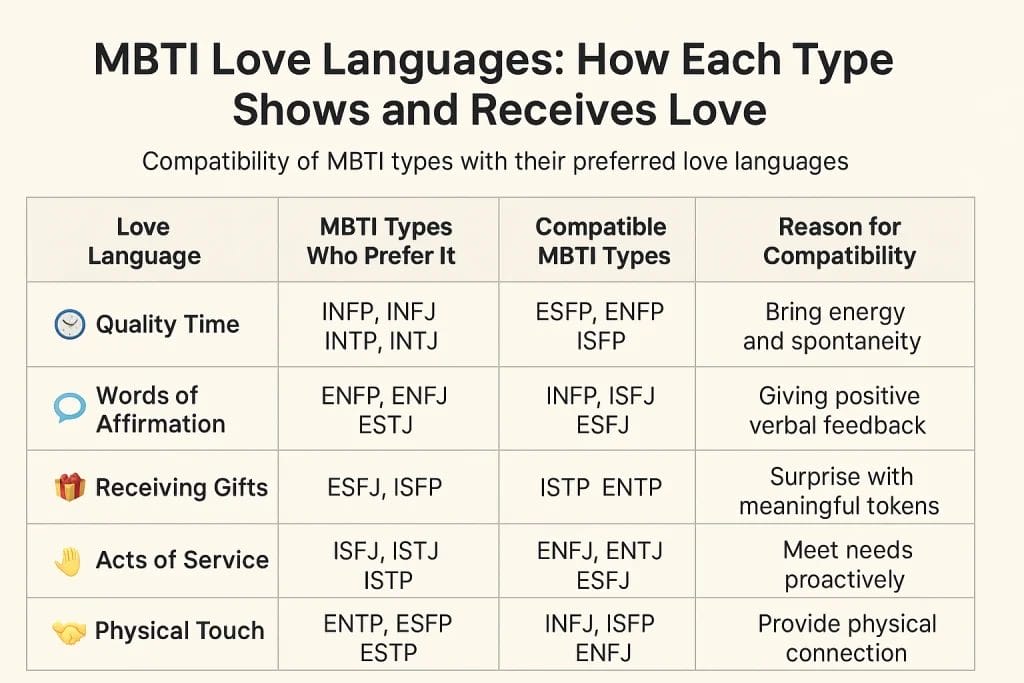
When your INFJ partner craves deep conversations while your ESTP self shows love through spontaneous adventures, the disconnect isn’t a relationship flaw—it’s a predictable pattern rooted in how your personality types are fundamentally wired to express and receive affection.
Key Takeaways
- Your personality type shapes how you naturally express and receive love through your cognitive function stack, with Fe users preferring Words of Affirmation while Te users favor Acts of Service.
- SP types (ESTP, ESFP, ISTP, ISFP) gravitate toward Physical Touch due to their Extraverted Sensing dominance, while NT types prefer Quality Time and practical problem-solving demonstrations of care.
- Love language preferences can evolve as you develop your cognitive functions throughout life, though your dominant function’s influence typically remains strongest in how you most authentically express care.
Introduction
Have you ever wondered why your partner shows love through actions while you crave words of affirmation? Or why your best friend feels most loved through quality time while you prefer thoughtful gifts? The answer might lie in the intersection of two powerful psychological frameworks: the Myers-Briggs Type Indicator (MBTI) and the 5 love languages.
Your personality type shapes not just how you think and make decisions, but also how you naturally express and receive affection. Understanding this connection can transform your relationships by revealing why certain expressions of love resonate deeply while others feel hollow, even when given with genuine care.
This comprehensive guide explores how each of the 16 MBTI personality types relates to Gary Chapman’s five love languages: Words of Affirmation, Quality Time, Acts of Service, Physical Touch, and Receiving Gifts. You’ll discover how cognitive functions influence love expression patterns, learn to bridge communication gaps between different types, and gain practical strategies for showing love in ways that truly resonate with your partner’s unique psychological wiring.
Understanding the Connection Between MBTI and Love Languages
The Myers-Briggs Type Indicator categorizes people into 16 distinct personality types based on four dichotomies: Extraversion/Introversion (E/I), Sensing/Intuition (S/N), Thinking/Feeling (T/F), and Judging/Perceiving (J/P). Each combination creates a unique cognitive profile that influences how individuals process information, make decisions, and interact with the world (Myers et al., 1998).
Meanwhile, Dr. Gary Chapman’s love languages framework identifies five distinct ways people prefer to give and receive love. Since Chapman introduced this concept in 1992, over 20 million people have explored their love language preferences, discovering that relationship satisfaction increases when partners speak each other’s emotional dialect (Chapman, 2015).
The connection between personality type and love language isn’t random. Research by Bland and McQueen (2018) found patterns in how different personality traits correlate with love language preferences. While individuals within each type show variation, certain types demonstrate clear tendencies toward specific love languages based on their cognitive processing styles.
For example, types with dominant Extraverted Feeling (Fe) naturally gravitate toward verbal affirmation and creating emotional harmony, while those with dominant Introverted Thinking (Ti) may struggle with emotional expression but excel at showing love through problem-solving and practical support. These patterns emerge from the fundamental ways different personality types experience and express emotions.
Understanding this connection provides several practical benefits. First, it helps you recognize that your partner’s different love expression isn’t a lack of care but rather a reflection of their natural cognitive wiring. Second, it offers a roadmap for adapting your expressions to match your partner’s psychological preferences. Third, it reduces relationship conflict by explaining why certain miscommunications occur between specific type combinations.
The science behind this connection draws from attachment theory (Bowlby, 1969), which demonstrates that early relationship experiences shape our emotional needs and expression patterns throughout life. When combined with personality psychology’s insights into cognitive preferences, we gain a comprehensive understanding of why we love the way we do.
How Cognitive Functions Shape Love Expression
To truly understand why different MBTI types show and receive love differently, we need to explore the underlying cognitive functions that drive each personality type. These eight mental processes—Ni, Ne, Si, Se, Ti, Te, Fi, and Fe—form the foundation of how we perceive the world and make decisions.
Extraverted Feeling (Fe) users process emotions outwardly and naturally attune to the emotional atmosphere around them. Types with dominant or auxiliary Fe—ENFJ, ESFJ, INFJ, and ISFJ—excel at reading others’ emotional states and creating harmony. They express love through verbal affirmation, emotional support, and actively maintaining warm, connected environments. These types need emotional reciprocity and thrive when their partners openly share feelings and appreciation.
Introverted Feeling (Fi) users process emotions internally according to deeply held personal values. INFP, ISFP, ENFP, and ESFP types lead or support with Fi, making them intensely authentic in relationships. They show love through actions aligned with their values and personal integrity rather than following social conventions. Fi types need partners who accept their true selves without judgment and respect their emotional depth even when it isn’t openly expressed.
Extraverted Thinking (Te) dominates or supports ENTJ, ESTJ, INTJ, and ISTJ types, leading them to demonstrate care through practical actions, problem-solving, and efficiency. While they may struggle with emotional expression, Te types show profound love by taking charge of practical aspects of life, helping partners achieve goals, and providing stability. They need respect for their competence and contributions rather than constant emotional validation.
Introverted Thinking (Ti) users—INTP, ISTP, ENTP, and ESTP—approach relationships analytically. They express love by helping solve complex problems, sharing intellectual insights, and maintaining logical consistency. Ti types may rationalize emotions rather than express them directly, needing partners who provide intellectual stimulation and respect their need for autonomy and understanding.
Extraverted Intuition (Ne), found in ENFP, ENTP, INFP, and INTP types, brings spontaneity and possibility-focused energy to relationships. These individuals show love through sharing ideas, creating adventures, and exploring potential together. They need freedom, flexibility, and partners who appreciate their creative approach to life.
Introverted Intuition (Ni) types—INFJ, INTJ, ENFJ, and ENTJ—favor deep, focused connection over superficial interaction. They express love through understanding their partner’s deeper meanings, supporting long-term visions, and creating profound emotional or intellectual intimacy. Ni users need quality over quantity and partners who can engage with complexity.
Extraverted Sensing (Se), dominant in ESTP and ESFP types, expresses love through physical experiences, present-moment adventures, and tangible demonstrations of affection. These individuals thrive on excitement, sensory engagement, and spontaneous expressions of love. They need action-oriented relationships with plenty of physical connection and shared experiences.
Introverted Sensing (Si) users—ISTJ, ISFJ, ESTJ, and ESFJ—show love through traditions, routines, reliability, and remembering important details. They create stability through consistent care and attention to their partner’s preferences. Si types need predictability, appreciation for their dependability, and partners who value established patterns of connection.
| Cognitive Function | Love Expression Style | Primary Need |
|---|---|---|
| Fe (Extraverted Feeling) | Verbal affirmation, emotional support, harmony creation | Emotional reciprocity |
| Fi (Introverted Feeling) | Values-aligned actions, authentic presence | Acceptance of true self |
| Te (Extraverted Thinking) | Problem-solving, practical help, achievement support | Respect for competence |
| Ti (Introverted Thinking) | Logical analysis, complex problem-solving | Intellectual stimulation |
| Se (Extraverted Sensing) | Physical touch, sensory experiences, adventures | Excitement and tangibility |
| Si (Introverted Sensing) | Traditions, reliability, detailed care | Stability and consistency |
Understanding these cognitive function patterns explains why MBTI relationships succeed or struggle. When partners share similar functions, they intuitively understand each other’s love language. When functions differ significantly, conscious translation effort becomes essential for relationship success.
The Analysts (NT Types): How They Show and Receive Love
INTJ – The Strategist
INTJs lead with Introverted Intuition (Ni) and support with Extraverted Thinking (Te), creating individuals who approach love with the same strategic intensity they apply to everything else. They show love through planning a shared future, solving practical problems, and engaging in deep intellectual conversations about meaningful topics.
The INTJ’s primary love language combines Quality Time with Acts of Service. They demonstrate care by dedicating focused attention to understanding their partner’s goals and then taking concrete steps to help achieve them. Rather than flowery words or spontaneous gestures, INTJs express affection through reliability, competence, and strategic support.
When receiving love, INTJs need respect for their independence and substantial alone time without this being interpreted as rejection. They appreciate intellectual stimulation and partners who can engage with complex ideas. Direct, honest communication resonates far more than emotional dramatics. Quality time matters, but it must be purposeful—INTJs prefer meaningful conversation over idle chitchat.
Emotional availability: INTJs process emotions through their tertiary Introverted Feeling (Fi), making them reserved initially. They open gradually with trusted partners, revealing strong internal values. The challenge lies in expressing these emotions verbally, as their Te dominance prioritizes logical efficiency over emotional articulation.
Often overlooked needs: INTJs require massive amounts of solitary time for processing and recharging. This isn’t rejection—it’s psychological necessity. They also need partners who trust their intuitive insights even when they can’t immediately explain the reasoning. Most importantly, INTJs need unconditional acceptance when they’re not performing at peak capacity, as their harsh self-standards can make vulnerability particularly difficult.
ENTJ – The Commander
ENTJs, leading with Extraverted Thinking (Te) and supported by Introverted Intuition (Ni), demonstrate love through action rather than sentiment. They take charge of practical relationship aspects, work toward partnership goals, and provide unwavering stability and direction.
Acts of Service dominates as the ENTJ’s primary love language, complemented by Words of Affirmation specifically around achievements and competence. ENTJs show they care by solving problems efficiently, removing obstacles from their partner’s path, and creating systems that benefit the relationship.
To feel loved, ENTJs need respect for their ambitions and recognition of their contributions. They appreciate partners who support their goals rather than viewing them as competition. Efficiency matters deeply—they feel cared for when partners match their energy and capability. Understanding that emotional expression doesn’t come naturally helps prevent misinterpreting their logical approach as coldness.
Emotional availability: ENTJs struggle significantly with emotions, viewing them as “fog” that clouds judgment. Their inferior Introverted Feeling (Fi) means emotional processing happens largely unconsciously. When overwhelmed, they may have explosive emotional releases rather than gradual expression. They need partners patient with their emotional development journey.
Often overlooked needs: Despite appearing prickly and self-sufficient, ENTJs have profound emotional depth and need unconditional positive regard, especially when not performing at their usual excellence. They need safe spaces to be imperfect without losing respect. Vulnerability feels particularly threatening to their self-concept as competent leaders.
INTP – The Logician
INTPs lead with Introverted Thinking (Ti) and support with Extraverted Intuition (Ne), creating brilliant analysts who approach relationships with curiosity tempered by caution. They express love through sharing fascinating ideas, helping solve intellectually complex problems, and offering unwavering loyalty once committed.
Quality Time and Acts of Service rank as primary love languages for INTPs. They show affection through comfortable silence or deep philosophical discussions, not small talk. Their acts of service involve solving problems their partner might not even realize they have, applying their analytical prowess to make life easier.
INTPs receive love best through intellectual partnership. They need freedom to pursue their interests, patience with their processing time (they’re rarely spontaneous emotional responders), and acceptance of their unconventional thinking patterns. Space to recharge without guilt matters tremendously. Playful, idea-focused communication resonates more than emotional intensity.
Emotional availability: INTPs are highly detached from emotions until overwhelmed, at which point feelings can flood in confusingly. Their dominant Ti constantly seeks to rationalize emotions away. They need partners who help them develop emotional vocabulary without judgment or pressure for immediate emotional reciprocity.
Long-distance strategy: INTPs often thrive in long-distance relationships, sometimes preferring to meet people online where intellectual connection can develop before physical presence complicates things. Their Ne allows them to maintain deep connections through ideas and possibility rather than requiring constant physical proximity.
ENTP – The Debater
ENTPs, with dominant Extraverted Intuition (Ne) and auxiliary Introverted Thinking (Ti), bring playful energy and intellectual stimulation to relationships. They show love through engaging debates, spontaneous adventures, creative problem-solving, and delightfully challenging their partners to grow.
Quality Time combined with Words of Affirmation forms the ENTP’s love language profile. They express affection through mental stimulation, sharing exciting possibilities, and verbal sparring that sharpens both partners’ thinking. Their compliments often come wrapped in humor and teasing, which can be misinterpreted by types seeking straightforward emotional affirmation.
ENTPs feel loved when given freedom and independence without jealousy or control. They appreciate partners who can match their energy for debate, spontaneity, and flexibility. Quick commitment pressure sends them fleeing—they need space to explore the relationship’s possibilities before making definitive choices.
Emotional availability: ENTPs deflect emotional intensity with humor, using their quick wit as a shield. They become more emotionally available with maturity but need encouragement to share deeper feelings without fear of vulnerability being used against them.
Apology style: Unlike many NT types, ENTPs are actually quite good at apologizing when wrong. They genuinely repent and accept responsibility, making them somewhat emotionally healthier in conflict than their analytical cousins might suggest.
The Diplomats (NF Types): How They Show and Receive Love
INFJ – The Advocate
INFJs lead with Introverted Intuition (Ni) and support with Extraverted Feeling (Fe), creating deeply empathetic individuals who seek authentic, meaningful connection. They show love through understanding their partner’s unspoken needs, supporting dreams with genuine enthusiasm, and creating profound emotional intimacy through deep one-on-one conversations.
Quality Time stands as the INFJ’s primary love language, closely followed by Words of Affirmation. They express affection through fully present attention, remembering small details that reveal they truly see their partner, and offering insights that help their loved ones understand themselves better. Their Fe makes them naturally attuned to emotional atmospheres, adjusting their care to match their partner’s state.
INFJs receive love through undivided attention and being truly understood at their core. They need emotional depth rather than superficial interaction, space for alone time without guilt (despite being emotionally available, they’re still introverts), and patience with their intensity. Authenticity matters tremendously—they can sense emotional fakery instantly and find it deeply off-putting.
Emotional availability: INFJs process emotions through Fe, making them emotionally expressive and available. However, they guard their inner world (Ni) carefully, revealing it slowly only to trusted partners. They need safe spaces to share their complex internal landscape without judgment.
Trust-building: INFJs require consistency, emotional safety, demonstrated depth, and extreme patience to build trust. Once betrayed, they typically door-slam permanently. Their intuition makes them excellent judges of character, and they’ll distance themselves immediately when sensing inauthenticity.
Often overlooked needs: Like their INTJ cousins, INFJs need massive alone time without it signaling relationship problems. They require emotional depth in all interactions—small talk drains them profoundly. Most importantly, they need partners who trust their intuitive insights even when they can’t logically explain them.
ENFJ – The Protagonist
ENFJs lead with Extraverted Feeling (Fe) and support with Introverted Intuition (Ni), making them warmly charismatic individuals who excel at understanding and meeting others’ needs. They show love through generous verbal affirmation, actively supporting their partner’s dreams, creating harmonious environments, and including their loved ones in their expansive social world.
Words of Affirmation combined with Quality Time dominates the ENFJ love language profile. They express care through enthusiastic compliments, emotional support, and dedicating substantial attention to their partner’s wellbeing. ENFJs naturally anticipate needs before they’re voiced, sometimes overwhelming partners with their attentiveness.
To feel loved, ENFJs need verbal appreciation and recognition of their efforts. They thrive on emotional reciprocity—giving constantly without receiving drains them dangerously. Quality time where they’re the focus rather than the caretaker feels particularly nurturing. Support when they’re caring for others in their community shows understanding of their core drive.
Emotional availability: Highly emotionally available and expressive, ENFJs process feelings outwardly through Fe. They may idealize relationships initially, needing reality checks to maintain balance. Their inferior Ti means they sometimes struggle with boundaries, giving more than sustainable.
Long-distance strategy: ENFJs excel at maintaining long-distance connections through their natural warmth and communication skills. They need a communication plan and regular emotional engagement but can sustain intimacy across distance better than many types.
INFP – The Mediator
INFPs lead with Introverted Feeling (Fi) and support with Extraverted Intuition (Ne), creating deeply authentic individuals who approach love with idealistic intensity. They show affection through deep listening, creative expressions (art, writing, thoughtfully chosen gifts), unwavering loyalty, and supporting their partner’s authentic self-expression.
Quality Time and Words of Affirmation show fairly even distribution for INFPs. They express love by truly hearing their partner’s feelings, creating meaningful experiences together, and offering verbal affirmation that acknowledges their partner’s unique value. Their gifts tend toward symbolic meaning rather than material worth.
INFPs receive love through acceptance of their true self without pressure to conform. They need freedom from judgment about their unconventional thoughts and intense emotions, quality time without shallow interaction, and understanding that their emotional depth is real and valid even when it seems disproportionate to situations.
Emotional availability: INFPs feel emotions extremely deeply but process them internally through Fi. They must move through their emotions fully before making decisions, needing time to understand what they feel. Their emotional compass requires respect, not dismissal as “overly sensitive” or “irrational.”
Often overlooked needs: INFPs need alone time to process without guilt. They require their emotional responses to be validated as legitimate, not minimized. Growth-oriented partners who support their ideals while grounding them when needed create ideal relationships.
ENFP – The Campaigner
ENFPs lead with Extraverted Intuition (Ne) and support with Introverted Feeling (Fi), bringing enthusiastic, authentic energy to relationships. They show love through spontaneous adventures, frequent verbal compliments, physical affection, emotional support during challenges, and sharing exciting possibilities with genuine enthusiasm.
Physical Touch, Quality Time, and Words of Affirmation all register strongly for ENFPs—they appreciate multiple love languages fairly equally. They express care through energetic presence, creative date ideas, affectionate touch, and verbal celebration of their partner’s uniqueness.
ENFPs feel loved when given freedom and flexibility without restriction. They appreciate partners who match their enthusiasm for ideas, engage physically and emotionally, and support their spontaneous nature. Quality time doing new, exciting activities together fills their love tank more than routine interactions.
Emotional availability: Highly emotionally available and expressive, ENFPs externalize both ideas and feelings to process them. They may change their mind after speaking because they’re processing outwardly rather than internally before sharing. This can confuse partners who interpret verbal sharing as final decisions.
Long-distance strategy: ENFPs show the highest openness to long-distance relationships among all types (80% agreement in surveys). Their Ne allows them to maintain connection through imagination and possibility-focused communication, making physical distance less challenging than for sensing types.
The Sentinels (SJ Types): How They Show and Receive Love
ISTJ – The Logistician
ISTJs lead with Introverted Sensing (Si) and support with Extraverted Thinking (Te), creating dependable individuals who show love through unwavering reliability. They demonstrate care through consistent actions, following through on every commitment, remembering important details and preferences, and providing practical support and stability.
Acts of Service combined with Quality Time forms the ISTJ love language profile. They express affection by taking care of practical needs, maintaining routines that benefit their partner, and dedicating predictable, comfortable time together. Grand romantic gestures feel uncomfortable; steady, reliable presence speaks volumes.
ISTJs receive love through respect for their routines and systems, practical help with responsibilities, words of affirmation about their reliability and contributions, quality time in comfortable familiar settings, and sentimental gestures tied to shared history and memories.
Emotional availability: Reserved and logical in processing, ISTJs need time to process emotions internally before discussing them. They’re not naturally emotionally demonstrative, showing care through actions rather than words. Partners who respect this and don’t pressure for constant emotional expression allow ISTJs to open at their own pace.
ESTJ – The Executive
ESTJs, leading with Extraverted Thinking (Te) and supporting with Introverted Sensing (Si), demonstrate love by taking charge of practical matters, protecting and providing for their loved ones, creating organized systems that benefit the relationship, and maintaining direct, honest communication.
Acts of Service dominates, complemented by Quality Time. ESTJs show they care through efficiency, competence, and protecting their partner from problems. They appreciate partners who respect their decision-making, support their goals, match their efficiency, and demonstrate loyalty through consistent actions.
Emotional availability: Logical, direct, and pragmatic, ESTJs may appear insensitive when prioritizing practical solutions over emotional processing. Understanding that they show care through action rather than empathy prevents misinterpreting their problem-solving as dismissiveness.
ISFJ – The Defender
ISFJs lead with Introverted Sensing (Si) and support with Extraverted Feeling (Fe), making them warm, nurturing individuals who excel at caring for others. They show love through attentive nurturing, remembering preferences and important details, creating comfortable home environments, providing practical support, and offering unwavering loyalty.
Acts of Service and Quality Time form the ISFJ’s primary love languages. They express care through thoughtful actions that anticipate needs, maintaining traditions that build connection, and dedicating consistent attention to their partner’s wellbeing.
ISFJs receive love through appreciation for their efforts (which often go unnoticed), help with daily tasks, quality time and attention, stability and security, and being protected and cared for occasionally (they give so much that receiving feels particularly meaningful).
Emotional availability: Warm but initially reserved, ISFJs process emotions internally through their Fi (though it’s tertiary) while wanting external harmony through Fe. They need safe spaces to express feelings without creating conflict.
Long-distance strategy: ISFJs excel at maintaining long-distance relationships through their loyalty and dedication. They need regular communication and concrete future plans to feel secure in the connection.
ESFJ – The Consul
ESFJs lead with Extraverted Feeling (Fe) and support with Introverted Sensing (Si), creating warmly social individuals who thrive on creating harmony and caring for others. They show love through frequent verbal affirmation, physical affection, hosting and bringing people together, anticipating needs before they’re expressed, and maintaining social connections.
Words of Affirmation, Physical Touch, and Quality Time all resonate strongly for ESFJs. They express love through frequent compliments, warm hugs, verbal encouragement, and dedicated attention to their loved ones’ happiness.
ESFJs feel loved through appreciation expressed verbally, quality time with full attention, physical affection, recognition of their efforts to care for others, and emotional support when they’re feeling overwhelmed by others’ needs.
Emotional availability: Highly warm and emotionally expressive, ESFJs process feelings outwardly and need emotional reciprocity. They may overwhelm partners with affection, needing reassurance that their generous care is welcomed rather than smothering.
The Explorers (SP Types): How They Show and Receive Love
ISTP – The Virtuoso
ISTPs lead with Introverted Thinking (Ti) and support with Extraverted Sensing (Se), creating practical, action-oriented individuals who show love through competent problem-solving. They demonstrate care by fixing things, sharing activities and experiences, giving their partner space and independence, and being reliably present without emotional pressure.
Acts of Service and Quality Time form the ISTP love language profile. They express affection through practical skills, solving tangible problems, and engaging in activities together rather than talking about feelings.
ISTPs receive love through freedom and independence, appreciation for their technical skills and competence, no emotional pressure or demands for constant expression, shared physical experiences and activities, and practical support when needed.
Emotional availability: Very reserved and often appearing cold or aloof, ISTPs process emotions internally and need substantial space. They struggle with verbal emotional expression but will apologize after calming down when they’ve been harsh during conflicts.
ESTP – The Entrepreneur
ESTPs lead with Extraverted Sensing (Se) and support with Introverted Thinking (Ti), bringing high-energy, present-focused intensity to relationships. They show love through spontaneous adventures, physical affection and touch, practical problem-solving in the moment, excitement and fun, and living fully in each experience together.
Physical Touch, Quality Time, and Acts of Service all resonate for ESTPs. They express care through action, physical presence, tangible help, and creating memorable experiences.
ESTPs feel loved through action and adventure together, frequent physical touch, freedom to be spontaneous, appreciation for their energy and capability, and partners who match their intensity.
Long-distance challenge: ESTPs show the least openness to long-distance relationships (40% agreement) among all types. They need physical presence and tangible connection, making distance particularly difficult for their Se dominance.
ISFP – The Adventurer
ISFPs lead with Introverted Feeling (Fi) and support with Extraverted Sensing (Se), creating authentic, artistic individuals who express love through creative means. They show affection through creative expressions and gifts, physical touch, sharing aesthetic experiences, supporting their partner’s authentic self-expression, and being fully present in the moment.
Physical Touch shows slightly higher preference, though ISFPs actually show fairly even distribution across all five love languages. They express care through sensory experiences, creative works made personally, and gentle physical affection.
ISFPs receive love through acceptance of their creativity and uniqueness, physical touch and affection, freedom to be their authentic selves, sharing beautiful experiences together, and appreciation without pressure to conform.
Emotional availability: ISFPs feel emotions intensely but process them internally through Fi. They may appear cold externally while experiencing profound feelings internally, creating misunderstandings with partners who expect external emotional expression.
ESFP – The Entertainer
ESFPs lead with Extraverted Sensing (Se) and support with Introverted Feeling (Fi), bringing vibrant, fun-loving energy to relationships. They show love through enthusiastic physical affection, creating entertaining experiences, generous verbal encouragement, living in the moment, and sharing their joy generously.
Physical Touch, Quality Time, and Words of Affirmation all resonate strongly for ESFPs. They express care through abundant affection, exciting activities, verbal celebration, and energetic presence.
ESFPs feel loved through frequent physical touch, quality time with attention and fun, words of affirmation and compliments, shared adventures and experiences, and genuine appreciation for their energy and enthusiasm.
Apology style: Uniquely among SP types, ESFPs score high on requesting forgiveness after conflicts. They value relationship repair and aren’t too proud to ask for another chance when they’ve made mistakes.
Common Miscommunications Between Different Types
Understanding where miscommunications predictably arise between different personality types helps prevent relationship conflicts before they begin. Research has identified several common patterns where cognitive function differences create predictable friction.
Fe vs Fi Conflicts represent the most frequent emotional miscommunication pattern. Types with Extraverted Feeling (ENFJ, ESFJ, INFJ, ISFJ) process emotions outwardly, naturally verbalizing their feelings and expecting reciprocal emotional sharing. They may perceive Fi users (INFP, ISFP, ENFP, ESFP) as selfish or emotionally withholding when Fi types need processing time before sharing.
Conversely, Fi types often perceive Fe expressions as fake, performative, or shallow because they don’t match Fi’s internal authenticity standard. When an Fe type immediately expresses care about a situation, Fi types may question whether the feeling is genuine or just social performance.
Resolution requires Fe types giving Fi users processing time without interpreting silence as coldness, while Fi types make conscious effort to eventually share their feelings verbally even when it feels unnatural. Both must recognize that different emotional processing styles don’t indicate different depths of feeling.
S vs N Gaps create the most fundamental communication challenges according to relationship research. Sensing types (all SJ and SP types) focus on concrete details, present realities, and practical specifics. Intuitive types (all NT and NF types) focus on patterns, possibilities, and abstract meanings.
In practical terms: an S type planning a vacation wants to know exactly where they’re staying, what they’re doing each day, and how they’re getting there. An N type wants to discuss why they’re going, what the experience might mean, and what possibilities might emerge. The S type sees the N type as impractical and head-in-clouds; the N type sees the S type as unimaginative and limited.
This dimension creates more relationship problems than any other according to Marioles et al. (1996). Resolution requires explicit translation—S types need to provide concrete examples when N types ask for specifics, while N types need to articulate the big picture before diving into details. Both must actively appreciate what the other brings rather than viewing differences as deficiencies.
T vs F Friction emerges in conflict situations when Thinking types (all NT and ST types) analyze problems logically while Feeling types (all NF and SF types) consider emotional impact first. In conflict, T types appear cold and dismissive, while F types appear overly emotional and illogical.
The T type wants to identify the problem, analyze causes, and implement solutions efficiently. The F type wants feelings validated first, emotional processing before problem-solving, and solutions that consider everyone’s emotional needs. T types need empathy training (recognizing that feelings are data too), while F types benefit from expressing needs logically (“I need you to listen without solving for 10 minutes, then we can strategize”).
J vs P Miscommunications center on planning and organization. Judging types (all NJ and SJ types) prefer structure, closure, and decided plans. Perceiving types (all NP and SP types) prefer spontaneity, flexibility, and open options.
J types see P types as unreliable, irresponsible, and chaotic. P types see J types as controlling, rigid, and unable to enjoy spontaneity. Major issues arise around household responsibilities, planning trips, remembering important dates, and making decisions.
Resolution requires P types making conscious effort to track important commitments and communicate clearly about timing, while J types practice “going with the flow” occasionally and recognizing that P flexibility offers valuable adaptation skills. Compromise might look like: “We’ll have a general plan with built-in flex time” or “These three things need structure; everything else can be spontaneous.”
| Type Combination Challenge | Common Complaint | Resolution Strategy |
|---|---|---|
| Fe vs Fi | “You’re fake” / “You’re cold” | Fe: Give processing time; Fi: Eventually share verbally |
| S vs N | “You’re impractical” / “You’re boring” | Create translation rituals; Appreciate different perspectives |
| T vs F | “You’re too emotional” / “You’re heartless” | T: Validate before solving; F: Express needs logically |
| J vs P | “You’re unreliable” / “You’re controlling” | P: Communicate timing; J: Release some control |
Research on type pairing shows that while complete opposites (like INTJ and ESFP) face significant challenges, any pairing can succeed with conscious effort and mutual respect. The key is understanding that differences in love expression stem from genuinely different cognitive wiring, not lack of care (Tieger & Barron-Tieger, 2000).
Practical Applications: Using This Knowledge in Your Relationship
Understanding the theory is valuable, but applying these insights transforms relationships practically. Here’s how to implement personality-informed love expression in your daily life.
Identifying Your Partner’s Type and Love Language
Start by having your partner take a reliable MBTI assessment and love languages quiz. Discuss results openly, focusing on insights rather than limitations. Ask questions like: “When have you felt most loved by me?” and “What do I do that makes you feel appreciated?”
Observe behavioral patterns rather than relying solely on test results. Notice: When does your partner seem most energized in the relationship? What do they naturally do when showing care to others? What complaints or requests do they repeat? These observations often reveal more than formal assessments.
Adapting Your Expression to Match Their Preferences
Once you understand your partner’s combination, consciously adapt your love expression even when it doesn’t feel natural. If you’re a Words of Affirmation person partnered with an Acts of Service type, remember that washing their car expresses love more effectively than a love letter, even though the letter feels more loving to you.
Create a “love expression translation” for your relationship. If your partner is an ISTJ who feels loved through consistent routines and remembering preferences, develop systems: Set reminders for important dates, establish weekly routines they find comforting, and demonstrate reliability rather than spontaneous romance.
When Love Languages Clash: Bridging Strategies
When your preferred love languages differ significantly, implement these practical bridges. First, establish a baseline—both partners commit to learning at least one expression in their partner’s preferred language even when it feels awkward initially. Practice makes it more natural over time.
Second, create “emotional translation” moments. After giving love in your partner’s language, explicitly state what you did: “I spent today organizing your workspace because I know you feel cared for when I help with practical tasks.” This helps both partners recognize the loving intent even when it’s expressed differently than expected.
Third, negotiate compromise expressions that partially satisfy both preferences. If one partner needs Words of Affirmation and the other shows love through Acts of Service, they might write short notes while performing helpful tasks—combining both languages.
Long-Distance Considerations by Type
Different types handle long-distance relationships with varying success based on their cognitive functions. N types (INFJ, INTJ, INFP, INTP, ENFJ, ENTJ, ENFP, ENTP) generally handle distance better than S types because they can maintain connection through ideas, possibilities, and abstract communication rather than requiring physical presence.
Physical Touch-dominant types (ESTP, ESFP, ISFP) struggle most with distance, needing tangible connection and sensory experiences. These types benefit from: Scheduling regular video calls where physical proximity feels closer, sending physical items (care packages, clothing with their scent), planning specific reunion dates, and creating shared sensory experiences remotely (watching the same movie while on video call).
Quality Time types adapt by focusing on presence quality rather than physical proximity. Schedule undivided attention video calls rather than constant texting. Make the time “together” fully present rather than multitasking.
Building Trust Based on Type Patterns
Different types build trust differently. NF types (INFJ, INFP, ENFJ, ENFP) need emotional vulnerability and depth, building trust through sharing authentic feelings and demonstrating emotional safety. NT types (INTJ, INTP, ENTJ, ENTP) build trust through demonstrated competence, logical consistency, and respecting intellectual boundaries.
SJ types (ISTJ, ISFJ, ESTJ, ESFJ) build trust through consistent reliability over time—showing up repeatedly as promised builds security. SP types (ISTP, ISTP, ESTP, ESFP) build trust through sharing experiences together and demonstrating present-moment attentiveness.
For practical application, focus on your partner’s trust-building style rather than your own. If you’re naturally emotionally expressive (NF) but your ISTP partner builds trust through shared activities, prioritize doing things together over talking about feelings. Recognize that their trust-building is different, not deficient.
For more guidance on navigating love language differences, explore our article on when partners have different love languages, which examines how attachment styles interact with personality preferences to create comprehensive relationship dynamics.
Apology Languages and Forgiveness Patterns by Type
How personality type influences not just how we express love but also how we handle conflict, apologize, and forgive reveals crucial relationship dynamics. Research on apology languages shows clear patterns across different temperament groups.
Thinking Types and Apology Patterns
Thinking types (all NT and ST types) struggle with emotional apologies because saying “sorry” requires logical justification in their cognitive framework. For T types, the most effective apology languages are Accepting Responsibility (acknowledging what they did wrong factually), Making Restitution (fixing the problem practically), and Genuinely Repenting (changing behavior going forward).
ENTJs score highest on Making Restitution (9 out of 10) and Genuine Repentance (6 out of 10), showing their preference for rebuilding trust through competent action rather than emotional expression (Chapman & Thomas, 2013). INTPs score highest on Accepting Responsibility (10 out of 10) while scoring lowest on Expressing Regret (4 out of 10), reflecting their Ti dominance—they’ll logically acknowledge error but struggle to emotionally apologize.
For T types in relationships, understanding that your partner may need emotional expression alongside logical acknowledgment prevents “technically correct” apologies that leave your partner feeling unheard. Practice saying “I’m sorry for how my actions affected you” even when you think you were logically justified.
Feeling Types and Apology Patterns
Feeling types (all NF and SF types) are more comfortable with emotional apologies, preferring Expressing Regret, Requesting Forgiveness, and Genuine Repentance. They focus on relationship restoration and emotional repair over practical problem-solving.
FJ types (ENFJ, ESFJ, INFJ, ISFJ) may over-apologize due to their Fe drive for harmony, sometimes apologizing for things that aren’t their fault. They need reassurance that one mistake doesn’t destroy the relationship entirely.
ESFPs uniquely score high on Requesting Forgiveness (8 out of 10), rare among personality types. This reflects their Fi + Se combination—valuing authentic connection while being action-oriented about repair. They genuinely value relationship restoration and aren’t too proud to ask for another chance.
Forgiveness Patterns by Temperament
Diplomats (NF types—INFJ, INFP, ENFJ, ENFP) emerge as the most forgiving temperament group. ENFJs lead at 93% willing to forgive, driven by their Fe empathy and ability to understand others’ perspectives. Their Ni helps them see the fuller context beyond the immediate hurt.
Analysts (NT types—INTJ, INTP, ENTJ, ENTP) are least forgiving overall. INTJs and ISTJs both sit around 59% willingness to forgive, seeing certain lines that once crossed cannot be un-crossed. For these types, trust violations represent logical incompatibilities rather than emotional wounds—they conclude the person isn’t trustworthy rather than feeling hurt and eventually forgiving.
The key insight for relationships: Don’t assume your partner will forgive the way you do. If you’re an ENFP who quickly forgives because you value harmony and see the best in people, don’t expect your INTJ partner to match that timeline or certainty. Their slower, more cautious approach to forgiveness isn’t coldness—it’s their cognitive process protecting them from repeated violations.
Conversely, if you’re an INTJ who rarely forgives major violations, recognize that your NF partner’s quick forgiveness isn’t naïveté—it’s their genuine capacity for empathy and desire to restore connection. Don’t view their forgiveness as weakness or failure to maintain boundaries.
Practical Conflict Resolution by Type
For successful conflict resolution across types, follow these evidence-based strategies. T types need space to process logically before emotional discussion, clear problem identification, practical solutions rather than just emotional processing, and respect that their logical approach doesn’t mean they don’t care.
F types need emotional validation before problem-solving, space to express feelings without immediate fixing, acknowledgment of relationship impact beyond just the practical problem, and reassurance about relationship security.
S types need specific, concrete examples of the problem, detailed practical steps for resolution, consistency between words and actions, and time to observe changed behavior before fully trusting repair.
N types need understanding of the underlying pattern or meaning, discussion of how to prevent future issues, acknowledgment of the bigger picture beyond just this incident, and connection to shared values or future vision.
Conclusion
Understanding how your MBTI personality type influences your love language provides powerful insights for building stronger, more fulfilling relationships. While personality type doesn’t rigidly determine how you express or receive love, recognizable patterns emerge from your cognitive function stack that explain why certain expressions resonate deeply while others feel hollow.
The key takeaway isn’t that you’re limited by your type, but rather that you can consciously adapt your love expression to match your partner’s psychological wiring. An INTJ who naturally shows love through strategic planning can learn to also offer verbal affirmation when partnered with an ENFJ who craves words of appreciation. An ESFP who expresses care through physical touch and spontaneous adventures can also develop Acts of Service for an ISTJ partner who values reliability and practical support.
What matters most is conscious effort and mutual understanding. Recognize that when your partner shows love differently than you do, it’s not a lack of care—it’s their authentic expression filtered through different cognitive functions. The INTP who solves your complex problem is saying “I love you” just as genuinely as the ESFJ who verbally affirms you daily, even though the expressions appear completely different.
Use these insights as a starting point for deeper conversations about your relationship needs. Take assessments together, discuss your results openly, and create a relationship culture where differences are celebrated rather than criticized. Remember that healthy relationships require emotional maturity, developed communication skills, and genuine effort regardless of personality type compatibility.
Your personality type offers a lens for self-understanding and a vocabulary for discussing differences, but it never defines your potential for growth or limits your capacity for love. Every type can build beautiful, lasting relationships when both partners commit to speaking each other’s emotional language with patience, awareness, and care.
Frequently Asked Questions
Which MBTI type’s love language is physical touch?
Physical Touch resonates most strongly with SP types (ESTP, ESFP, ISTP, ISFP) who lead with Extraverted Sensing (Se) or support with Se. ESFPs and ESFPs in particular show the highest preference for physical affection, with many identifying Physical Touch as their primary love language. Their Se dominance makes them naturally attuned to sensory experiences, making physical expressions of love feel most authentic and meaningful. However, ENFPs also show strong Physical Touch preferences despite being intuitive types, demonstrating that individual variation exists within type patterns.
What are the 5 love languages of personality?
The five love languages are Words of Affirmation (verbal compliments and appreciation), Quality Time (undivided attention and meaningful connection), Acts of Service (helpful actions and practical support), Physical Touch (physical affection and closeness), and Receiving Gifts (thoughtful presents and tangible symbols of love). Developed by Dr. Gary Chapman in 1992, these categories describe how people prefer to express and receive love. Each MBTI personality type shows tendencies toward certain love languages based on their cognitive functions—for example, Fe users gravitate toward Words of Affirmation while Te users prefer Acts of Service—though individuals within each type vary based on personal experiences and development.
Which MBTI type falls in love the hardest?
INFJ and INFP types are often described as falling in love most intensely due to their dominant Introverted Feeling (Fi for INFPs) or auxiliary Extraverted Feeling (Fe for INFJs) combined with their idealistic nature. INFJs in particular idealize relationships through their Ni-Fe combination, envisioning deep spiritual and emotional connections that can create powerful romantic intensity. ENFPs also fall quickly and intensely due to their Ne-Fi combination, seeing endless possibilities in relationships and connecting deeply through their authentic Fi values. However, “falling hardest” varies by what you measure—NF types feel emotional intensity strongly, while some SJ types show equal devotion through unwavering loyalty and commitment over decades.
What is the INTP’s love language?
INTPs primarily prefer Quality Time combined with Acts of Service as their love languages. They express love through sharing fascinating ideas, engaging in deep intellectual discussions, and solving complex problems for their partners. INTPs feel most loved when given intellectual partnership, freedom to pursue their interests without judgment, and patience with their need for processing time before responding emotionally. They appreciate comfortable silence or meaningful conversation far more than small talk or overt displays of physical affection. Their Ti-Ne combination makes them value mental connection and practical demonstrations of care over emotional expressions, which can feel uncomfortable due to their inferior Fe.
Can your love language change based on your MBTI type development?
Yes, love language preferences can evolve as you develop your cognitive functions throughout life. Younger individuals often rely heavily on their dominant function for expressing love, while mature individuals integrate auxiliary and even tertiary functions, expanding their love language repertoire. For example, a young ENTJ might only show love through Acts of Service (Te), but as they develop their auxiliary Ni and eventually work on inferior Fi, they may become more comfortable with Quality Time and even emotional expressions. However, your primary preference typically remains influenced by your dominant cognitive functions even as you develop flexibility in other love languages.
Are certain MBTI type pairings incompatible due to different love languages?
No MBTI pairing is inherently incompatible, though some combinations require more conscious effort than others. Research by Marioles et al. (1996) found that shared cognitive functions, particularly the Sensing/Intuition dimension, correlate with higher initial satisfaction. However, any type pairing can succeed with mutual understanding, conscious adaptation, and developed communication skills. Different love languages become problematic only when partners refuse to learn each other’s preferred expressions or dismiss differences as deficiencies rather than diversity. The most successful relationships involve partners who consciously practice expressing love in their partner’s preferred language even when it doesn’t feel natural initially.
How do introverts vs. extraverts differ in love language preferences?
Extraverts (E types) generally prefer more frequent, outward expressions of love including Words of Affirmation, Physical Touch, and Quality Time involving social activities. They process emotions externally and often need verbal or physical confirmation of love regularly. Introverts (I types) tend toward Quality Time in intimate one-on-one settings, Acts of Service, and less frequent but deeper expressions of affection. They recharge through solitude and may show love through thoughtful actions rather than constant verbal or physical expressions. However, the Thinking/Feeling and Sensing/Intuition dimensions influence love language preferences more strongly than Extraversion/Introversion alone, making function analysis more predictive than the E/I dichotomy.
What’s the difference between cognitive functions and love languages?
Cognitive functions (Ni, Ne, Si, Se, Ti, Te, Fi, Fe) describe the mental processes underlying how you perceive information and make decisions—they’re the “why” behind your behavior. Love languages describe the preferred methods of expressing and receiving affection—they’re the “what” of your relationship needs. Cognitive functions influence your love language preferences by shaping what feels authentic and meaningful to you. For example, dominant Fe creates natural affinity for Words of Affirmation because Fe processes emotions outwardly through verbal expression, while dominant Te leads to Acts of Service because Te values practical efficiency and tangible results. Understanding cognitive functions provides deeper insight into why your love language preferences exist.
References
Bland, A. M., & McQueen, K. S. (2018). The distribution of Chapman’s love languages in couples: An exploratory cluster analysis. Couple and Family Psychology: Research and Practice, 7(2), 103-126. https://doi.org/10.1037/cfp0000102
Bowlby, J. (1969). Attachment and loss: Vol. 1. Attachment. Basic Books.
Chapman, G. D. (2015). The 5 love languages: The secret to love that lasts. Northfield Publishing.
Chapman, G. D., & Thomas, J. (2013). The 5 apology languages: The secret to healthy relationships. Northfield Publishing.
Hughes, J. L., & Camden, A. A. (2020). Using Chapman’s Five Love Languages theory to predict love and relationship satisfaction. Psi Chi Journal of Psychological Research, 25(4), 328-335.
Jung, C. G. (1971). Psychological types (H. G. Baynes, Trans.; R. F. C. Hull, Rev.). Princeton University Press. (Original work published 1921)
Marioles, N. S., Strickert, D. P., & Hammer, A. L. (1996). Attraction, satisfaction, and psychological types of couples. Journal of Psychological Type, 36, 16-27.
Myers, I. B., McCaulley, M. H., Quenk, N. L., & Hammer, A. L. (1998). MBTI manual: A guide to the development and use of the Myers-Briggs Type Indicator (3rd ed.). Consulting Psychologists Press.
Tieger, P. D., & Barron-Tieger, B. (2000). Just your type: Create the relationship you’ve always wanted using the secrets of personality type. Little, Brown and Company.
Section Title: Further Reading and Research
Recommended Articles
- The 5 Love Languages: How do you Receive and Express Love? – Comprehensive guide to Chapman’s love languages framework with recent 2024 research findings and practical relationship applications.
- MBTI in Relationships: Compatibility and Communication – Evidence-based examination of what science reveals about personality type compatibility and communication patterns in relationships.
- Attachment Styles & Love Languages: How Frameworks Connect – Explores how childhood attachment patterns influence adult love language preferences and relationship dynamics.
- MBTI Cognitive Functions: The Building Blocks of Personality – Deep dive into the eight cognitive functions (Ni, Ne, Si, Se, Ti, Te, Fi, Fe) that drive personality type differences.
- Myers-Briggs Personality Types: Complete Guide to the 16 Types – Comprehensive overview of MBTI theory, all 16 types, scientific validity concerns, and practical applications.
Suggested Books
- Chapman, G. D. (2015). The 5 love languages: The secret to love that lasts. Northfield Publishing. – The foundational text introducing love languages theory with practical relationship applications and assessment tools for identifying your primary love language.
- Tieger, P. D., & Barron-Tieger, B. (2000). Just your type: Create the relationship you’ve always wanted using the secrets of personality type. Little, Brown and Company. – Explores how MBTI personality types influence romantic relationships with specific guidance for each type combination.
- Kroeger, O., & Thuesen, J. M. (2002). Type talk: The 16 personality types that determine how we live, love, and work. Dell Publishing. – Accessible introduction to MBTI types with applications across relationships, careers, and personal development.
Recommended Websites
- The Myers-Briggs Company Official Site – Official foundation providing research, certified practitioner information, and evidence-based resources about psychological type and the MBTI assessment.
- 5 Love Languages Official Website – Features love language assessments for adults, couples, children, and teens along with practical relationship advice and resources.
- Personality Junkie – Comprehensive resource exploring cognitive functions theory, type development, career guidance, and relationship compatibility with detailed MBTI content.
Kathy Brodie
Kathy Brodie is an Early Years Professional, Trainer and Author of multiple books on Early Years Education and Child Development. She is the founder of Early Years TV and the Early Years Summit.

To cite this article please use:
Early Years TV MBTI Love Languages: How Each Type Shows and Receives Love. Available at: https://www.earlyyears.tv/mbti-love-languages-how-each-type-shows-and-receives-love/ (Accessed: 16 January 2026).