



Trauma Responsive Practice: Creating Safe Havens for Every Child
“Regardless of what a child has gone through, you can and do make a difference for the children in your care.”
Are you struggling to understand why some children in your setting seem perpetually on edge, find separations excruciating, or respond to everyday situations with overwhelming emotions? Uncertain about how to support families facing difficult circumstances? Concerned about balancing compassionate care with professional boundaries?
You’re not alone. Many early years professionals feel unprepared when trauma enters their settings. You strive to create nurturing environments where all children can flourish, but when challenging behaviours emerge or families share difficult experiences, many practitioners feel uncertain about their response.
The reality: With research showing that half the UK population has experienced at least one Adverse Childhood Experience (ACE), and 9% experiencing four or more, trauma-affected children are likely present in every early years setting. Yet most professionals receive minimal training in trauma-responsive practice, leaving them feeling overwhelmed and underprepared.
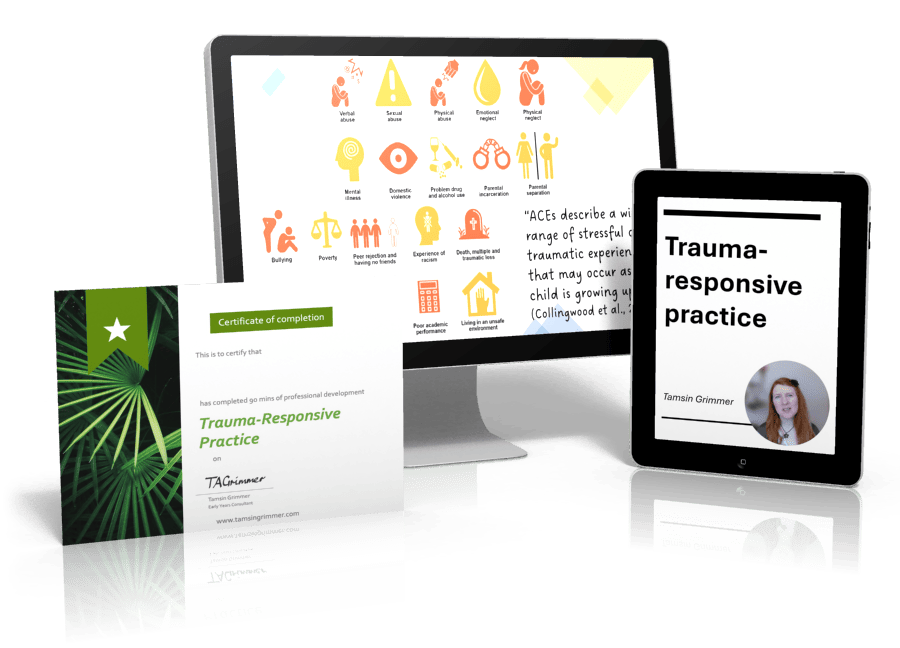
Trauma Responsive Practice is a comprehensive professional development course that equips you with evidence-based strategies to recognise, understand, and respond to trauma with confidence and compassion. Through expert content delivered by early years consultant Tamsin Grimmer, you’ll transform your ability to support children and families affected by trauma whilst protecting your own wellbeing.
Understanding Trauma and Its Impact
- The crucial difference between positive, tolerable, and toxic stress in child development
- How Adverse Childhood Experiences (ACEs) affect brain development and behaviour
- Why traditional behaviour management approaches often fail with trauma-affected children
- The science behind fight, flight, and freeze responses in young children
Building Secure Attachments and Relationships
- The four S’s of attachment: helping children feel Safe, Seen, Soothed, and Secure
- Practical strategies for becoming a “secure base” for vulnerable children
- Reframing “attention-seeking” behaviour as “attachment-seeking” behaviour
- Creating consistent, trustworthy relationships that build resilience
Trauma-Informed Practice Strategies
- Implementing emotion coaching approaches that validate feelings whilst teaching regulation
- Creating physical and emotional environments that promote safety and belonging
- Using trauma-sensitive language that supports rather than shames
- Developing effective key person approaches for children with additional needs
Partnership with Families
- Trauma-informed approaches to gathering sensitive information about children’s experiences
- Building trust and rapport with families affected by trauma
- Supporting parents whilst maintaining appropriate professional boundaries
- Communicating with empathy whilst avoiding judgement
Course Format:
- 60 minutes of expert video instruction
- Practical reflection activities and implementation strategies
- Certificate for 90 minutes of professional development
- Lifetime access to all materials
- Compatible with any device
Meet Your Course Instructor: Tamsin Grimmer
Tamsin Grimmer is a respected early years consultant, author and trainer specialising in trauma-responsive practice and children’s emotional wellbeing. Her approach combines cutting-edge research with practical strategies you can implement immediately in your setting.
With extensive experience supporting early years professionals across diverse settings, Tamsin brings both academic expertise and real-world understanding to this essential topic. Her compassionate, evidence-based approach helps practitioners develop the confidence and skills needed to support their most vulnerable children and families.

Tamsin’s professional background includes specialisation in attachment theory, trauma-informed practice, and creating emotionally supportive environments for young children.
Course Overview: What You’ll Discover
This comprehensive course transforms your understanding of trauma and equips you with practical tools for trauma-responsive practice:
Module 1: Introduction to Trauma Responsive Practice
- Welcome to your safe learning space – understanding the importance of self-care during trauma education
- The calm lake metaphor – creating peaceful havens in early years settings
- Why trauma-responsive practice is essential for all early years professionals
- Setting intentions for your learning journey
Module 2: Early Brain Development and Trauma
- The critical first 1001 days – how experiences shape developing brains
- Neuron development from birth to age two – understanding synaptic pruning
- The devastating impact of extreme neglect on brain architecture
- The hopeful message: how loving environments can restore functionality
Module 3: Understanding Trauma and ACEs
- Defining trauma and its three types: positive, tolerable, and toxic stress
- The landmark ACE study findings and their implications for early years
- Common ACEs affecting children: abuse, neglect, and household dysfunction
- How cortisol and toxic stress affect learning and behaviour
Module 4: Impact of Trauma on Children and Families
- Recognising trauma responses in children’s behaviour and development
- Understanding factors that increase vulnerability to ACEs
- The ripple effects: how trauma impacts entire family systems
- Moving beyond correlation to causation – the power of protective factors
Module 5: Building Secure Attachments
- Why promoting secure attachments is vital for trauma recovery
- The four S’s framework: Safe, Seen, Soothed, and Secure
- Understanding attachment as a stress regulatory system
- Practical strategies for becoming a child’s “secure base”
Module 6: Partnership with Parents and Carers
- Gathering sensitive information with trauma-informed approaches
- Building trust and rapport whilst maintaining professional boundaries
- Effective questioning techniques that avoid re-traumatisation
- Supporting families without judgement or blame
Module 7: Trauma-Responsive Practice Strategies
- Creating physically and emotionally safe environments
- Implementing emotion coaching and co-regulation techniques
- Using trauma-sensitive language in daily interactions
- Developing consistent routines and predictable boundaries
Module 8: Being Children’s Cheerleaders
- Becoming the “irrationally crazy” adult every child needs
- Creating your personal recipe for trauma-responsive practice
- Reflection questions for ongoing professional development
- Maintaining hope and making a lasting difference
Frequently Asked Questions
Q: How long do I have access to the course materials?
A: You have unlimited lifetime access to all course content, allowing you to revisit the materials whenever needed for ongoing professional development.
Q: Can I pause and resume the course as needed?
A: Absolutely! The course is designed for busy early years professionals. You can pause, rewind, and revisit sections as often as you like to fit around your schedule.
Q: Do I need any special materials or equipment?
A: Just a notebook and pen for the reflection activities. The course is accessible on any device with internet access.
Q: Our setting doesn’t currently have many children affected by trauma. Is this course still relevant?
A: Yes! With research showing that 9% of the population has experienced four or more ACEs, trauma-affected children are likely present in every setting. This course equips you with preventative strategies and creates trauma-informed foundations for all children.
Q: I find discussing trauma emotionally challenging. Will this course be suitable for me?
A: The course is designed with your wellbeing in mind. Tamsin emphasises self-care throughout and creates a safe learning environment. You can engage with activities at a depth that feels comfortable for you.
Q: I’m new to early years practice. Is this course suitable for beginners?
A: Absolutely! The course provides foundational understanding alongside practical strategies, making it ideal for professionals at all experience levels.
Q: I’ve worked with trauma-affected children before. Will I learn anything new?
A: Yes! The course combines current research with evidence-based strategies, offering fresh perspectives on brain development, attachment theory, and practical implementation techniques.
Q: How quickly can I implement what I learn?
A: Many strategies can be implemented immediately, such as language choices and environmental considerations. Others, like policy development, may take longer but the course provides clear guidance for sustainable change.
Q: What technology do I need to access the course?
A: Any device with internet access and audio capability will work—computer, tablet, or smartphone.
Q: Why is the course priced at just £48?
A: We’ve kept the price accessible to ensure all early years professionals can benefit from this essential training, whilst maintaining high-quality content from an expert instructor.
Q: Will I receive a certificate upon completion?
A: Yes, you’ll receive a certificate for 90 minutes of professional development upon course completion. This includes the 60 minutes of video instruction plus time allocated for reflection and implementation activities.
Q: Is there any support available if I have questions?
A: Yes, as with all our products you can contact us at any time via email or our chat feature and we’ll get back to you as soon as we can – usually within 24 hours and often much faster.
Q: Can I share the course materials with my colleagues?
A: Your course access is for individual use only. However, we offer group discounts if you’d like to enroll multiple team members. Just contact us via email or the website chat feature.
If you have any other questions, please don’t hesitate to contact us using the chat feature or email and we’ll get back to you straight away.
Transform Your Practice Today
Equip yourself with the essential skills to support trauma-affected children and families with confidence and compassion. This focused professional development opportunity represents more than just training—it’s an investment in becoming a protective factor in children’s lives, potentially changing their developmental trajectory forever.
For just £48, you’ll gain:
- Expert-led video instruction from trauma specialist Tamsin Grimmer
- Evidence-based strategies for trauma-responsive practice
- Clear frameworks for building secure attachments
- Practical tools for supporting families with sensitivity
- Professional certification for your CPD portfolio
- The knowledge that you can and do make a difference
Don’t miss this opportunity to enhance your professional toolkit with essential skills that transform your ability to support your most vulnerable children and families.
Remember: “Regardless of what a child has gone through, you can and do make a difference for the children in your care.”
Episode Content
Episode Includes
- 8 Videos
- Episode Certificate
