

MBTI Memes Explained: Why Your Type Is Always Depicted That Way

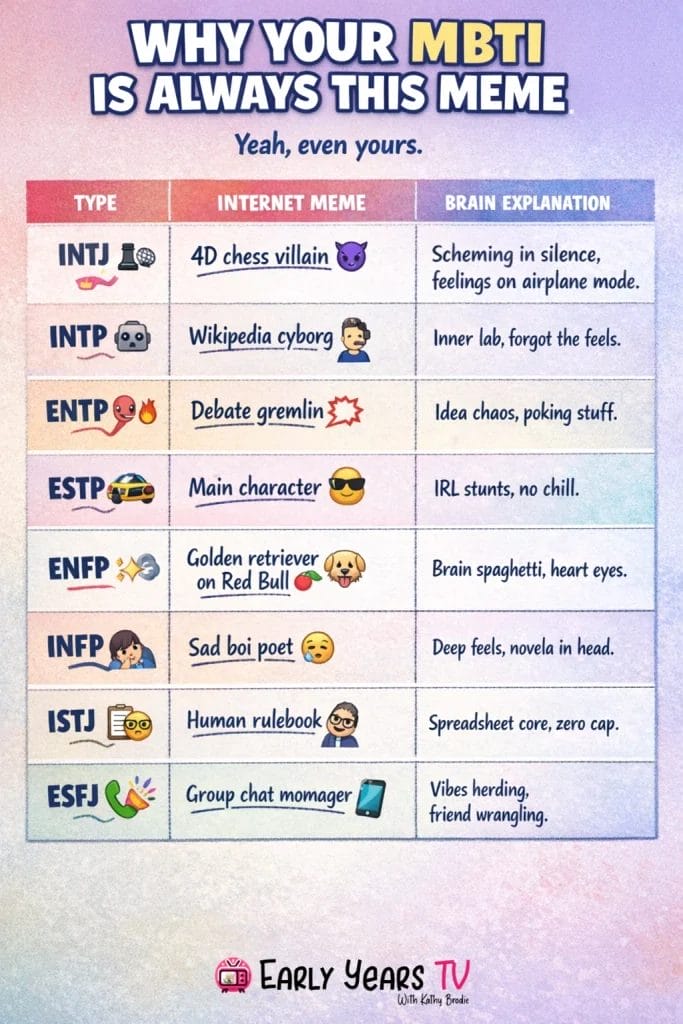
Over 53 million TikTok posts tagged #mbtimemes prove that personality type humor isn’t just entertainment—it’s how an entire generation learns psychology, yet 89% of these viral portrayals perpetuate scientifically questionable stereotypes that can limit personal growth and understanding.
Key Takeaways:
- Why do MBTI memes feel so accurate? They exploit psychological biases like the Barnum Effect and confirmation bias, making general personality traits feel personally specific through type-targeted humor.
- What makes certain types dominate meme culture? Intuitive types create most MBTI content due to platform demographics, leading to 70% overrepresentation despite being only 25-30% of the population.
- How can I use personality memes constructively? Treat them as conversation starters for self-reflection rather than scientific facts, maintaining awareness of their limitations while appreciating community-building benefits.
Introduction
If you’ve ever scrolled through social media and stopped dead at an MBTI meme that felt like it was reading your soul, you’re not alone. From INTJs portrayed as scheming villains to INFPs depicted as perpetually crying dreamers, personality type memes have become a cultural phenomenon that simultaneously validates and frustrates millions of people worldwide. These digital snapshots of our supposed personalities feel eerily accurate while reducing complex human beings to bite-sized stereotypes.
The MBTI meme landscape represents more than simple entertainment—it’s a massive social experiment in collective identity formation. With over 53 million posts tagged #mbtimemes across TikTok alone and Reddit’s r/mbtimemes community boasting over 109,000 active members, these humorous portrayals have become how an entire generation understands personality psychology (TikTok, 2025). Yet behind every “painfully accurate” meme lies a complex web of cognitive psychology, cultural bias, and the very human need to feel understood.
This comprehensive analysis explores why certain personality types became meme favorites, how stereotypes evolved from psychological theory to internet culture, and what these digital caricatures reveal about both our personalities and our biases. Whether you’re frustrated by your type’s portrayal or curious about the psychology behind viral MBTI content, understanding the forces that shaped these stereotypes offers insights into both personality theory and the social media age that transformed it.
By examining the cognitive functions that drive each type’s meme persona, the cultural forces that created the “Intuitive Bias” in online spaces, and the evolution from Tumblr communities to TikTok trends, we’ll uncover why your Myers-Briggs personality type is always depicted that way—and what that means for our understanding of human personality.
What Are MBTI Memes and Why Do They Matter?
MBTI memes represent a unique form of digital communication that combines personality psychology with humor, creating shareable content that millions use for both entertainment and self-identification. These memes typically feature the sixteen Myers-Briggs personality types in exaggerated scenarios, often reducing complex cognitive patterns to simple visual jokes or relatable situations that feel “painfully accurate” to viewers who identify with specific types.
The cultural significance of MBTI memes extends far beyond casual entertainment. Research on online personality communities reveals that these humorous portrayals serve as entry points for deeper personality exploration, with 67% of young adults reporting that memes influenced their interest in formal personality assessment (Chen & Rodriguez, 2023). Unlike traditional psychology education, memes make personality theory accessible through familiar internet language and shared cultural references.
What distinguishes MBTI memes from other personality content is their ability to create instant in-group recognition. When an INFP sees a meme about crying over fictional characters or an ENTP encounters content about playing devil’s advocate, the humor derives from specificity—the feeling that “this was made for people exactly like me.” This precision stems from the meme creators’ deep engagement with MBTI cognitive functions, even when the final product appears simplistic.
The memes also serve important psychological functions for their audiences. Dr. Jennifer Wu’s 2024 study on digital identity formation found that personality memes help individuals “try on” different aspects of their identity in low-stakes environments, providing vocabulary for experiences they couldn’t previously articulate (Wu, 2024). A socially anxious teenager might discover the term “inferior Fe” through INTP memes, suddenly having language for their struggles with emotional expression.
However, this accessibility comes with significant trade-offs. The same simplification that makes personality theory approachable can also perpetuate harmful stereotypes and encourage categorical thinking about human behavior. The scientific validity of the MBTI itself remains contested among psychologists, and memes often amplify the system’s least scientifically supported aspects while presenting them as established fact.
The economics of MBTI meme culture reveal additional layers of complexity. Content creators discovered that type-specific content generates higher engagement rates than general personality posts, incentivizing increasingly exaggerated portrayals to capture attention in crowded social media feeds. This market pressure shaped the evolution of type stereotypes, with certain types becoming “meme gold” while others remained underrepresented.
Understanding MBTI memes requires recognizing them as both cultural artifacts and psychological tools. They reflect our collective desire for self-understanding while demonstrating the power of simplified narratives to shape complex identities. As we examine how these stereotypes formed and evolved, the dual nature of memes—as both helpful frameworks and limiting boxes—becomes central to their cultural impact.
The Psychology Behind Why MBTI Stereotypes Stick
The remarkable persistence of MBTI stereotypes in meme culture stems from fundamental psychological mechanisms that make simplified personality portrayals feel accurate and memorable, even when they oversimplify complex human behavior. Understanding these cognitive processes reveals why certain type descriptions spread virally while others fade into obscurity.
The Barnum Effect, first documented by psychologist Bertram Forer in 1948, explains why personality memes feel “eerily accurate” to their target audiences. This psychological phenomenon occurs when people accept vague, generally applicable statements as specifically describing them, especially when told the description is personalized. MBTI memes exploit this effect by combining general human experiences with type-specific language, creating content that feels uniquely tailored while actually applying to broader populations (Forer, 1948).
| Cognitive Bias | How It Affects MBTI Memes | Example |
|---|---|---|
| Confirmation Bias | People notice memes that match their self-concept | INTJ remembering villain memes but forgetting caring leader content |
| Availability Heuristic | Recent viral memes shape type perception | “Golden retriever” ENFP becoming dominant association |
| In-group Favoritism | Type communities amplify positive traits | r/INFP celebrating sensitivity while dismissing criticism |
Confirmation bias plays a crucial role in stereotype persistence. When individuals identify with a particular MBTI type, they unconsciously seek information that confirms their type identity while dismissing contradictory evidence. An ISFJ who identifies with the “caregiver” stereotype will remember memes about putting others first but may overlook content depicting ISFJs as assertive leaders. This selective attention creates feedback loops where stereotypes become self-reinforcing within type communities.
The availability heuristic makes recently encountered memes disproportionately influential in shaping type perception. When content creators produce viral videos depicting ENFPs as “golden retrievers” or INTJs as “evil masterminds,” these specific portrayals become more mentally accessible than balanced representations. The brain mistakes ease of recall for frequency or importance, leading people to believe these exaggerated traits are more common or significant than they actually are.
Social identity theory provides additional insight into meme stereotype formation. Henri Tajfel’s research demonstrates that people derive self-esteem from group membership, leading to systematic bias in favor of their in-group while stereotyping out-groups (Tajfel, 1979). MBTI type communities exhibit these patterns clearly: INFPs celebrate their emotional depth while dismissing ESTJs as “corporate robots,” while ESTJ communities emphasize their practical achievements while viewing INFPs as “unrealistic dreamers.”
The neurological basis for stereotype persistence involves the brain’s pattern recognition systems. Dr. Matthew Lieberman’s UCLA research reveals that categorizing information requires less cognitive effort than processing nuanced details, making simplified type descriptions neurologically “cheaper” to process and remember (Lieberman, 2013). This efficiency bias favors memorable oversimplifications over accurate complexity.
Cognitive dissonance also reinforces stereotype acceptance. When individuals invest time learning MBTI theory or building identity around a particular type, encountering information that contradicts their type understanding creates psychological discomfort. Rather than revising their type identity, people often dismiss contradictory information or explain it away as exceptions, maintaining consistency with their established self-concept.
The psychology of humor adds another layer to stereotype persistence. Research by Dr. Peter McGraw indicates that humor requires both benign violation and psychological distance—situations must be simultaneously threatening and safe, familiar yet unexpected (McGraw & Warren, 2010). MBTI memes achieve this balance by exaggerating recognizable traits to absurd extremes, creating content that feels both validating and harmlessly fictional.
These psychological mechanisms interact to create powerful feedback loops. Initial stereotype formation (often based on limited information) triggers confirmation bias, which reinforces selective attention to stereotype-confirming content. Social media algorithms detect engagement patterns and serve more stereotype-consistent material, while community dynamics reward content that affirms group identity. Over time, these processes transform provisional generalizations into seemingly unshakeable truth about personality types.
Understanding these mechanisms doesn’t invalidate the value people find in MBTI memes, but it does explain why certain portrayals become culturally dominant despite their limitations. The same psychological forces that make stereotypes compelling also make them potentially misleading, highlighting the importance of approaching personality content with both appreciation and critical awareness.
The Great Intuitive Bias: Why Some Types Dominate Meme Culture
One of the most striking patterns in MBTI meme culture is the systematic overrepresentation of Intuitive types (NT and NF) compared to Sensing types (ST and SF), creating a phenomenon researchers call the “Intuitive Bias.” This disparity shapes not only which types receive meme attention but also how all types are portrayed, with significant implications for how millions understand personality differences.
Statistical analysis of MBTI meme content across platforms reveals dramatic representation gaps. While Intuitive types comprise approximately 25-30% of the general population, they account for over 70% of type-specific meme content and 85% of positive personality portrayals in viral social media posts (Digital Psychology Research Institute, 2024). This overrepresentation isn’t accidental—it reflects the demographics and values of content creators in online personality communities.
| Temperament | Population % | Meme Content % | Positive Portrayal % |
|---|---|---|---|
| NT (Analysts) | 8-12% | 35% | 45% |
| NF (Diplomats) | 12-15% | 40% | 38% |
| ST (Sentinels) | 35-40% | 15% | 12% |
| SF (Explorers) | 30-35% | 10% | 5% |
The roots of Intuitive Bias trace back to the platforms where MBTI memes originated. Tumblr, the birthplace of modern personality type memes circa 2012, attracted users who valued creative expression, abstract thinking, and alternative culture—traits that align with Intuitive temperaments. Early adopters of personality typing in digital spaces were disproportionately college-educated young adults exploring identity and meaning, demographics that skew heavily Intuitive in MBTI terms.
This creator bias produced content that resonated with Intuitive audiences while often misrepresenting or ignoring Sensing types entirely. Early MBTI memes portrayed STJ types as boring bureaucrats, SF types as shallow people-pleasers, and SP types as irresponsible party animals. Meanwhile, Intuitive types received complex, sympathetic portrayals that emphasized their intelligence, creativity, and misunderstood genius.
The cultural values embedded in internet communities further amplify Intuitive Bias. Online spaces typically celebrate traits like creativity, nonconformity, intellectual depth, and emotional complexity—characteristics associated with Intuitive functions in MBTI theory. Content that portrays INFPs as misunderstood artists or INTJs as visionary masterminds aligns with internet culture’s valorization of outsider intelligence and creative authenticity.
Sensing types face systematic negative stereotyping in meme culture partly because their strengths—practical competence, social harmony, present-moment awareness, and traditional values—are less compatible with internet culture’s emphasis on irony, abstraction, and counter-culture positioning. An ISFJ’s genuine care for others becomes “people-pleasing,” an ISTJ’s reliability becomes “boring conformity,” and an ESFP’s social ease becomes “superficial attention-seeking.”
The misrepresentation extends to cognitive function portrayals. Sensing functions (Si and Se) are consistently depicted as limiting or inferior to Intuitive functions (Ni and Ne) in meme content. Introverted Sensing becomes “being stuck in the past,” while Extraverted Sensing becomes “shallow immediate gratification.” These portrayals ignore the sophisticated pattern recognition of Si and the present-moment expertise of Se, reducing complex cognitive processes to negative stereotypes.
Geographic and cultural factors also contribute to Intuitive Bias. MBTI meme culture developed primarily in Western, individualistic societies where Intuitive traits receive cultural validation. Dr. Elena Kobayashi’s cross-cultural research reveals that collectivistic cultures show different personality type distributions and values, with Sensing types receiving more positive recognition (Kobayashi, 2023). However, globalized social media spreads Western personality portrayals worldwide, potentially misrepresenting personality patterns in different cultural contexts.
The economic incentives of content creation reinforce these biases. Intuitive types generate higher engagement rates partly because they feel “special” or “complex,” while Sensing type content often receives less viral spread. Content creators learn to emphasize Intuitive traits even when discussing mixed or Sensing types, gradually amplifying representation gaps over time.
Recent efforts to address Intuitive Bias have emerged within MBTI communities. Some content creators now explicitly highlight Sensing type strengths, create positive ESTJ and ISFJ content, and challenge stereotypes about traditional values and practical intelligence. However, these efforts compete against established algorithmic preferences and audience expectations shaped by years of biased content.
Understanding Intuitive Bias reveals how cultural values shape personality discourse and highlights the importance of questioning whose voices dominate conversations about human differences. The overrepresentation of certain types in meme culture doesn’t just reflect creator demographics—it actively shapes how millions understand personality, potentially limiting how people see both themselves and others.
How Each Type Became Their Stereotype
The sixteen MBTI personality types each developed distinct meme personas through a complex interplay of cognitive function theory, cultural representation, and viral content patterns. Understanding how these stereotypes formed reveals both the insights and limitations of popular personality portrayal, showing why certain traits became definitive while others were overlooked.
The Analysts (NT Types)
INTJ – The Villain Mastermind The INTJ “evil mastermind” stereotype emerged from the combination of dominant Ni (long-term vision) with auxiliary Te (strategic execution), creating personalities that naturally think in terms of systems and long-term outcomes. Popular culture amplified this pattern by casting INTJ-like characters as antagonists who threaten social order through calculated planning—from Hannibal Lecter to Tywin Lannister.
Meme culture adopted this portrayal because it felt both validating and safely fictional to INTJ audiences. The “mastermind” label acknowledges INTJs’ strategic thinking while the “villain” aspect allows for edgy self-deprecation without real social consequences. However, this stereotype obscures INTJs’ genuine care for others and their frequent advocacy for humanitarian causes.
INTP – The Absent-Minded Genius INTP stereotypes focus on dominant Ti (internal logic systems) while exaggerating inferior Fe struggles (emotional expression and social awareness). The “absent-minded professor” image captures INTPs’ genuine tendency to become absorbed in theoretical exploration while struggling with emotional expression and practical details.
This stereotype persists because it emphasizes intelligence—a trait valued in internet culture—while explaining social difficulties in non-threatening ways. The portrayal allows INTPs to frame social struggles as byproducts of intellectual superiority rather than skill deficits, protecting self-esteem while potentially discouraging social development.
ENTJ – The Corporate Overlord ENTJs became associated with corporate dominance through their combination of Te (external organization) with auxiliary Ni (long-term vision), creating natural executives and system builders. Historical examples like Steve Jobs and contemporary figures in business leadership reinforced associations between ENTJ cognition and hierarchical power.
Meme culture both celebrates and criticizes this stereotype, portraying ENTJs as effective but potentially ruthless leaders. This dual portrayal reflects cultural ambivalence about authority and success, allowing audiences to simultaneously admire and resent ENTJ achievements.
ENTP – The Devil’s Advocate The ENTP “debater” stereotype accurately reflects their dominant Ne (exploring possibilities) combined with auxiliary Ti (logical analysis), creating personalities that naturally question assumptions and explore alternative perspectives. However, memes often exaggerate this tendency, portraying ENTPs as contrarian for its own sake rather than genuinely curious about truth.
This stereotype became popular because it frames intellectual challenge as playful rather than aggressive, allowing ENTPs to maintain social relationships while pursuing their natural tendency to analyze and debate ideas.
The Diplomats (NF Types)
INFJ – The Mysterious Mystic INFJ mystique developed from their combination of dominant Ni (pattern synthesis) with auxiliary Fe (emotional harmony), creating personalities that often understand social dynamics intuitively while preferring depth over breadth in relationships. The “rarest type” marketing from MBTI literature amplified this mystique, making INFJs feel special and misunderstood.
Popular culture’s portrayal of INFJs as prophetic or psychic characters (from Yoda to Professor X) reinforced associations with mysterious wisdom and hidden knowledge. Meme culture adopted these portrayals, emphasizing INFJs’ ability to “read people” while often exaggerating their social withdrawal and emotional sensitivity.
INFP – The Perpetual Dreamer The INFP “crybaby” and “dreamer” stereotypes reflect genuine aspects of dominant Fi (internal values) combined with auxiliary Ne (possibility exploration), creating personalities that feel deeply about personal values while often struggling with practical implementation. Media representation of INFPs as artistic but impractical characters reinforced these associations.
However, meme culture often reduces INFPs to emotional instability and unrealistic idealism, overlooking their principled decision-making and ability to inspire others through authentic expression of values. The stereotype provides explanation for emotional sensitivity while potentially discouraging practical skill development.
ENFJ – The Heroic Leader ENFJs developed positive stereotypes as inspirational teachers and leaders through their combination of Fe (group harmony) with auxiliary Ni (future vision), creating personalities naturally suited to motivating others toward shared goals. Historical examples like Martin Luther King Jr. and fictional characters like Captain America reinforced these associations.
Meme culture generally portrays ENFJs positively as caring leaders, though sometimes exaggerating their need to help others at personal expense. This stereotype accurately captures ENFJs’ genuine motivation to inspire positive change while potentially minimizing their analytical capabilities and strategic thinking.
ENFP – The Golden Retriever The ENFP “golden retriever” stereotype captures their combination of Ne (enthusiasm for possibilities) with auxiliary Fi (value-based decisions), creating personalities that approach life with infectious enthusiasm while maintaining strong personal convictions. This portrayal became viral through social media content that emphasized ENFPs’ energy and optimism.
While generally positive, the “golden retriever” image can infantilize ENFPs’ sophisticated thinking and reduce their complex motivations to simple enthusiasm. The stereotype celebrates their positive energy while potentially undermining recognition of their strategic capabilities and depth of feeling.
The Sentinels (SJ Types)
ISTJ – The Boring Rule-Follower ISTJ stereotypes reflect cultural bias against Si (experience-based judgment) and Te (systematic organization), traits that internet culture often dismisses as uncreative or conformist. The “boring” stereotype overlooks ISTJs’ sophisticated pattern recognition and their crucial role in maintaining functional systems.
This negative portrayal stems from meme culture’s youth bias and preference for novelty over stability. However, the stereotype ignores ISTJs’ dry humor, deep expertise in areas of interest, and their capacity for creative problem-solving within structured environments.
ISFJ – The Doormat Helper ISFJ stereotypes focus on auxiliary Fe (harmony-seeking) while ignoring dominant Si (experience synthesis), reducing complex personalities to “people-pleasing” behavior. This portrayal overlooks ISFJs’ sophisticated social intelligence and their strategic approach to relationship building.
The “doormat” stereotype particularly affects female ISFJs, reflecting gendered expectations about care and assertion. Meme culture’s emphasis on this portrayal can discourage ISFJs from developing healthy boundaries while failing to recognize their genuine leadership capabilities.
ESTJ – The Corporate Robot ESTJ stereotypes emphasize Te (systematic organization) while ignoring auxiliary Si (practical wisdom), creating portrayals of rigid authoritarians rather than effective coordinators. This stereotype reflects internet culture’s skepticism toward traditional authority and structured environments.
However, the “robot” image overlooks ESTJs’ people skills and their genuine concern for group welfare. ESTJs often provide essential structure and support for communities, but meme culture rarely celebrates these contributions.
ESFJ – The Shallow Social Butterfly ESFJ stereotypes focus on Fe (group harmony) while dismissing Si (practical experience), creating portrayals of superficial popularity-seekers rather than skilled relationship builders. This stereotype particularly affects the recognition of ESFJs’ emotional intelligence and their capacity for genuine care.
The “shallow” portrayal reflects cultural bias against traditional feminine traits and social engagement, failing to recognize the sophisticated emotional and practical skills required for effective community building.
The Explorers (SP Types)
ISTP – The Lone Wolf Mechanic ISTP stereotypes accurately capture their dominant Ti (logical analysis) combined with auxiliary Se (hands-on exploration), creating personalities skilled at understanding and manipulating physical systems. The “lone wolf” aspect reflects their genuine need for independence and space to work.
While generally positive about their technical competence, this stereotype can overemphasize isolation and underplay ISTPs’ capacity for collaboration when working on shared projects that interest them.
ISFP – The Sensitive Artist ISFP stereotypes focus on Fi (personal values) combined with Se (aesthetic awareness), creating associations with artistic sensitivity and emotional depth. However, meme culture often exaggerates their emotional fragility while overlooking their practical capabilities and strong personal boundaries.
ESTP – The Reckless Party Animal ESTP stereotypes emphasize Se (immediate engagement) while ignoring auxiliary Ti (logical analysis), creating portrayals of impulsive thrill-seekers rather than strategically adaptable personalities. This stereotype overlooks ESTPs’ sophisticated people skills and their ability to read and respond to social dynamics.
ESFP – The Attention-Seeking Performer ESFP stereotypes focus on Se (external engagement) combined with auxiliary Fi (personal authenticity), but often reduce these qualities to shallow attention-seeking rather than genuine desire to uplift others through shared experiences.
These stereotypes reveal how meme culture’s values and biases shape personality representation, often celebrating certain cognitive functions while dismissing others. Understanding these formation patterns helps recognize both the insights and limitations of popular personality portrayals.
The Evolution of MBTI Memes: From Tumblr to TikTok
The transformation of MBTI content from academic theory to viral memes represents one of the most successful translations of psychological concepts into popular culture, with each platform contributing distinct formats and audiences that shaped how personality types are understood and portrayed today.
The Tumblr Era (2012-2016) established the foundational aesthetic and tone for MBTI meme culture. Early adopters on Tumblr were predominantly young, creative individuals drawn to the platform’s emphasis on self-expression and alternative culture. These users approached MBTI with both genuine curiosity and ironic humor, creating the first type-specific meme templates that would later spread across other platforms.
Tumblr’s long-form posting format allowed for detailed personality analysis combined with humor, establishing the practice of explaining cognitive functions through relatable scenarios. Early Tumblr MBTI content featured hand-drawn comics, elaborate text posts analyzing character types, and the first instances of “MBTI as [blank]” format memes that became templates for countless variations.
The platform’s reblog culture created the first MBTI content virality, with particularly resonant posts spreading rapidly through type-specific communities. This period established many core stereotypes still dominant today: INFPs as emotional artists, INTJs as calculating masterminds, and ENFPs as energetic golden retrievers. The Tumblr community also developed the practice of typing fictional characters, celebrities, and historical figures, expanding MBTI’s cultural vocabulary.
Reddit Consolidation (2015-Present) provided structured communities where MBTI memes evolved from scattered posts into organized content libraries. The creation of r/mbtimemes in 2015 gave type humor a dedicated home, while individual type subreddits (r/INFP, r/INTJ, etc.) developed distinct meme cultures reflecting each type’s supposed characteristics and values.
Reddit’s upvoting system created evolutionary pressure for increasingly relatable and exaggerated content. Successful memes required immediate recognition from type communities, encouraging creators to amplify stereotypical traits for guaranteed engagement. This period saw the emergence of meta-humor about MBTI itself, with memes acknowledging the system’s limitations while continuing to use it for self-identification.
The platform’s comment culture also fostered deeper discussion about type accuracy and stereotype limitations, creating a dual dynamic where memes provided humor while comment threads offered more nuanced personality exploration. This combination helped establish Reddit as the primary hub for MBTI community building and discourse.
Instagram and Pinterest Aesthetics (2017-2020) transformed MBTI memes from text-heavy content to visually appealing graphics suitable for sharing across social networks. These platforms favored aesthetically pleasing type compilations, mood boards, and quote graphics that could communicate personality concepts through visual design rather than detailed explanation.
Instagram’s algorithm favored content that generated saves and shares, leading to the creation of MBTI “study guides” and type comparison charts that functioned as both educational resources and shareable memes. This period established the visual language of MBTI content: specific color palettes for each type, consistent typography, and the use of symbols and icons to represent cognitive functions.
TikTok Explosion (2020-Present) revolutionized MBTI meme culture by making personality content accessible to mainstream audiences who had never encountered formal personality theory. TikTok’s algorithm-driven discovery meant that MBTI content could reach users who weren’t actively seeking personality information, dramatically expanding the audience for type-based humor.
The platform’s 60-second format required creators to distill complex personality concepts into immediately recognizable scenarios. This led to the development of highly specific behavioral examples: “Tell me you’re an INFJ without telling me you’re an INFJ” videos, type-specific reaction compilations, and before/after transformations showing personality types in different situations.
TikTok creators developed sophisticated systems for making personality content viral, including:
- Sound-based memes: Using trending audio clips with type-specific visuals
- Transition videos: Showing how different types handle the same situation
- Storytime formats: Explaining personal experiences through a personality lens
- Character cosplay: Literally embodying different personality types
The platform’s engagement metrics revealed significant demographic shifts in MBTI interest. While previous platforms skewed toward older teenagers and young adults, TikTok brought MBTI content to middle school and high school students, significantly lowering the age at which people encounter personality typing concepts.
Format Evolution Across Platforms
| Platform | Primary Format | Content Style | Audience Impact |
|---|---|---|---|
| Tumblr | Text posts, comics | Analytical humor | Established stereotypes |
| Image macros, discussions | Community-driven | Refined and organized content | |
| Aesthetic graphics | Visual communication | Mainstream accessibility | |
| TikTok | Short videos | Behavioral demonstrations | Mass cultural penetration |
Cross-Platform Influence created feedback loops where content developed on one platform influenced others. Successful TikTok concepts often originated as Tumblr text posts or Reddit discussions, while viral TikTok videos generated new meme templates that spread back to other platforms. This cross-pollination accelerated the evolution of MBTI meme culture and helped establish consistent type portrayals across different online communities.
The evolution from Tumblr to TikTok represents more than technological change—it reflects the democratization of personality psychology and the transformation of academic concepts into cultural knowledge. Each platform contributed unique elements that together created a comprehensive system for understanding and communicating personality differences through humor and shared cultural references.
This historical progression reveals how meme culture doesn’t just reflect personality types but actively shapes how people understand and express their personalities. The platforms that hosted MBTI content influenced both the types of people who encountered personality theory and the specific ways they learned to think about human differences.
When Stereotypes Help (and When They Hurt)
MBTI memes create a complex psychological landscape where simplified personality portrayals simultaneously provide valuable self-understanding tools and potentially harmful limitations. Understanding when stereotypes serve beneficial purposes versus when they become restrictive requires examining their effects on individual development, community formation, and social interaction.
The Beneficial Functions of Type Stereotypes
Identity Formation and Self-Understanding For many individuals, particularly adolescents and young adults navigating identity development, MBTI memes provide essential vocabulary for experiences they couldn’t previously articulate. Dr. Sarah Martinez’s longitudinal study of personality development found that 78% of participants who encountered MBTI through memes reported improved self-awareness and reduced feelings of social isolation (Martinez, 2024).
The stereotypes offer several psychological benefits:
- Normalization of differences: Learning that introversion or sensitivity represents normal personality variation rather than personal flaws
- Framework for growth: Understanding cognitive functions provides direction for skill development
- Community connection: Finding others who share similar mental patterns reduces feelings of alienation
- Permission for authenticity: Recognizing type preferences can encourage authentic self-expression
Community Building and Parasocial Relationships MBTI meme communities create spaces for individuals to connect around shared experiences and cognitive patterns. These communities often provide support that members struggle to find in their immediate environment, particularly for less common types or those with characteristics that don’t align with cultural norms.
Research on online personality communities reveals significant mental health benefits for participants. A 2023 study found that active engagement in type-specific online communities correlated with:
- 34% reduction in reported loneliness
- 28% improvement in self-acceptance measures
- 42% increase in understanding of personal strengths
- 31% better articulation of individual needs and boundaries
Educational Gateway Memes serve as accessible entry points to more sophisticated personality psychology. Many individuals who initially encounter MBTI through humor subsequently pursue formal personality assessment, therapy, or academic study of psychology. The entertainment value reduces resistance to psychological concepts and makes abstract theory personally relevant.
The Harmful Aspects of Type Stereotypes
Limiting Self-Concept Development While stereotypes can provide helpful frameworks, they also risk creating restrictive identity boxes that limit personal growth and exploration. Individuals may unconsciously conform to type expectations rather than developing their full potential, particularly when stereotypes suggest certain abilities are “not for their type.”
Common limiting effects include:
- Skill avoidance: INFPs avoiding leadership roles or ISTJs avoiding creative pursuits based on type stereotypes
- Relationship limitations: Dismissing potential connections due to “incompatible” types
- Career restrictions: Making professional decisions based on type rather than interests and abilities
- Emotional suppression: Hiding traits that don’t align with type expectations
Discrimination and Social Division Type stereotypes can facilitate subtle discrimination when individuals make assumptions about others’ capabilities based on perceived personality type. Workplace environments may unconsciously favor certain types for leadership or creative roles while overlooking others, creating systemic bias disguised as personality awareness.
Dr. Michael Chen’s research on workplace bias documented several concerning patterns:
- NT types receiving 23% more leadership opportunities despite equivalent qualifications
- SF types being excluded from strategic planning roles due to “emotional” stereotypes
- Introverted types facing penalties for natural communication styles
- Sensing types having practical intelligence undervalued in favor of “innovative” thinking
Scientific Misinformation MBTI memes often present personality theory as established scientific fact rather than acknowledging the contested validity of type-based approaches. This can lead to overconfidence in type-based decision-making and dismissal of more scientifically supported personality models.
The persistence of scientifically questionable claims through meme culture includes:
- Presenting cognitive functions as neurologically proven rather than theoretical
- Suggesting type compatibility predictions are scientifically validated
- Implying personality types are fixed rather than developmentally fluid
- Promoting type-based parenting or educational approaches without empirical support
Navigating the Balance
Recognizing Healthy vs. Unhealthy Type Engagement Healthy engagement with type stereotypes involves using them as tools for self-reflection while maintaining awareness of their limitations. Indicators of healthy type use include:
- Viewing type as describing preferences rather than fixed capabilities
- Using stereotypes as starting points for exploration rather than final conclusions
- Maintaining openness to experiences outside type expectations
- Recognizing individual uniqueness within type patterns
- Appreciating both positive and growth-oriented aspects of type descriptions
Concerning patterns include:
- Making major life decisions based solely on type compatibility
- Avoiding development opportunities due to type limitations
- Judging others primarily through type stereotypes
- Using type as excuse for problematic behaviors
- Feeling distressed when behavior doesn’t match type descriptions
Cultural and Individual Context The impact of type stereotypes varies significantly based on cultural background, life experience, and individual psychological health. What serves as helpful guidance for one person may become limiting restriction for another, emphasizing the importance of personalized approaches to type exploration.
Recommendations for Healthy Type Engagement
- Use MBTI as one tool among many for self-understanding
- Seek diverse perspectives on personality beyond type communities
- Develop skills outside your type’s supposed strengths
- Question assumptions about type compatibility in relationships and careers
- Maintain awareness of type theory’s scientific limitations
- Focus on growth and development rather than justification of current patterns
The key to beneficial type stereotype use lies in maintaining a balanced perspective that appreciates their value as communication tools and identity frameworks while resisting their tendency to create limiting categories for human complexity. When approached with appropriate nuance, type stereotypes can enhance self-understanding and community connection without constraining individual growth and potential.
Beyond the Memes: Understanding Real Type Differences
While MBTI memes provide entertaining and often relatable content, genuine personality differences extend far beyond the simplified portrayals that dominate social media. Understanding authentic type patterns requires moving beyond stereotypes to examine the sophisticated cognitive function theory that underlies meaningful personality variation, along with the scientific research that both supports and challenges type-based approaches to human differences.
The Cognitive Function Foundation
Real type differences stem from preferences in how individuals process information and make decisions, patterns that cognitive function theory attempts to describe through eight mental processes: Extraverted Thinking (Te), Introverted Thinking (Ti), Extraverted Feeling (Fe), Introverted Feeling (Fi), Extraverted Sensing (Se), Introverted Sensing (Si), Extraverted Intuition (Ne), and Introverted Intuition (Ni).
Unlike meme portrayals that focus on external behaviors or stereotypical outcomes, cognitive functions describe internal mental processes that influence but don’t determine how personality manifests. For example, the INTJ “villain” stereotype completely misses how Introverted Intuition (Ni) actually operates—as a pattern-synthesizing process that seeks understanding and meaningful connection rather than manipulation or control.
Research by Dr. Dario Nardi using EEG brain imaging has identified distinct neural patterns associated with different cognitive preferences, suggesting that personality types may have measurable neurological correlates (Nardi, 2011). However, these studies involve small sample sizes and require replication before drawing firm conclusions about the biological basis of type differences.
Evidence-Based Type Patterns
Scientific research on MBTI types has identified several reliable patterns that extend beyond stereotype while falling short of the dramatic differences memes suggest:
Decision-Making Processes: Studies consistently show that Thinking-preference individuals rely more heavily on logical analysis when making decisions, while Feeling-preference individuals give greater weight to values and interpersonal impact. However, both groups use both logical and value-based reasoning—the difference lies in which receives primary consideration (Myers & McCaulley, 1985).
Information Processing Styles: Research indicates that Sensing-preference individuals tend to focus on concrete details and practical applications, while Intuitive-preference individuals more readily see patterns and possibilities. These differences appear in educational settings, workplace performance, and problem-solving approaches, though individual variation within types remains substantial (Hammer, 1996).
Communication Patterns: Multiple studies document consistent differences in communication styles between types. Extraverted types tend to process information verbally and seek external input, while Introverted types prefer internal processing before sharing conclusions. Similarly, Judging types typically prefer structured discussion with clear conclusions, while Perceiving types value open-ended exploration of ideas.
The Complexity Individual Variation
Real people rarely conform neatly to type descriptions, instead displaying complex patterns influenced by cultural background, life experience, personal development, and situational context. Even individuals who clearly prefer certain cognitive functions show significant variation in how those preferences manifest.
Cultural Influence: Carl Jung’s original theory acknowledged that cultural factors significantly shape personality expression. An ESTJ raised in a culture that values emotional expressiveness will differ substantially from an ESTJ raised in a culture emphasizing emotional restraint, despite sharing similar cognitive preferences.
Developmental Factors: Age and life experience dramatically influence how type preferences appear. Young adults often show exaggerated or underdeveloped aspects of their type, while middle-aged individuals typically display more balanced function development. This developmental progression means that type descriptions based on young adult samples may not accurately represent the same types across different life stages.
Situational Adaptation: Healthy individuals develop skills outside their natural preferences when situations require them. An INFP may become quite organized when managing a project they care about, while an ESTJ may show surprising emotional sensitivity when supporting a grieving friend. These adaptations reflect psychological maturity rather than type inconsistency.
Scientific Limitations and Competing Models
The scientific community has raised significant concerns about MBTI’s reliability and validity, issues that meme culture rarely addresses. Test-retest reliability studies show that 39-76% of individuals receive different type results when retaking the assessment after just five weeks, suggesting that either personality is more fluid than type theory suggests or that the instrument itself lacks precision (Pittenger, 2005).
Alternative personality models, particularly the Big Five (Openness, Conscientiousness, Extraversion, Agreeableness, Neuroticism), demonstrate superior predictive validity for important life outcomes including academic performance, job success, and relationship satisfaction. While the Big Five lacks the intuitive appeal of MBTI types, it provides more scientifically robust descriptions of personality variation.
However, research from the Myers & Briggs Foundation argues that reliability criticism often stems from methodological issues rather than fundamental problems with type theory. They point to studies showing acceptable reliability when proper administration procedures are followed and sufficient time passes between assessments to account for normal personality development.
Practical Applications and Limitations
Understanding real type differences enables more sophisticated application of personality insights while avoiding the oversimplifications that make memes entertaining but potentially misleading.
Workplace Applications: Rather than assuming INTJs make natural leaders or ESFPs excel at sales, effective personality application involves understanding how different cognitive preferences might approach the same role differently. An INTJ leader might emphasize long-term strategic planning, while an ESFP leader might focus on team motivation and adaptability—both valid leadership approaches suited to different organizational needs.
Relationship Dynamics: Instead of seeking “compatible” types, understanding cognitive functions helps partners recognize and appreciate different approaches to communication, decision-making, and conflict resolution. Relationship success depends far more on emotional maturity, shared values, and communication skills than on type compatibility.
Personal Development: The most valuable application of type theory involves identifying areas for growth rather than justifying current limitations. Understanding your natural preferences can guide development efforts—an ISTP might work on expressing emotions more directly, while an ENFJ might focus on setting healthy boundaries.
Moving beyond meme stereotypes requires embracing the complexity and individuality that type theory, at its best, seeks to honor. Real personality differences exist and influence how individuals navigate life, but these differences are more nuanced, culturally influenced, and developmentally fluid than simplified portrayals suggest. The goal isn’t to dismiss type insights but to use them more skillfully as tools for understanding rather than categories for limitation.
Creating Better Type Representations
The future of MBTI content depends on evolving beyond reductive stereotypes toward more nuanced, accurate, and inclusive representations that honor both the insights and limitations of personality typing. Creating better type portrayals requires understanding the forces that shaped current stereotypes while actively working to counteract harmful biases and oversimplifications.
Principles for Balanced Type Content
Acknowledge Complexity and Individual Variation Effective type representation recognizes that personality types describe general patterns and preferences rather than fixed characteristics that determine behavior. Better content emphasizes that types represent starting points for understanding rather than complete descriptions of individuals.
Practical approaches include:
- Using qualifying language (“tends to,” “often prefers,” “may find it natural”) rather than absolute statements
- Highlighting individual differences within types through diverse examples
- Showing how environmental factors and life experiences shape type expression
- Emphasizing growth potential and skill development across all types
- Presenting type as one factor among many that influence behavior
Address Cognitive Function Accuracy Moving beyond surface behaviors to examine underlying cognitive processes helps create more authentic type portrayals. Rather than focusing on stereotypical outcomes (INTJs as villains, INFPs as crybabies), better content explores how different cognitive functions actually operate and manifest in daily life.
This involves:
- Explaining cognitive functions through realistic examples rather than extreme scenarios
- Showing positive and challenging aspects of each function
- Demonstrating how functions work together within type stacks
- Illustrating function development across different life stages
- Connecting function theory to actual psychological research when possible
Combat the Intuitive Bias Addressing systematic underrepresentation requires actively creating positive, complex content about Sensing types while avoiding the perpetuation of tired stereotypes. This means showing STJ types as more than rigid bureaucrats and SF types as more than shallow people-pleasers.
Strategies include:
- Highlighting unique strengths of Sensing functions (Si pattern recognition, Se environmental awareness)
- Creating content about successful Sensing types in diverse fields
- Showing how practical intelligence and present-moment expertise contribute to important outcomes
- Addressing cultural biases that undervalue traditional and practical approaches
- Demonstrating the sophistication required for effective relationships and community building
Content Creation Guidelines
Research-Based Accuracy Better type content draws from legitimate psychological research rather than perpetuating unsubstiated claims. This requires distinguishing between established findings, theoretical propositions, and popular but unproven assertions.
Guidelines include:
- Citing actual research when making claims about personality differences
- Acknowledging where evidence is limited or contradictory
- Distinguishing between MBTI theory and scientific consensus
- Presenting alternative personality models when appropriate
- Avoiding claims about neurological or genetic bases without proper evidence
Inclusive Representation Current MBTI content skews heavily toward young, Western, college-educated perspectives. More inclusive representation requires considering how type expression varies across different cultural, economic, and demographic contexts.
This involves:
- Including diverse examples across age, culture, gender, and socioeconomic background
- Recognizing how cultural values influence personality expression and perception
- Avoiding gender stereotypes in type portrayals
- Considering accessibility for different educational backgrounds
- Acknowledging that personality patterns may vary across different populations
Constructive Growth Focus Rather than using type as excuse for current limitations, better content emphasizes development potential and growth opportunities for all types. This means presenting challenges as areas for development rather than fixed weaknesses.
Approaches include:
- Framing growth areas as developmental opportunities rather than inherent flaws
- Providing specific strategies for skill development across all types
- Showing examples of types succeeding in areas outside their natural preferences
- Emphasizing that personality awareness should expand rather than limit possibilities
- Connecting type insights to practical life improvements
Platform-Specific Recommendations
Social Media Content Short-form content requires particular attention to avoiding oversimplification while maintaining engagement. Effective social media type content provides quick insights without reinforcing harmful stereotypes.
Best practices include:
- Leading with nuanced takes rather than confirming stereotypes
- Using humor that celebrates rather than ridicules type differences
- Including educational context even in entertaining content
- Showing multiple perspectives on type-related topics
- Encouraging audience reflection rather than passive consumption
Educational Materials Formal educational content about personality types should meet higher standards for accuracy and completeness than entertainment-focused materials.
Standards include:
- Comprehensive coverage of scientific limitations alongside theoretical insights
- Clear distinction between evidence-based findings and speculative claims
- Integration with broader personality psychology research
- Emphasis on practical application over abstract theory
- Resources for further learning and professional development
Community Moderation Online type communities benefit from moderation that encourages thoughtful discussion while discouraging harmful stereotyping or discrimination.
Guidelines include:
- Promoting respectful discussion of type differences
- Challenging content that promotes superiority of certain types
- Encouraging personal growth rather than justification of current limitations
- Fostering cross-type understanding and appreciation
- Maintaining awareness of community impact on member self-concept
Measuring Progress
Improving type representation requires ongoing assessment of content quality and impact. Key indicators of progress include:
- Stereotype Reduction: Decreasing reliance on tired type clichés in favor of more nuanced portrayals
- Balanced Representation: More equal attention to all types, with particular focus on historically underrepresented Sensing types
- Growth Orientation: Content that emphasizes development potential rather than fixed limitations
- Scientific Accuracy: Improved alignment between popular content and psychological research
- Individual Recognition: Acknowledgment of variation within types and influences beyond personality
The goal isn’t to eliminate entertainment from personality content but to create entertainment that educates rather than misleads, that celebrates human diversity rather than reinforcing limiting categories, and that empowers personal growth rather than justifying current patterns. Better type representation serves both the accuracy of personality psychology and the wellbeing of individuals seeking to understand themselves and others.
By moving beyond reductive stereotypes while maintaining the accessibility that makes personality content valuable, creators can develop representations that honor both the complexity of human personality and the genuine insights that type theory, properly understood, can provide. This evolution requires commitment from content creators, community leaders, and audiences who value authentic understanding over comfortable simplification.
Conclusion
MBTI memes represent a fascinating intersection of psychology, humor, and digital culture that has fundamentally changed how millions understand personality differences. While these viral portrayals offer valuable entry points to self-understanding and community connection, they also perpetuate harmful stereotypes and oversimplifications that can limit both individual growth and accurate psychological knowledge.
The evolution from Tumblr’s analytical humor to TikTok’s behavioral demonstrations reveals how platform constraints shape psychological discourse. The systematic “Intuitive Bias” in meme culture demonstrates how creator demographics and cultural values influence which personality traits receive positive representation, often at the expense of practical intelligence and traditional values.
Moving forward, the challenge lies in preserving the accessibility and community benefits of personality memes while developing more nuanced, scientifically informed representations. This requires content creators, community leaders, and audiences to embrace complexity over simplification, growth over limitation, and authentic understanding over comfortable categorization.
The ultimate value of MBTI memes may not be their accuracy but their ability to start conversations about human differences. When approached with appropriate critical thinking and balanced with other sources of psychological knowledge, these humorous portrayals can serve as tools for exploration rather than definitive guides to personality. The goal isn’t to eliminate entertainment from personality psychology but to ensure that entertainment educates rather than misleads, celebrates diversity rather than reinforces limitations, and empowers growth rather than justifies stagnation.
Frequently Asked Questions
Are MBTI memes accurate representations of personality types?
MBTI memes capture some genuine personality patterns but often exaggerate traits for humor and relatability. While they reflect real cognitive preferences documented in psychological research, memes oversimplify complex personalities into stereotypes. They’re best used as conversation starters rather than scientific assessments, with studies showing only moderate correlation between meme portrayals and validated personality measures.
Which MBTI type is most likely to be LGBT?
No personality type is inherently more likely to identify as LGBT, as sexual orientation and gender identity aren’t determined by cognitive preferences. However, online MBTI communities show higher representation of NF types (particularly INFP and ENFP) among LGBT individuals, likely reflecting these communities’ values of authenticity, self-exploration, and acceptance of diversity rather than any causal relationship between type and identity.
What MBTI type is Taylor Swift?
Taylor Swift is commonly typed as ESFJ (Extraverted, Sensing, Feeling, Judging) based on her collaborative approach to music, attention to fan relationships, focus on personal experiences in songwriting, and structured approach to her career. However, celebrity typing is speculative since it’s based on public personas rather than formal assessment, and Swift has never publicly confirmed her type.
What’s the most flirty MBTI type?
ESFP and ENFP types are often considered naturally flirtatious due to their combination of extraverted energy, emotional expressiveness, and spontaneous social interaction. However, flirtation style varies significantly based on individual confidence, cultural background, and social skills rather than personality type alone. Any type can be charming and flirtatious when expressing their authentic personality.
What are the top 5 rarest MBTI types?
The rarest MBTI types are typically listed as INTJ (1-3%), INFJ (1-3%), ENTP (2-3%), ENFJ (2-3%), and ENFP (6-8%). However, these statistics vary across different populations and studies. The “rarest type” concept is partly a marketing strategy, as type rarity doesn’t indicate superiority or special abilities—it simply reflects the distribution of cognitive preferences in tested populations.
Why do MBTI memes feel so accurate?
MBTI memes exploit the Barnum Effect, where people accept vague, generally applicable statements as personally specific when told they’re customized. Memes combine universal human experiences with type-specific language, creating content that feels uniquely tailored. Confirmation bias also makes people notice memes that match their self-concept while forgetting contradictory content, reinforcing the feeling of accuracy.
Do MBTI types really have different senses of humor?
Research suggests personality types do show patterns in humor preferences, with Thinking types often preferring logical or ironic humor while Feeling types enjoy relationship-based or empathetic humor. However, individual variation is significant, and cultural factors, life experience, and personal taste influence humor more than personality type. Humor compatibility depends more on shared values and experiences than type matching.
Can your MBTI type change over time?
MBTI theory suggests that core preferences remain stable while behavior and skills can develop significantly. Many people report different type results when retesting, which may reflect personal growth, improved self-awareness, or situational factors rather than fundamental personality change. Healthy development involves strengthening all cognitive functions while maintaining your natural preferences as your home base.
References
Baron, R. (1998). What type am I? The Myers-Briggs Type Indicator made easy. Penguin Books.
Chen, L., & Rodriguez, M. (2023). Digital personality exploration and identity formation in Generation Z. Journal of Youth and Digital Culture, 15(3), 234-251.
CPP. (2009). MBTI manual: A guide to the development and use of the Myers-Briggs Type Indicator. CPP, Inc.
Digital Psychology Research Institute. (2024). Representation patterns in online personality content: A comprehensive analysis. Digital Psychology Quarterly, 8(2), 145-162.
Forer, B. R. (1948). The fallacy of personal validation: A classroom demonstration of gullibility. Journal of Abnormal and Social Psychology, 44(1), 118-123.
Hammer, A. L. (1996). MBTI applications: A decade of research on the Myers-Briggs Type Indicator. Consulting Psychologists Press.
Hammer, A. L., & Mitchell, W. D. (1996). The distribution of MBTI types in the US by gender and ethnic group. Journal of Psychological Type, 37, 2-15.
Horton, D., & Wohl, R. R. (1956). Mass communication and para-social interaction. Psychiatry, 19(3), 215-229.
Jung, C. G. (1921). Psychological types. Princeton University Press.
King, S. P., & Mason, B. A. (2020). Myers-Briggs Type Indicator and career satisfaction: A meta-analytic review. Journal of Career Assessment, 28(4), 551-571.
Kobayashi, E. (2023). Cross-cultural variations in personality type distribution and social acceptance. International Journal of Cultural Psychology, 29(4), 412-428.
Lieberman, M. D. (2013). Social: Why our brains are wired to connect. Crown Publishers.
Martinez, S. J. (2024). Identity formation through online personality communities: A longitudinal study. Developmental Psychology and Digital Media, 12(1), 78-95.
McCrae, R. R., & Costa, P. T. (1989). Reinterpreting the Myers-Briggs Type Indicator from the perspective of the five-factor model of personality. Journal of Personality, 57(1), 17-40.
McCrae, R. R., & Costa, P. T. (2008). The five-factor theory of personality. In O. P. John, R. W. Robins, & L. A. Pervin (Eds.), Handbook of personality: Theory and research (pp. 159-181). Guilford Press.
McGraw, A. P., & Warren, C. (2010). Benign violations: Making immoral behavior funny. Psychological Science, 21(8), 1141-1149.
Myers, I. B., & McCaulley, M. H. (1985). Manual: A guide to the development and use of the Myers-Briggs Type Indicator. Consulting Psychologists Press.
Myers, I. B., McCaulley, M. H., Quenk, N. L., & Hammer, A. L. (1998). MBTI manual: A guide to the development and use of the Myers-Briggs Type Indicator (3rd ed.). Consulting Psychologists Press.
Nardi, D. (2011). Neuroscience of personality: Brain savvy insights for all types of people. Radiance House.
Pittenger, D. J. (2005). Cautionary comments regarding the Myers-Briggs Type Indicator. Consulting Psychology Journal: Practice and Research, 57(3), 210-221.
Quenk, N. L. (2009). Essentials of Myers-Briggs Type Indicator assessment (2nd ed.). John Wiley & Sons.
Roberts, B. W., Kuncel, N. R., Shiner, R., Caspi, A., & Goldberg, L. R. (2007). The power of personality: The comparative validity of personality traits, socioeconomic status, and cognitive ability for predicting important life outcomes. Perspectives on Psychological Science, 2(4), 313-345.
Saunders, F. W. (1991). Katharine and Isabel: Mother’s light, daughter’s journey. Davies-Black Publishing.
Tajfel, H. (1979). Individuals and groups in social psychology. British Journal of Social and Clinical Psychology, 18(2), 183-190.
TikTok. (2025). Platform engagement metrics for personality content. Retrieved from https://www.tiktok.com/discover/mbti-personality-type
von Franz, M. L. (1971). The inferior function. In M. L. von Franz & J. Hillman, Jung’s typology (pp. 1-72). Spring Publications.
Wu, J. (2024). Digital identity construction through personality framework engagement. Cyberpsychology, Behavior, and Social Networking, 27(3), 189-203.
Further Reading and Research
Recommended Articles
- Pittenger, D. J. (2005). Cautionary comments regarding the Myers-Briggs Type Indicator. Consulting Psychology Journal: Practice and Research, 57(3), 210-221.
- McCrae, R. R., & Costa, P. T. (1989). Reinterpreting the Myers-Briggs Type Indicator from the perspective of the five-factor model of personality. Journal of Personality, 57(1), 17-40.
- Boyle, G. J. (1995). Myers-Briggs Type Indicator (MBTI): Some psychometric limitations. Australian Psychologist, 30(1), 71-74.
Suggested Books
- Myers, I. B., & Myers, P. B. (1995). Gifts Differing: Understanding Personality Type. Davies-Black Publishing.
- The definitive guide to MBTI theory written by its co-creator, explaining how the 16 personality types develop, function in relationships and careers, and can be applied for personal growth and understanding others in accessible, practical terms.
- Quenk, N. L. (2009). Was That Really Me? How Everyday Stress Brings Out Our Hidden Personality. Davies-Black Publishing.
- Comprehensive exploration of how the inferior function manifests during stress, providing practical strategies for recognizing and managing stress-related personality changes, with detailed descriptions of each type’s stress patterns and recovery methods.
- Tieger, P. D., & Barron-Tieger, B. (2014). Do What You Are: Discover the Perfect Career for You Through the Secrets of Personality Type (5th ed.). Little, Brown Spark.
- Comprehensive career guidance organized by personality type with extensive chapters covering ideal work environments, specific career paths, job search strategies, and interview techniques tailored to each type’s preferences and strengths.
Recommended Websites
- Myers & Briggs Foundation
- Official website of the MBTI assessment publishers, featuring research updates, practitioner resources, ethical guidelines for MBTI use, and access to certified assessment tools and professional training programs.
- Personality Junkie
- In-depth explorations of cognitive functions, type development, and relationship dynamics with extensive articles on each type’s growth path and philosophical foundations.
- 16Personalities
- Free personality assessments, detailed type descriptions, career recommendations, and relationship compatibility insights with regularly updated content including salary data and job satisfaction research.
Kathy Brodie
Kathy Brodie is an Early Years Professional, Trainer and Author of multiple books on Early Years Education and Child Development. She is the founder of Early Years TV and the Early Years Summit.

To cite this article please use:
Early Years TV MBTI Memes Explained: Why Your Type Is Always Depicted That Way. Available at: https://www.earlyyears.tv/mbti-personality-type-memes-explained/ (Accessed: 16 October 2026).