

MBTI Cognitive Functions: The Building Blocks of Personality

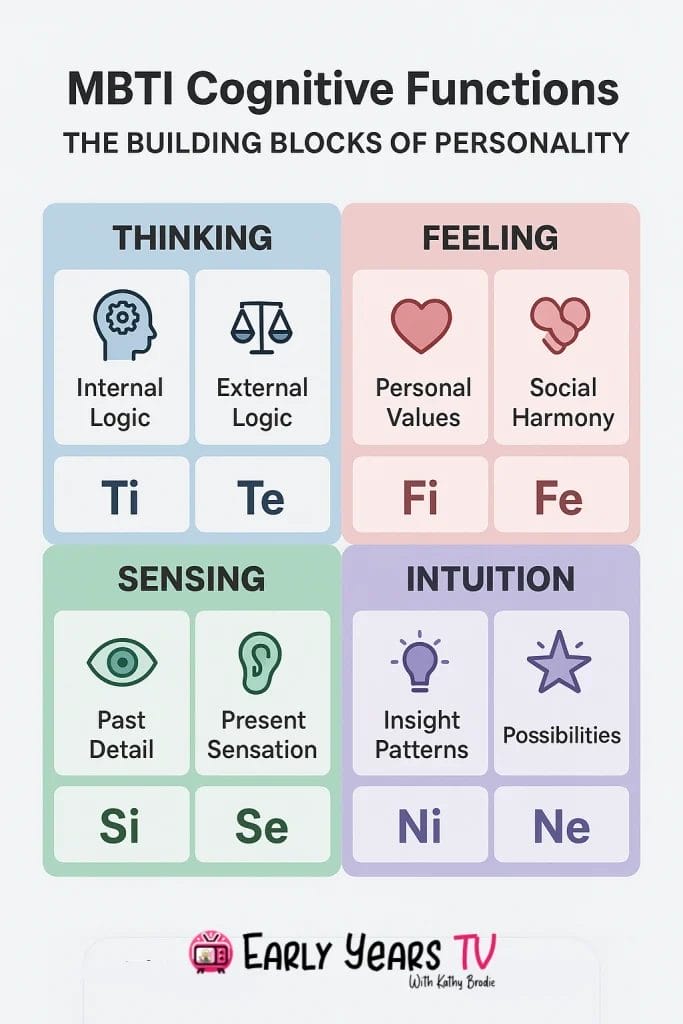
Two million people take the Myers-Briggs assessment annually, yet most only learn their four-letter type without understanding the eight cognitive functions—the underlying mental processes that explain not just what you prefer, but how your mind actually processes information and makes decisions.
Key Takeaways:
- What are cognitive functions? Cognitive functions are eight mental processes (Ni, Ne, Si, Se, Ti, Te, Fi, Fe) that explain how you perceive information and make decisions—the deeper mechanisms behind your four-letter MBTI type that reveal why you think the way you do.
- How do they create personality? Each personality type uses four of these eight functions in a specific order called your “function stack”—your dominant function (strongest), auxiliary (supporting), tertiary (developing), and inferior (growth edge)—alternating between introverted and extraverted orientations.
Introduction
You’ve probably taken a Myers-Briggs personality test and discovered you’re an INFP, ENTJ, or one of the other 14 types. Maybe you recognize yourself in descriptions of your four-letter type, but something feels incomplete—like you’re reading the chapter summary instead of the full story. That’s because the Myers-Briggs personality types you’re familiar with are actually built on a deeper foundation: cognitive functions.
Cognitive functions are the mental processes that drive how you take in information, make decisions, and interact with the world around you. While your four-letter type tells you what you prefer, cognitive functions explain why you prefer it and how your mind actually works. Understanding these building blocks transforms personality typing from simple labels into a practical framework for understanding yourself and others on a much deeper level.
In this guide, you’ll discover the eight cognitive functions that power all 16 personality types, learn how they stack together to create your unique mental architecture, and explore how this knowledge can help you navigate relationships, career decisions, and personal growth. This framework originated with Carl Jung’s psychological theory in the 1920s and was later refined into the practical system we use today.
What Are Cognitive Functions?
Beyond the Four Letters
When you look at MBTI types, you see four letters representing preferences: Extraversion or Introversion (E/I), Sensing or Intuition (S/N), Thinking or Feeling (T/F), and Judging or Perceiving (J/P). These dichotomies provide a helpful starting point, but they don’t tell the whole story of how your mind processes the world.
The dichotomy approach treats each preference as an either-or choice—you’re either an Extravert or an Introvert, a Thinker or a Feeler. But in reality, everyone uses all eight cognitive functions to some degree. What makes you unique isn’t which functions you have, but rather which ones you prefer, how strongly you prefer them, and in what order you typically use them (Jung, 1921/1971).
Think of it this way: if MBTI types are like describing a car by its color and size, cognitive functions are like understanding what’s under the hood—the engine, transmission, and systems that actually make it run. Two people with the same four-letter type might seem very different because their cognitive function development varies based on life experience, maturity, and individual expression.
Understanding cognitive functions provides deeper self-knowledge because it reveals your natural mental strengths, explains why certain tasks feel effortless while others drain you, and illuminates your blind spots. This knowledge bridges the gap between “I’m an INFJ” and truly understanding how your unique mind works in practical, everyday situations.
The Eight Core Functions Overview
Cognitive functions are the mental tools your brain uses to perceive information and make decisions. There are eight functions in total, organized around two key dimensions: orientation (introverted or extraverted) and purpose (perceiving or judging).
Introverted vs. Extraverted: These terms don’t just describe your social energy—they indicate whether a function is focused inward on your internal world of thoughts and impressions, or outward on the external environment and other people. An introverted function processes information through your personal, subjective lens, while an extraverted function engages directly with the objective world outside yourself.
Perceiving vs. Judging Functions: Perceiving functions gather and process information—they’re about how you take in data about the world. Judging functions evaluate information and make decisions—they’re about how you organize that data and come to conclusions. Everyone uses both types of functions, alternating between gathering information and making decisions based on what they’ve gathered.
Let’s briefly introduce all eight functions before exploring them in detail:
| Function | Symbol | Orientation | Focus | Quick Description |
|---|---|---|---|---|
| Introverted Intuition | Ni | Introverted | Perceiving | Recognizing patterns and forming insights about where things are heading |
| Extraverted Intuition | Ne | Extraverted | Perceiving | Exploring multiple possibilities and connections in the external world |
| Introverted Sensing | Si | Introverted | Perceiving | Comparing present experiences to past memories and stored impressions |
| Extraverted Sensing | Se | Extraverted | Perceiving | Engaging fully with immediate physical reality and sensory experience |
| Introverted Thinking | Ti | Introverted | Judging | Building internal logical frameworks to understand how things work |
| Extraverted Thinking | Te | Extraverted | Judging | Organizing external systems efficiently to accomplish objectives |
| Introverted Feeling | Fi | Introverted | Judging | Evaluating decisions based on personal values and authenticity |
| Extraverted Feeling | Fe | Extraverted | Judging | Creating harmony by attuning to others’ emotions and social dynamics |
These eight functions form the complete toolkit of human cognitive processing. Understanding how they differ and interact is the foundation for personality psychology and helps explain the incredible diversity in how people think, communicate, and make decisions. The official Myers & Briggs Foundation provides detailed technical explanations of how cognitive functions form the foundation of personality type theory, offering deeper insights into the dynamic interplay between these mental processes.
Understanding Function Stacks
How the Function Hierarchy Works
Here’s something that surprises most people: you don’t use all eight cognitive functions equally. Instead, each personality type relies on a specific “stack” of four functions in a particular order, like a hierarchy of mental preferences.
Your function stack determines which cognitive tools you reach for first when processing information or making decisions. The functions are arranged in four positions, each playing a distinct role in your personality:
Dominant Function (1st Position): This is your primary way of interacting with the world—your mental home base. It’s the function you’ve developed since childhood and use most naturally. Your dominant function represents your greatest strength and feels nearly effortless when you use it. For Extraverts, the dominant function is directed outward toward the external world. For Introverts, it’s focused inward on their internal world.
Auxiliary Function (2nd Position): Your auxiliary function acts as a supporting player, balancing your dominant function. If your dominant function is introverted, your auxiliary will be extraverted (and vice versa), ensuring you can engage with both your inner and outer worlds. This function develops during childhood and youth, becoming increasingly sophisticated as you mature. It helps round out your personality and prevents you from being one-dimensional.
Tertiary Function (3rd Position): Less developed than your first two functions, your tertiary function typically emerges more fully in adulthood. It operates in the same orientation (introverted or extraverted) as your dominant function. Many people experience their tertiary function as a source of relaxation or creative exploration—it’s familiar enough to be accessible but different enough to feel refreshing.
Inferior Function (4th Position): This is your least developed function, operating in the opposite orientation from your dominant. The inferior function represents your psychological growing edge—it’s where you’re most vulnerable to stress but also where significant personal development can occur later in life. Under pressure, your inferior function can “take over” in problematic ways, but learning to integrate it healthily is a key aspect of psychological maturity.
This hierarchical structure means that functions in the same orientation (both introverted or both extraverted) work together more smoothly, while functions in opposite orientations provide necessary balance. The alternating pattern of introversion and extraversion throughout your stack ensures you can engage with both your inner experience and the external world, even if one feels more natural than the other.
Your Personal Function Stack
Let’s see how your four-letter MBTI type translates into a specific function stack. Understanding this connection helps you move from general type descriptions to precise insights about your cognitive processes.
Take the INFP type as an example. The four letters indicate: Introversion (I), Intuition (N), Feeling (F), and Perceiving (P). But how do these letters translate into actual cognitive functions?
The INFP function stack is: Fi-Ne-Si-Te
Breaking this down:
- Dominant: Introverted Feeling (Fi) – INFPs lead with internal values evaluation, making decisions based on personal authenticity and what aligns with their deep-seated principles
- Auxiliary: Extraverted Intuition (Ne) – Supporting their values with creative possibility exploration, seeing connections and potential in the external world
- Tertiary: Introverted Sensing (Si) – Drawing on personal memories and past experiences to inform their understanding
- Inferior: Extraverted Thinking (Te) – Their least developed function, involving external organization and systematic efficiency
Notice how the functions alternate between introverted and extraverted orientations, creating balance. The dominant and tertiary are both introverted (Fi and Si), while the auxiliary and inferior are extraverted (Ne and Te). This pattern holds true for all personality types.
Here’s how position in the stack affects each function’s role and development:
| Position | Name | Development Stage | Role in Personality | Typical Strength |
|---|---|---|---|---|
| 1st | Dominant | Childhood (0-7) | Core identity and natural strength | 95-100% |
| 2nd | Auxiliary | Youth (7-20) | Supporting decision-making | 70-80% |
| 3rd | Tertiary | Adulthood (20-40) | Creative relief and balance | 40-60% |
| 4th | Inferior | Midlife+ (40+) | Growth edge and stress trigger | 20-40% |
The percentages reflect typical development and comfort levels—your dominant function feels nearly automatic, while your inferior function remains relatively underdeveloped even with conscious effort. These percentages aren’t fixed capabilities but rather indicators of natural preference and developmental ease (Myers & McCaulley, 1985).
Different personality types have completely different function stacks. For example, an INFJ personality uses Ni-Fe-Ti-Se, making their cognitive process fundamentally different from an INFP’s Fi-Ne-Si-Te stack, even though the types look similar on the surface. This explains why two types that differ by only one letter can think and process information in remarkably different ways.
The Eight Cognitive Functions Explained in Detail
The Intuitive Functions
Introverted Intuition (Ni): The Internal Visionary
Introverted Intuition is like having a powerful pattern-recognition system running in the background of your mind, constantly synthesizing information to form insights about where things are headed. If you’ve ever had a sudden “aha!” moment where everything clicks into place, or you just “know” something is going to happen without being able to explain exactly why, you’ve experienced Ni in action.
People with strong Ni don’t focus on individual data points or surface details. Instead, their minds automatically extract the underlying pattern or essence from complex information. They’re less interested in what is happening and more focused on what it all means and where it’s leading. This creates a future-oriented perspective with a gift for seeing the inevitable conclusion or the singular best path forward.
Real-world manifestations of Ni include:
- Having deep convictions about the direction of events that prove accurate over time
- Experiencing frequent “eureka” moments after periods of unconscious processing
- Seeing through surface appearances to understand someone’s true motivations or intentions
- Developing a singular vision for the future and working persistently toward that specific outcome
- Feeling frustrated when asked to explain your reasoning because your insights arrived fully formed
Common misunderstandings about Ni: Many people mistake it for magical thinking or psychic ability. In reality, Ni users are processing vast amounts of information unconsciously and extracting patterns—it’s not mystical, just internal and automatic. Ni also isn’t the same as being “intuitive” in everyday language; it’s specifically about this future-focused, pattern-synthesizing way of perceiving.
You might recognize Ni in yourself if you trust your gut instincts about people and situations, often think “I knew this would happen,” prefer having one clear direction rather than multiple options, and find detailed explanations of your reasoning tedious because the conclusion feels obvious to you. You might recognize it in others when they make confident predictions about future outcomes, seem to understand complex situations with minimal information, or become uncommonly focused on a singular vision or goal.
Extraverted Intuition (Ne): The Possibility Explorer
Extraverted Intuition is like having a mental spotlight that constantly illuminates connections, possibilities, and potential in the external world. Where Ni converges toward a single insight, Ne diverges outward in multiple directions simultaneously. If you’ve ever started a conversation about one topic and found yourself discussing five completely different (but somehow related) subjects ten minutes later, you’ve experienced Ne at work.
Ne users see the world as endlessly interconnected, with each observation sparking new ideas and associations. They excel at brainstorming because they naturally generate multiple interpretations, possibilities, and “what if” scenarios. This function isn’t satisfied with the obvious or conventional—it seeks the novel, the potential, and the previously unconsidered angle.
Real-world manifestations of Ne include:
- Making unexpected connections between seemingly unrelated concepts or fields
- Getting excited by new ideas, possibilities, and potential opportunities
- Keeping multiple options open rather than committing to a single path prematurely
- Seeing how things could be rather than just accepting how they are
- Starting many projects based on different interesting possibilities (with varying follow-through)
Common misunderstandings about Ne: It’s not about being scattered or unfocused, though it can appear that way. Ne is actively exploring the possibility space to find the best or most interesting options. It’s also not the same as being imaginative or creative in general—Ne specifically generates possibilities by recombining and reinterpreting external data in novel ways.
You might recognize Ne in yourself if you love brainstorming and idea generation, get bored with routine and sameness, see connections others miss, enjoy keeping your options open, and find yourself saying “but what if…” or “that reminds me of…” frequently. You might recognize it in others when they seem to jump from topic to topic with unexpected but creative connections, generate multiple interpretations of the same situation, or express excitement about various possibilities without necessarily committing to any single one.
The Sensing Functions
Introverted Sensing (Si): The Experience Librarian
Introverted Sensing functions like a detailed internal archive of personal experiences, storing not just facts but the full sensory and emotional texture of past moments. When Si users encounter something new, their minds automatically reference their personal database of similar experiences, creating a rich sense of continuity between past and present.
If you’ve ever eaten something that instantly transported you back to childhood, triggering not just the memory but the actual feelings and sensations of that time, you’ve experienced what Si users naturally do with most experiences. This function doesn’t just remember what happened—it recreates the subjective experience of having lived through it, providing context and meaning through personal history.
Si users trust what they know from direct experience. They value tradition not because they’re blindly conservative, but because past experience has proven certain approaches work reliably. This creates a detail-oriented, careful approach that respects established methods while remaining deeply personal and subjective in nature (Myers et al., 1998).
Real-world manifestations of Si include:
- Comparing new situations to similar past experiences: “This reminds me of when…”
- Noticing when something is different from how it usually is or “should” be
- Maintaining meaningful routines and traditions that connect you to your personal history
- Recalling specific sensory details from past events with remarkable accuracy
- Feeling unsettled when familiar environments or routines are disrupted
Common misunderstandings about Si: Many people think Si is about having a good memory in general, but it’s more specific—Si stores the subjective, sensory quality of experiences, not just objective facts. It’s also not about being stuck in the past; Si users reference history to navigate the present effectively. The function isn’t inherently resistant to change, but it does prefer change that builds on proven foundations rather than abandoning them entirely.
You might recognize Si in yourself if you frequently reference personal precedents, feel comforted by familiar routines and environments, notice when details are “off” from the normal state, appreciate traditions that connect to your personal or family history, and trust methods that have proven reliable through experience. You might recognize it in others when they recall past experiences in vivid detail, prefer incremental improvement over radical change, or express discomfort when established routines are disrupted without good reason.
Extraverted Sensing (Se): The Present-Moment Engager
Extraverted Sensing is about direct, immediate engagement with physical reality as it unfolds right now. While Si references internal impressions and past experiences, Se fully inhabits the present moment, absorbing sensory information from the external environment without filtering it through memory or interpretation.
Think of Se as having all your senses turned up, fully alert to what’s happening around you in real-time. Se users notice everything—movement, aesthetics, textures, sounds, the energy in a room—and they respond quickly and appropriately to changing circumstances. This creates natural skill in areas requiring physical awareness, real-time reaction, and aesthetic judgment.
Se users are often described as “present” or “grounded” because they’re genuinely engaged with immediate reality rather than lost in thought or memory. They excel in situations requiring quick reactions, physical coordination, or noticing environmental details that others miss. This function also drives appreciation for beauty, quality, and sensory richness in immediate experience (Nardi, 2011).
Real-world manifestations of Se include:
- Noticing subtle changes in your environment that others miss entirely
- Responding quickly and appropriately to unexpected situations
- Seeking out rich sensory experiences—good food, beautiful spaces, physical activities
- Having strong aesthetic sense and awareness of visual harmony or discord
- Becoming restless or uncomfortable when stuck in abstract discussion or routine
Common misunderstandings about Se: It’s not just about being active or athletic, though Se users often excel physically. Se is fundamentally about immediate sensory awareness and responsiveness. It’s also not impulsive or reckless—Se makes quick decisions based on accurate read of present circumstances, which can actually be quite practical. The function isn’t shallow or superficial; it’s simply oriented toward the richness of direct experience rather than abstract concepts.
You might recognize Se in yourself if you’re highly aware of your physical surroundings, enjoy hands-on activities and real-world experiences, get bored with too much theory or planning, notice aesthetic details others miss, and feel most alive when actively engaging with your environment. You might recognize it in others when they seem unusually present and responsive, notice environmental details that passed you by, show skill in physical or aesthetic domains, or express restlessness with too much abstract discussion.
The Thinking Functions
Introverted Thinking (Ti): The Internal Logic Builder
Introverted Thinking is about constructing precise, internally consistent logical frameworks for understanding how things work. If you’ve ever taken something apart just to understand its mechanism, or felt compelled to find the flaw in an argument even when everyone else accepted it, you’ve experienced Ti in action.
Ti users are driven by the need for logical coherence and precision. They don’t just want to know what is true—they want to understand why it’s true and exactly how the underlying mechanism works. This creates a deeply analytical approach that questions assumptions, seeks first principles, and builds models of understanding from the ground up. Ti evaluates information against internal logical standards rather than external sources or authorities (Jung, 1921/1971).
When Ti users explain their reasoning, they often break down complex ideas into precise components, showing exactly how A leads to B leads to C. They’re uncomfortable with logical inconsistencies, even minor ones, and will pursue understanding until their model makes complete sense internally—regardless of whether others care about that level of precision.
Real-world manifestations of Ti include:
- Analyzing how systems and mechanisms function at a fundamental level
- Finding logical flaws or inconsistencies in arguments that others accepted
- Preferring to understand principles deeply rather than memorizing procedures
- Becoming frustrated when explanations lack precision or skip logical steps
- Developing complex personal frameworks for understanding various domains
Common misunderstandings about Ti: Many people think Ti is about being smart or intellectual, but it’s actually about a specific type of logical analysis. Ti isn’t necessarily good at all forms of reasoning—it excels at internal logical consistency but may overlook practical effectiveness or emotional impact. It’s also not cold or unfeeling; Ti users have feelings, they just evaluate ideas separately from emotional considerations.
You might recognize Ti in yourself if you naturally categorize and systematize information, get bothered by logical inconsistencies even when they don’t matter practically, prefer understanding why something works over just knowing that it works, question assumptions others accept, and build detailed mental models of how things function. You might recognize it in others when they dissect arguments looking for flaws, ask detailed “but why?” questions, explain concepts with unusual precision, or seem to prioritize logical accuracy over practical outcomes.
Extraverted Thinking (Te): The External Organizer
Extraverted Thinking is about organizing external systems and resources efficiently to accomplish objectives. Where Ti builds internal logical frameworks, Te arranges the external world according to logical principles of efficiency and effectiveness. If you’ve ever created a detailed project plan, optimized a workflow, or felt satisfaction from systematically solving a practical problem, you’ve experienced Te.
Te users focus on what works in the real world. They evaluate ideas and methods based on measurable outcomes and practical effectiveness rather than theoretical elegance. This creates a results-oriented approach that values efficiency, clear metrics, and logical organization of resources, time, and people (Myers & Myers, 1995).
Te naturally spots inefficiencies and sees how to reorganize systems for better results. It’s the function that asks “what’s the most effective way to accomplish this goal?” and then implements structures and procedures to achieve it. Te users are comfortable making decisions based on objective criteria and external standards rather than purely personal or subjective factors.
Real-world manifestations of Te include:
- Creating efficient systems, schedules, and organizational structures
- Making decisions based on objective data and measurable outcomes
- Becoming impatient with inefficiency or disorganization
- Breaking goals into clear, actionable steps with measurable progress
- Using established methods and best practices that have proven effective
Common misunderstandings about Te: It’s not about being bossy or controlling, though Te users do naturally organize their environment. Te is fundamentally about logical effectiveness in the external world. It’s also not emotionless or uncaring—Te simply evaluates situations based on objective effectiveness rather than personal feelings. The function isn’t rigid or inflexible; it’s pragmatic and adapts methods when evidence shows better approaches.
You might recognize Te in yourself if you naturally organize projects and tasks into efficient systems, make decisions based on evidence and outcomes, become frustrated by inefficiency, value clear goals and measurable progress, and appreciate logical structure in your external environment. You might recognize it in others when they quickly identify inefficiencies, create detailed plans and systems, make decisions based on objective criteria, or express frustration with disorganization or lack of structure.
The Feeling Functions
Introverted Feeling (Fi): The Values Compass
Introverted Feeling is about evaluating decisions and experiences against a deeply personal internal value system. Fi users have a rich inner emotional life and a strong sense of what’s right or wrong for them personally. If you’ve ever felt that something was deeply important to you even if you couldn’t fully explain why to others, or made a decision based on “staying true to yourself,” you’ve experienced Fi.
Fi creates an authentic, individualized moral and emotional framework. Rather than adopting values from external sources or society, Fi users develop their principles through deep personal reflection on what matters most to them. This inner compass guides their decisions and helps them maintain personal integrity—doing what aligns with their values even when it’s difficult or unpopular.
Fi users are often described as having strong convictions and a clear sense of personal identity. They evaluate situations by asking “does this align with who I am and what I believe?” rather than “what do others think?” or “what’s most efficient?” This creates authenticity and depth, though Fi can be difficult to explain to others because the value system is so internal and personal (Quenk, 2009).
Real-world manifestations of Fi include:
- Making decisions based on personal values even when it’s not practical or popular
- Having intense emotional reactions to values violations (both your own and others’)
- Knowing yourself well and what you stand for, often from a young age
- Evaluating people and situations based on authenticity and alignment with values
- Feeling uncomfortable or “fake” when acting against your values, even in small ways
Common misunderstandings about Fi: Many people think Fi is about being emotional or sensitive, but it’s specifically about using personal values as a decision-making framework. Fi users can be quite logical and rational—they just ultimately prioritize value alignment. It’s also not selfish or self-centered; Fi’s strong personal values often include deep care for others. The function isn’t inflexible or judgmental, though Fi users do have clear standards they won’t compromise.
You might recognize Fi in yourself if you have a strong sense of personal values and identity, make decisions that align with your principles even when difficult, know what you stand for and what you won’t accept, feel deeply about things that matter to you even if you don’t always express it outwardly, and become very uncomfortable when acting inauthentically. You might recognize it in others when they demonstrate strong personal convictions, make principled decisions regardless of external pressure, express deep care for causes or individuals aligned with their values, or seem to know themselves very well.
Extraverted Feeling (Fe): The Harmony Creator
Extraverted Feeling is about creating harmony, connection, and positive emotional atmosphere in external environments. Where Fi is oriented toward internal values, Fe is attuned to the emotions, needs, and social dynamics of the people around them. If you’ve ever walked into a tense room and immediately felt the need to lighten the mood, or naturally adjusted your behavior to make others comfortable, you’ve experienced Fe.
Fe users are remarkably sensitive to the emotional state of groups and individuals. They pick up on social dynamics, unexpressed feelings, and interpersonal tension, often before others consciously recognize these elements. This awareness drives them to facilitate harmony, ensure everyone feels included and valued, and create positive emotional environments (Myers et al., 1998).
This function isn’t just about being nice or accommodating—it’s about actively managing social and emotional dynamics for collective wellbeing. Fe users naturally consider how their actions affect others emotionally and adjust their behavior accordingly. They value social connection and shared emotional experiences, seeking to bring people together and maintain positive relationships.
Real-world manifestations of Fe include:
- Naturally noticing and responding to others’ emotional states and needs
- Facilitating group harmony and ensuring everyone feels included
- Adjusting your communication style based on your audience
- Becoming distressed by interpersonal conflict or negative emotional atmospheres
- Expressing emotions readily and encouraging others to share their feelings too
Common misunderstandings about Fe: It’s not about being a people-pleaser or lacking personal opinions, though unhealthy Fe can manifest this way. Fe is fundamentally about maintaining emotional harmony and connection with others. It’s also not manipulative or fake—Fe users genuinely value positive relationships and social cohesion. The function isn’t weak or passive; Fe can be quite assertive in creating the emotional environment it seeks.
You might recognize Fe in yourself if you’re highly aware of group emotional dynamics, feel responsible for maintaining harmony in relationships, naturally adjust to make others comfortable, become uncomfortable when there’s tension or conflict, and value connection and emotional sharing with others. You might recognize it in others when they skillfully navigate social situations, notice and respond to unstated emotions, work to include everyone and create positive atmosphere, or seem naturally gifted at making people feel welcomed and understood.
Function Dynamics and Development
How Functions Work Together
Cognitive functions don’t operate in isolation—they work together in complementary pairs called function axes. Each function has an opposite: Ni pairs with Se, Ne pairs with Si, Ti pairs with Fe, and Te pairs with Fi. Understanding these pairings reveals why certain functions naturally balance each other and how development in one area affects its opposite.
The Ni-Se Axis: Introverted Intuition (future-focused pattern synthesis) balances with Extraverted Sensing (present-moment awareness). People who lead with Ni need to develop their Se to stay grounded in physical reality and current circumstances. Those who lead with Se need Ni to extract meaning and direction from their experiences. When balanced, this axis creates someone who can both engage fully with immediate reality and understand where things are heading.
The Ne-Si Axis: Extraverted Intuition (possibility exploration) balances with Introverted Sensing (experiential memory). Ne users who never reference past experience may repeatedly make the same mistakes or miss valuable lessons. Si users who never explore new possibilities can become stuck in familiar patterns. Healthy development of this axis allows both innovation and learning from experience.
The Ti-Fe Axis: Introverted Thinking (internal logic) balances with Extraverted Feeling (interpersonal harmony). Ti users need Fe to ensure their logical systems account for human impact and relationship health. Fe users need Ti to maintain objectivity and logical clarity beneath their social awareness. This axis, when developed, creates people who can think clearly while maintaining strong relationships.
The Te-Fi Axis: Extraverted Thinking (external organization) balances with Introverted Feeling (personal values). Te users need Fi to ensure their efficient systems align with what matters most fundamentally. Fi users need Te to implement their values effectively in the real world. Mature development here produces individuals who achieve meaningful results that align with their deepest principles.
When functions work together healthily, they create psychological balance and flexibility. Problems arise when people over-rely on their dominant function while neglecting others, or when opposite functions conflict rather than complement each other.
Function Development Across Your Lifespan
Cognitive functions don’t all develop simultaneously—they emerge and mature in a specific sequence throughout your life. Understanding this developmental timeline helps explain why certain capabilities come naturally at different life stages and what psychological work is appropriate for your current phase.
Childhood (Ages 0-7): Dominant Function Emergence
Your dominant function typically emerges first and develops most quickly during early childhood. This is your natural orientation to the world—the mental tool you reach for instinctively. Parents often recognize their child’s dominant function through preferences that appear very early and remain consistent. A child with dominant Ne might constantly ask “why?” and “what if?” questions, while a child with dominant Si might insist on familiar routines and remember details from past experiences with surprising accuracy.
During this phase, supporting healthy development means allowing children to exercise their dominant function freely rather than forcing them into patterns that contradict their natural preferences. An introverted child needs quiet time and deep focus, while an extraverted child needs action and interaction. Respecting these natural orientations builds confidence and psychological health (Myers & Myers, 1995).
Youth (Ages 7-20): Auxiliary Function Development
The auxiliary function begins developing during later childhood and becomes more sophisticated through adolescence. This function balances the dominant, ensuring you can engage with both the inner and outer world effectively. If your dominant is introverted, your auxiliary is extraverted (and vice versa), providing necessary balance.
Development of the auxiliary function is crucial for psychological health. Those who over-rely on their dominant function without developing their auxiliary can become unbalanced—too inward-focused or too outward-focused, stuck in perception or judgment. Encouraging auxiliary development often involves gently pushing outside comfort zones while still respecting natural preferences. For detailed insights into how personality develops throughout different life stages, research from the Myers-Briggs Foundation explores the patterns and challenges associated with each phase of psychological maturation.
Early Adulthood (Ages 20-40): Tertiary Function Integration
The tertiary function typically emerges more fully during adult years, often experienced as a source of relaxation and creative exploration. Since it shares orientation with the dominant (both introverted or both extraverted), it feels somewhat familiar while offering new perspective.
Many people find that engaging their tertiary function provides healthy recreation. An INTJ (dominant Ni, tertiary Fi) might discover the pleasure of personal artistic expression in their 30s. An ESTP (dominant Se, tertiary Fe) might develop greater interest in facilitating group harmony. This development is usually playful rather than pressured—tertiary function growth happens through enjoyment rather than necessity.
Midlife and Beyond (Ages 40+): Inferior Function Work
The inferior function represents the greatest growth challenge and typically only receives serious attention during midlife and beyond. This function operates in the opposite orientation from your dominant, making it feel foreign and difficult. However, integrating your inferior function is key to psychological wholeness and maturity.
Many people experience what psychologists call “midlife individuation,” where the neglected aspects of personality—particularly the inferior function—demand attention. This can be challenging but ultimately rewarding. A lifelong Thinking type might develop greater emotional attunement. A Perceiving type might discover the satisfaction of completing projects and creating structure.
Healthy inferior function development requires patience and self-compassion. This function will never feel as natural as your dominant, but you can develop sufficient competence to access it when genuinely needed. The goal isn’t mastery but rather conscious access and integration (Quenk, 2009).
The Grip: When Your Inferior Function Takes Over
One of the most important concepts in function dynamics is the “grip state”—what happens when stress pushes you out of your normal function usage into the control of your least developed, inferior function. Understanding grip states helps you recognize when you’re psychologically overwhelmed and what to do about it.
What Is an Inferior Function Grip State?
Under normal circumstances, you primarily use your dominant and auxiliary functions to navigate life. But when you experience prolonged stress, exhaustion, or overwhelming circumstances, your psyche can essentially “give up” on its preferred functions and default to the inferior function—the one you’re least equipped to use effectively.
When this happens, you’re literally not yourself. The inferior function operates crudely and primitively because it’s underdeveloped, producing behaviors that seem completely out of character. This isn’t just stress affecting your normal personality—it’s a fundamental shift in how your psyche is operating (Quenk, 2009).
Common Triggers and Manifestations
Grip states typically emerge after periods of:
- Prolonged stress without adequate recovery
- Situations that demand constant use of your non-preferred functions
- Major life transitions or losses
- Physical exhaustion, illness, or sleep deprivation
- Environments that violate your core needs (over-stimulation for introverts, isolation for extraverts)
Each inferior function produces characteristic grip behaviors. Here’s an example: An INTJ with inferior Se (Extraverted Sensing) might suddenly become impulsive, overindulging in sensory experiences—binge eating, excessive shopping, or obsessive focus on physical appearance. This contrasts sharply with their normal controlled, future-oriented approach. Their usually strategic mind becomes fixated on immediate physical concerns in clumsy, excessive ways.
An ESTP with inferior Ni (Introverted Intuition) might suddenly have catastrophic visions of doom, convinced that everything is going to fall apart in specific, terrible ways. This dark, pessimistic future-focus is completely opposite to their normal present-focused optimism and adaptability.
How to Recognize and Manage Grip Experiences
The first step is recognizing you’re in a grip state rather than just having a bad day. Warning signs include:
- Behavior that feels completely unlike your normal self
- Obsessive focus on concerns that normally wouldn’t bother you
- Using your inferior function in extreme, rigid ways
- Feeling overwhelmed and unable to access your usual problem-solving abilities
Recovery from grip states requires addressing the underlying exhaustion or stress, not trying to “fix” the inferior function behavior directly. Most people find that rest, supportive relationships, and time engaging in activities that use their dominant and auxiliary functions help restore balance.
| Inferior Function | Dominant Types | Grip Behavior | Recovery Strategy |
|---|---|---|---|
| Se | INTJ, INFJ | Overindulgence, recklessness, obsession with physical details | Gentle sensory engagement, physical comfort without excess |
| Si | ENTP, ENFP | Catastrophic thinking, rigid focus on negative details from past | Structured routine support, gentle present-moment grounding |
| Ne | ISTJ, ISFJ | Paranoid possibilities, imagining worst-case scenarios | Brainstorm without judgment, reality-check with trusted others |
| Ni | ESTP, ESFP | Doom prophecies, dark visions of inevitable negative futures | Creative visioning exercises, reconnect with present moment |
| Te | INFP, ISFP | Harsh criticism of self/others, aggressive “getting organized” | Organized action steps, practical accomplishment without pressure |
| Ti | ENFJ, ESFJ | Cold withdrawal, hyper-critical analysis, emotional detachment | Logical problem-solving in supportive context, gentle thinking |
| Fe | INTP, ISTP | Emotional outbursts, irrational concern about relationships | Social connection, emotional expression with safe people |
| Fi | ENTJ, ESTJ | Wounded sensitivity, feeling unappreciated, value judgment | Values clarification exercises, appreciation acknowledgment |
Understanding grip states helps you be more compassionate with yourself during difficult times and recognize when you need to step back and recover rather than pushing through.
Advanced Concepts: Shadow Functions and Subtypes
Understanding Shadow Functions
Beyond your primary four-function stack lies another set of four functions called shadow functions—the same functions as your stack but in opposite orientations. For example, if you use Fi (Introverted Feeling), your shadow includes Fe (Extraverted Feeling). These are functions you have access to but typically don’t prefer or develop deliberately.
Shadow functions occupy the 5th through 8th positions in your extended function stack. They’re called “shadow” functions because they operate in the unconscious, emerging primarily under stress, during creative flow states, or when consciously developed later in life. Unlike your primary stack which feels natural and develops automatically, shadow functions feel foreign and require conscious effort to access healthfully (Beebe, 2016).
Jungian analyst John Beebe developed an archetypal model for understanding shadow functions:
- 5th Position (Opposing): Opposes your dominant function, often experienced as critical or oppositional
- 6th Position (Critical Parent): Opposes your auxiliary, manifesting as inner criticism or attack
- 7th Position (Trickster): Opposes your tertiary, creating double-binds and confusion
- 8th Position (Demon): Opposes your inferior, representing your darkest, most destructive potential
Most people experience their shadow functions as less controlled and more problematic than their primary functions. However, integrating shadow functions consciously—rather than being unconsciously controlled by them—represents advanced psychological development.
Function Loops and Tertiary Temptations
A function loop occurs when you bypass your auxiliary function and over-rely on your dominant and tertiary functions together. This creates an unhealthy pattern because you’re using two functions in the same orientation (both introverted or both extraverted) without the balance your auxiliary provides.
For example, an INFP in a Fi-Si loop bypasses their auxiliary Ne (Extraverted Intuition). Instead of exploring new possibilities in the external world, they withdraw into their inner world of values (Fi) while ruminating on negative past experiences (Si). This creates a depressive, stuck pattern where they lose perspective and stop exploring solutions.
Similarly, an ENTJ in a Te-Se loop bypasses their auxiliary Ni. Instead of taking time for strategic insight, they become hyperactive—organizing, doing, consuming, and dominating their environment through Te and Se without pause for reflection. This creates burnout and poor decision-making despite high activity levels.
Why Loops Are Unhealthy and How to Break Them
Loops are problematic because they’re unbalanced—you’re missing either your connection to the outer world (if both functions are introverted) or your inner reflection and processing (if both are extraverted). Breaking loops requires consciously engaging your auxiliary function, which always provides the opposite orientation from your dominant.
If you’re an INFP in a Fi-Si loop, deliberately engage Ne: explore new ideas, brainstorm possibilities, try novel experiences, or discuss creative options with others. If you’re an ENTJ in a Te-Se loop, engage Ni: take quiet time for reflection, consider long-term implications, look for underlying patterns, or meditate on your strategic direction.
Type Variations Within Each MBTI Type
Not all people of the same MBTI type look identical—there’s significant variation in how cognitive functions manifest. Several factors create this diversity:
Function Strength Variations: While all INFJs use Ni-Fe-Ti-Se, some have highly developed Ni with weak Se, while others have more balanced development across all four functions. Life experiences, deliberate development efforts, and individual circumstances affect how strongly each function operates.
Subtype Differences: Some type theorists propose subtypes based on which function is slightly more developed. An INFJ might be “Ni-subtype” (dominant function extra strong) or “Fe-subtype” (auxiliary function unusually well-developed), creating somewhat different presentations of the same type.
Cultural and Environmental Influences: Culture profoundly shapes how functions express themselves. An ESTP raised in a culture valuing emotional restraint will express their Se and Fe differently than one raised in an expressive culture. Similarly, life circumstances can force development of non-preferred functions, creating more well-rounded but still recognizably typed individuals.
Enneagram and Other Systems: Many people integrate MBTI with other personality systems like the Enneagram. An INFJ who is Enneagram Type 2 will seem quite different from an INFJ who is Enneagram Type 5, even though both share the same cognitive function stack. These additional layers create rich individuality within type patterns.
Understanding these variations prevents stereotyping and helps explain why two people with the same type can seem quite different in practice. The cognitive function framework describes preferences and tendencies, not rigid boxes that everyone fits into identically.
The Science Behind Cognitive Functions
Neurological Research and Brain Patterns
The scientific status of cognitive functions remains complex and somewhat controversial. While the MBTI has limited empirical support from mainstream personality psychology, some neuroscience research has explored whether different types show distinct brain patterns.
The most cited neuroscience research comes from Dario Nardi at UCLA, who conducted EEG studies examining brain activity patterns in different MBTI types. Nardi’s work suggests that different personality types do show characteristic patterns of brain region activation and connectivity when performing various tasks (Nardi, 2011).
For example, Nardi reported that dominant Introverted Intuition (Ni) users showed a distinctive “zen” pattern with integration across multiple brain regions, while dominant Extraverted Sensing (Se) users showed more activation in sensory-motor areas. Dominant Thinking types appeared to show more left-hemisphere activity, while dominant Feeling types showed more right-hemisphere integration.
Important Limitations of Current Research
These findings are intriguing but should be interpreted cautiously. Nardi’s research involved relatively small sample sizes and hasn’t been independently replicated at large scale. EEG measures electrical activity but doesn’t provide the detailed spatial information of fMRI, limiting conclusions about specific brain regions. Most importantly, showing that personality types have different brain patterns doesn’t necessarily validate the specific eight-function model—it might simply demonstrate that people with different preferences activate their brains differently, which is relatively unsurprising.
The broader neuroscience of personality has found that well-established traits like the Big Five show consistent neural correlates, but specific validation of the eight cognitive functions as distinct neural systems remains limited. More research is needed before strong neuroscientific claims about cognitive functions are warranted (DeYoung et al., 2010).
The Type Dynamics vs Dichotomy Debate
Within the MBTI community itself, there’s an ongoing debate about whether the cognitive functions model or the simpler dichotomy model better represents personality.
The Dichotomy Approach: This view, more common among researchers and official MBTI practitioners, treats personality type as four independent dimensions (E-I, S-N, T-F, J-P). Your scores on each dimension can be strong or weak, and the four letters simply indicate your preferences. This approach aligns better with statistical analysis showing these dimensions operate relatively independently (McCrae & Costa, 1989).
The Type Dynamics Approach: This view, more common among type enthusiasts and Jungian-oriented practitioners, emphasizes the cognitive function stack as the “true” nature of type. Your four letters are simply a code for your underlying function stack. This approach emphasizes type as holistic and dynamic rather than as four separate dimensions.
What Research Shows: Statistical studies generally support the dichotomy model over rigid type dynamics. Factor analyses consistently show that MBTI preferences cluster into dimensions similar to the Big Five personality traits rather than into the 16 distinct types predicted by type dynamics theory. Test-retest reliability is better for individual dimensions than for the full four-letter type (Pittenger, 2005).
However, many practitioners find the cognitive functions framework clinically useful even if it lacks statistical validation. It provides a richer language for describing mental processes and helps explain variations within types that the simple dichotomy model struggles to address.
A Balanced Perspective on Scientific Validity
The honest assessment is that MBTI cognitive functions lack strong empirical support from mainstream personality science. The Big Five model demonstrates superior reliability, validity, and predictive power across cultures and contexts. Professional psychologists conducting personality research or clinical assessment typically use the Big Five or other empirically validated instruments rather than MBTI (Costa & McCrae, 2017).
That said, cognitive functions can still offer practical value for self-understanding and interpersonal dynamics, even if they’re not scientifically precise. Many people find the framework helps them understand their mental processes, communication patterns, and development areas in ways that purely trait-based models don’t capture. The key is holding this knowledge lightly—using it as a lens for reflection rather than treating it as scientific fact or making high-stakes decisions based on type.
Identifying Your Cognitive Functions
Self-Assessment Strategies
Determining your cognitive function stack is more complex than taking a simple test. While assessments can provide starting points, the most accurate identification comes from careful self-observation combined with understanding function theory. Here are effective strategies for identifying your functions:
Observe Your Natural Problem-Solving Approach: Pay attention to how you automatically approach unfamiliar problems. Do you immediately reference past similar situations (Si)? Start brainstorming multiple possibilities (Ne)? Look for the underlying pattern or where things are heading (Ni)? Dive directly into the physical problem (Se)? Build a logical model of how it works (Ti)? Create an efficient system to address it (Te)? Evaluate it against your values (Fi)? Consider how it affects people involved (Fe)?
Identify What Energizes vs. Drains You: Your dominant and auxiliary functions typically feel energizing and natural, while opposite functions feel draining. Notice which activities leave you feeling alive and which exhaust you. An Fi user feels energized by reflecting on personal values and what matters most, while the same reflection might bore or frustrate a Te user who wants to organize and accomplish things.
Recognize Your Stress Responses: How you behave under stress reveals important function information. Do you withdraw into rumination (introverted functions) or become scattered and overactive (extraverted functions)? Do you become more critical and logical (Thinking) or more emotional (Feeling)? Grip states, discussed earlier, can reveal your inferior function.
Examine Your Development History: Consider which capabilities came naturally from childhood versus which you developed later. Your dominant function typically emerged first and felt effortless. Your auxiliary developed during adolescence and young adulthood. If you didn’t really access certain perspectives until midlife, those likely involve tertiary or inferior functions.
Function Identification Exercises
These practical exercises help you distinguish between similar functions by observing your natural responses:
Perceiving Functions Test: Sensing vs. Intuition
Imagine you’re in an unfamiliar city with free time to explore. What naturally appeals to you?
Se (Extraverted Sensing) Response: I’d want to walk around and take in the sights, sounds, and energy of the place. I’d notice interesting architecture, find good food, maybe try a local activity. I want to experience the city directly and be present to what’s happening around me.
Si (Introverted Sensing) Response: I’d probably have some reference points from past travels or things I’ve read about this place. I’d want to compare how it feels to other cities I’ve visited. I might seek out familiar types of experiences while noting what’s different from my expectations.
Ne (Extraverted Intuition) Response: I’d be excited by all the possibilities—this neighborhood looks interesting, but so does that one. I wonder what’s down this street? This reminds me of that other place, which makes me think we should try… I’d probably start several different explorations and see where they lead.
Ni (Introverted Intuition) Response: I’d get a sense of the “essence” of the city—what it’s really about beneath the surface. I’d probably focus on one or two things that seem most meaningful or representative, going deep rather than trying to see everything. I’d form impressions about where the city is heading or what it means culturally.
Judging Functions Test: Thinking vs. Feeling
Your close friend is upset because they didn’t get a promotion they worked hard for. How do you naturally respond?
Te (Extraverted Thinking) Response: I’d want to understand what happened objectively and help them strategize their next steps. What feedback did they get? What can they do differently? Let’s make a plan for next time.
Ti (Introverted Thinking) Response: I’d want to analyze the situation to understand the logic of the decision. Was it fair? What were the actual criteria? Does the company’s decision-making process make sense? I’d help them understand the reasoning even if it’s disappointing.
Fe (Extraverted Feeling) Response: I’d focus on how they’re feeling and try to provide emotional support and validation. I’d probably feel their disappointment with them and want to help them process the emotions. I might also think about how this affects the group dynamic at their workplace.
Fi (Introverted Feeling) Response: I’d consider how this aligns with their personal values and what matters most to them. Is this job really right for them? What does this experience tell them about themselves and what they need? I’d validate their feelings and help them connect with their authentic response.
Orientation Test: Introverted vs. Extraverted Processing
After an intense day at a conference or social event, what do you naturally need?
Introverted Function Response: I need time alone to process everything. I might journal, go for a solitary walk, or just sit quietly and think. I need to integrate the experiences internally before I can fully understand them. Talking about it right away would feel overwhelming.
Extraverted Function Response: I want to talk through the experience with someone, even if I’m tired. Processing happens through external engagement—discussing what happened, hearing others’ perspectives, or actively doing something with the information. Sitting alone with it would feel stagnant.
Common Mistyping Patterns
Many people initially identify with the wrong type or function stack. Understanding common mistyping patterns helps you avoid these pitfalls:
Confusing Aspiration with Preference: Many people type themselves based on who they want to be rather than how they naturally function. A person might test as ENTJ because they admire efficiency and leadership, when they’re actually an INFP who developed Te for their job. Remember: your type describes your natural preferences, not your values or aspirations.
Mistaking Developed Functions for Natural Preferences: Life often forces us to develop non-preferred functions. An ISFJ who developed Ne through their career as a creative professional might seem like an ENFP, but their natural energy and recovery comes from Si-Fe, not Ne-Fi. Pay attention to what energizes versus what you’ve learned to do well.
Cultural and Gender Stereotypes: Thinking types aren’t all men, and Feeling types aren’t all women. Men with Feeling preferences and women with Thinking preferences often mistype because they’ve learned to mask their natural preferences to fit social expectations. Look beneath social conditioning to your genuine preferences (Martin, 1997).
Function Loop Confusion: When stuck in a loop, you might overidentify with your tertiary function and mistype accordingly. An INFP in a Fi-Si loop might seem like an ISFJ. An ENTJ in a Te-Se loop might seem like an ESTP. If you’re experiencing stress, wait until you’re more balanced before finalizing your type assessment.
Test Limitations: Most online tests measure dichotomies rather than functions directly, and they can be inaccurate based on your mood, context, or how you interpret questions. Take test results as hypotheses to explore rather than definitive answers. If test results don’t resonate deeply, trust your self-knowledge over the test.
When to Seek Professional Assessment: If you’re genuinely confused after self-study, consider working with a certified MBTI practitioner. Professional administration includes interpretive discussion that helps clarify confusing results and ensures accurate typing. This is particularly valuable if you plan to make significant decisions based on type insights.
| If you naturally… | You might prefer… | Common in types… |
|---|---|---|
| See patterns and future implications everywhere | Ni | INTJ, INFJ, ENFJ, ENTJ |
| Generate multiple possibilities and connections | Ne | ENTP, ENFP, INFP, INTP |
| Compare present to past experiences constantly | Si | ISTJ, ISFJ, ESTJ, ESFJ |
| Notice immediate physical details and aesthetics | Se | ESTP, ESFP, ISTP, ISFP |
| Build internal logical frameworks and models | Ti | INTP, ISTP, ENTP, ESTP |
| Organize external systems efficiently | Te | ENTJ, ESTJ, INTJ, ISTJ |
| Evaluate decisions by personal values and authenticity | Fi | INFP, ISFP, ENFP, ESFP |
| Attune to others’ emotions and create harmony | Fe | ENFJ, ESFJ, INFJ, ISFJ |
Remember that accurate self-typing takes time and honest self-reflection. Don’t rush the process, and be willing to revise your understanding as you learn more about yourself and function theory.
Practical Applications in Daily Life
Using Functions for Personal Growth
Understanding your cognitive function stack isn’t just interesting—it provides a roadmap for personal development. Different functions require different development approaches, and knowing your stack helps you prioritize growth areas effectively.
Developing Your Auxiliary Function: This should be your primary development focus if you haven’t already cultivated it fully. A strong auxiliary balances your dominant function and prevents one-dimensional personality development. An INTJ (Ni-Te) who hasn’t developed Te might have brilliant insights (Ni) but struggle to implement them effectively. An ENFP (Ne-Fi) who hasn’t developed Fi might generate endless possibilities (Ne) but struggle to make decisions that align with their values.
To develop your auxiliary function, create regular practice opportunities that feel stretching but not overwhelming. If you’re developing Te, start with small organizational projects before tackling major system overhauls. If you’re developing Fi, spend time journaling about what matters most to you before making major values-based decisions.
Gentle Inferior Function Exposure: You’ll never be highly skilled with your inferior function, but you can develop sufficient competence to avoid grip states and access it when genuinely needed. The key is low-pressure, playful engagement rather than demanding mastery.
If your inferior is Se, try activities that engage your senses without high stakes—cooking, crafts, or gentle physical activities. If your inferior is Ni, practice quiet reflection and journaling about patterns you notice, without expecting profound insights immediately. If your inferior is Te, organize one small area of your life, celebrating progress without perfectionism. If your inferior is Fi, explore what matters to you personally through values clarification exercises in a supportive environment.
Creating Balanced Decision-Making: Most important decisions benefit from input from multiple functions, even those you don’t prefer. Deliberately engage different functions in sequence:
- Gather information using both Sensing and Intuition: What are the concrete facts and immediate realities? What are the patterns, possibilities, and long-term implications?
- Evaluate using both Thinking and Feeling: What does logical analysis suggest? What do your values and the human impact indicate?
- Consider both introverted and extraverted perspectives: What do your internal convictions say? What does the external situation and others’ input suggest?
This comprehensive approach helps you make decisions that account for multiple important factors rather than privileging only your preferred functions.
Improving Relationships Through Function Understanding
Cognitive functions explain why certain people naturally “click” while others consistently misunderstand each other. Understanding function differences helps you communicate more effectively and appreciate different perspectives.
Communication Style Differences: Different functions have distinct communication preferences. Fe users expect emotional expression and appreciate when others share feelings openly. Fi users value authenticity and may find Fe’s social fluency superficial. Te users want efficiency and clear conclusions. Ti users want precise logic and may feel rushed by Te’s action focus.
When communicating across function differences, adapt your style to your audience. With Feeling types, acknowledge emotional impact before launching into logic. With Thinking types, present your logical framework before expressing how you feel about it. With Intuitive types, start with the big picture. With Sensing types, provide concrete examples and practical details.
Why Conflict Happens Between Function Users: Many relationship conflicts stem from function clashes rather than fundamental incompatibility. An Si user might feel their Se partner is reckless and impulsive, while the Se user feels their partner is rigid and stuck in the past. Neither is wrong—they’re simply operating from different perceiving functions.
A Ti user might frustrate their Fe partner by analyzing emotional situations logically, appearing cold and unfeeling. The Ti user genuinely believes logical clarity helps, while the Fe user needs emotional validation first. Understanding these differences as function preference rather than personal flaws reduces blame and increases empathy (Tieger & Barron-Tieger, 2014).
Bridging Function Preference Gaps: The key to successful relationships across function differences is conscious translation. Learn to speak each other’s “language” when it matters most. If your partner uses Fe, express appreciation explicitly and regularly—don’t assume they “just know.” If your partner uses Ti, respect their need to understand the logical framework before agreeing to action.
For relationships between different MBTI types, understanding cognitive functions reveals both potential friction points and complementary strengths. An ESTJ-INFP pairing has completely opposite function stacks (Te-Si-Ne-Fi vs. Fi-Ne-Si-Te), which can create both attraction (opposites attract) and conflict (opposites clash). Success requires mutual appreciation for different strengths and conscious effort to understand the other’s perspective.
Career and Work Applications
Different cognitive functions excel in different work environments and tasks. Understanding your function stack helps you choose roles that leverage your natural strengths and develop strategies for required tasks that use non-preferred functions.
Matching Functions to Job Requirements: Certain functions naturally excel in specific job aspects. Ni thrives in strategy and long-term planning. Ne excels in innovation, brainstorming, and seeing connections across domains. Si performs well in roles requiring attention to precedent, detail, and established procedures. Se succeeds in fast-paced environments requiring immediate response and physical awareness.
Ti naturally handles complex analysis, systems thinking, and troubleshooting. Te excels in project management, operations, and organizational efficiency. Fi brings authenticity to counseling, values-based advocacy, and individual mentorship. Fe succeeds in facilitation, team building, and roles requiring social-emotional attunement.
Rather than looking for a perfect “INTJ job” or “ESFP job,” analyze what functions the role actually requires and whether that aligns with your strengths. You can succeed in many roles by focusing on responsibilities that leverage your preferred functions and developing strategies for others.
Building Diverse Teams: The most effective teams include function diversity. A team of all Thinking types might create brilliant systems but fail to consider human impact. A team of all Feeling types might maintain great relationships while struggling with objective analysis. A team of all Intuitive types might generate creative visions while missing practical details. A team of all Sensing types might execute current plans excellently while missing strategic opportunities.
When building or joining teams, appreciate what different function users bring. The Ne user generates possibilities for consideration. The Si user remembers what worked before and what to avoid. The Te user organizes resources efficiently. The Fi user ensures decisions align with values. Rather than seeing different approaches as wrong, recognize them as necessary for comprehensive team function.
Managing Different Cognitive Styles: If you manage others, understanding their cognitive functions helps you support their development and effectiveness. An employee with strong Ne needs variety and exploration opportunities, while one with strong Si needs clear procedures and continuity. An employee with strong Fi needs work aligned with their values, while one with strong Te needs clear objectives and measures of success.
Provide information in formats suited to different functions. Sensing types want concrete data and examples. Intuitive types want context and big picture. Thinking types want logical rationale. Feeling types want to understand human impact. Adapting your management style to cognitive diversity increases engagement and performance across your team.
Understanding how personality influences workplace dynamics helps create environments where diverse cognitive styles can contribute their unique strengths while developing complementary skills. This approach moves beyond one-size-fits-all management to personalized support that respects individual differences.
CONCLUSION
Understanding cognitive functions transforms the Myers-Briggs Type Indicator from a simple personality label into a practical framework for understanding how your mind actually works. While your four-letter type provides a useful starting point, the eight cognitive functions reveal the deeper architecture—the mental processes that explain why you naturally excel in certain areas, struggle in others, and respond to stress in characteristic ways.
The function stack model shows how these eight cognitive tools arrange themselves in a unique hierarchy for each personality type, with your dominant and auxiliary functions representing your greatest strengths and your tertiary and inferior functions marking your growth edges. Throughout your lifespan, these functions develop in predictable patterns, from the emergence of your dominant function in childhood through the integration of your inferior function in midlife and beyond.
While the scientific validity of cognitive functions remains debated in academic psychology, many people find this framework offers practical insights that purely trait-based models don’t capture. The key is using function knowledge as a tool for self-understanding and interpersonal effectiveness rather than treating it as rigid scientific fact. Whether you’re navigating relationships, making career decisions, or pursuing personal growth, understanding your cognitive function stack provides a roadmap for leveraging your natural strengths while developing greater psychological balance and maturity.
The journey from simply knowing your type to truly understanding your cognitive functions takes time, self-observation, and honest reflection. As you continue exploring how these mental processes operate in your daily life, you’ll gain deeper insights into your authentic self and more effective strategies for personal development, meaningful relationships, and purposeful living.
Frequently Asked Questions
What are the 8 cognitive functions of the MBTI?
The eight cognitive functions are Introverted Intuition (Ni), Extraverted Intuition (Ne), Introverted Sensing (Si), Extraverted Sensing (Se), Introverted Thinking (Ti), Extraverted Thinking (Te), Introverted Feeling (Fi), and Extraverted Feeling (Fe). These functions represent four basic mental processes—Intuition, Sensing, Thinking, and Feeling—each expressed in either an introverted (internal) or extraverted (external) orientation. Everyone uses all eight functions, but each personality type has a preferred stack of four functions they rely on most naturally.
Is MBTI based on cognitive functions?
Yes, the MBTI is theoretically based on Carl Jung’s cognitive functions from his 1921 work “Psychological Types.” Jung proposed eight functions that Isabel Myers and Katharine Briggs used as the foundation for their personality assessment. However, there’s ongoing debate within the MBTI community about whether the four-letter dichotomies (E-I, S-N, T-F, J-P) or the eight-function stack model better represents personality. Official MBTI materials emphasize both perspectives, though research tends to support the dichotomy approach more strongly.
What is actually the rarest MBTI?
INFJ is considered the rarest MBTI personality type, representing approximately 1-3% of the general population according to Myers-Briggs Foundation data. INFJs use the cognitive function stack Ni-Fe-Ti-Se, combining deep intuitive insight with strong interpersonal awareness. However, rarity statistics vary across different populations and cultures, and some research suggests INTJ females and ENTJ females may be equally or more rare due to gender distribution patterns within types.
What are the 4 domains of the MBTI?
The MBTI has four preference dimensions (not domains): Extraversion-Introversion (where you focus attention and gain energy), Sensing-Intuition (how you take in information), Thinking-Feeling (how you make decisions), and Judging-Perceiving (how you approach the outer world). These four dichotomies combine to create 16 personality types. Each preference dimension relates to specific cognitive functions—for example, the Thinking-Feeling dimension corresponds to the judging functions Ti, Te, Fi, and Fe.
Can your cognitive functions change over time?
Your core cognitive function preferences remain relatively stable throughout life, but how you use and develop these functions evolves significantly. Your dominant function emerges in childhood and stays consistent, while auxiliary, tertiary, and inferior functions develop progressively through youth, adulthood, and midlife. Life experiences, conscious development efforts, and psychological maturity can strengthen underdeveloped functions, but you won’t fundamentally switch function stacks. Think of it as becoming more well-rounded within your natural preferences rather than changing your basic cognitive architecture.
How do I know which cognitive functions I use?
Identifying your cognitive functions requires careful self-observation combined with understanding function theory. Notice how you naturally solve problems, what energizes versus drains you, and how you behave under stress. Your dominant function feels effortless and emerged in childhood, while your inferior function feels awkward and develops later. Function tests provide starting points, but the most accurate identification comes from studying function descriptions and observing your authentic patterns over time. Professional MBTI assessment with a certified practitioner can help clarify confusing results.
What’s the difference between cognitive functions and MBTI types?
MBTI types are the four-letter codes (like INFP or ESTJ) representing your preferences across four dimensions. Cognitive functions are the underlying mental processes that create those preferences—the actual mechanisms of how you perceive information and make decisions. Your four-letter type indicates which cognitive function stack you use. For example, INFP translates to the function stack Fi-Ne-Si-Te, meaning your dominant function is Introverted Feeling. Understanding functions explains why people with the same type can still seem different based on function development.
Are cognitive functions scientifically proven?
The scientific status of cognitive functions is complex. While some neuroscience research by Dario Nardi suggests different personality types show distinct brain activation patterns, this work hasn’t been independently replicated at large scale. Mainstream personality psychology research generally supports the Big Five model over MBTI’s eight-function theory, and factor analyses don’t consistently validate the specific function stack predictions. However, many practitioners and individuals find cognitive functions clinically useful for self-understanding even if they lack rigorous scientific validation.
What happens when you use your inferior function?
Your inferior function is your least developed cognitive process, typically emerging during stress in what’s called a “grip state.” When overwhelmed, exhausted, or in prolonged stress, you may unconsciously default to your inferior function, producing out-of-character behaviors that feel primitive and uncontrolled. For example, someone with inferior Se might become impulsive and reckless, while someone with inferior Ni might have catastrophic visions of doom. Recovery requires rest and re-engaging your dominant and auxiliary functions rather than trying to “fix” inferior function behavior directly.
How can understanding cognitive functions improve my relationships?
Cognitive functions explain why people communicate differently, process information uniquely, and have distinct needs in relationships. An Fi user needs authenticity and values alignment, while an Fe user needs harmony and emotional expression. A Ti user wants logical precision, while a Te user wants efficient action. Understanding these differences helps you translate across function preferences—adapting how you communicate, recognizing that different approaches aren’t wrong but simply reflect different cognitive processes, and appreciating what each function brings to relationships and teamwork.
References
- Beebe, J. (2016). Energies and patterns in psychological type: The reservoir of consciousness. Routledge.
- Costa, P. T., & McCrae, R. R. (2017). The NEO inventories as instruments of psychological theory. In T. A. Widiger (Ed.), The Oxford handbook of the five factor model (pp. 11-38). Oxford University Press.
- DeYoung, C. G., Hirsh, J. B., Shane, M. S., Papademetris, X., Rajeevan, N., & Gray, J. R. (2010). Testing predictions from personality neuroscience: Brain structure and the big five. Psychological Science, 21(6), 820-828.
- Jung, C. G. (1971). Psychological types. Princeton University Press. (Original work published 1921)
- Martin, C. R. (1997). Looking at type: The fundamentals. Center for Applications of Psychological Type.
- McCrae, R. R., & Costa, P. T. (1989). Reinterpreting the Myers-Briggs Type Indicator from the perspective of the five-factor model of personality. Journal of Personality, 57(1), 17-40.
- Myers, I. B., & McCaulley, M. H. (1985). Manual: A guide to the development and use of the Myers-Briggs Type Indicator. Consulting Psychologists Press.
- Myers, I. B., & Myers, P. B. (1995). Gifts differing: Understanding personality type. Davies-Black Publishing.
- Myers, I. B., McCaulley, M. H., Quenk, N. L., & Hammer, A. L. (1998). MBTI manual: A guide to the development and use of the Myers-Briggs Type Indicator (3rd ed.). Consulting Psychologists Press.
- Nardi, D. (2011). Neuroscience of personality: Brain savvy insights for all types of people. Radiance House.
- Pittenger, D. J. (2005). Cautionary comments regarding the Myers-Briggs Type Indicator. Consulting Psychology Journal: Practice and Research, 57(3), 210-221.
- Quenk, N. L. (2009). Was that really me? How everyday stress brings out our hidden personality. Davies-Black Publishing.
- Tieger, P. D., & Barron-Tieger, B. (2014). Just your type: Create the relationship you’ve always wanted using the secrets of personality type. Little, Brown and Company.
Further Reading and Research
Recommended Articles
- Pittenger, D. J. (2005). Cautionary comments regarding the Myers-Briggs Type Indicator. Consulting Psychology Journal: Practice and Research, 57(3), 210-221.
- McCrae, R. R., & Costa, P. T. (1989). Reinterpreting the Myers-Briggs Type Indicator from the perspective of the five-factor model of personality. Journal of Personality, 57(1), 17-40.
- DeYoung, C. G., Hirsh, J. B., Shane, M. S., Papademetris, X., Rajeevan, N., & Gray, J. R. (2010). Testing predictions from personality neuroscience: Brain structure and the big five. Psychological Science, 21(6), 820-828.
Suggested Books
- Quenk, N. L. (2009). Was that really me? How everyday stress brings out our hidden personality. Davies-Black Publishing.
- Comprehensive exploration of inferior function grip states with detailed descriptions of how each type behaves under stress, practical recovery strategies, and real-world case studies illustrating the dynamics of the least developed function.
- Nardi, D. (2011). Neuroscience of personality: Brain savvy insights for all types of people. Radiance House.
- Groundbreaking research using EEG brain imaging to explore neurological patterns associated with different MBTI types and cognitive functions, offering scientific perspective on how personality preferences may manifest in brain activity and connectivity.
- Tieger, P. D., & Barron-Tieger, B. (2014). Just your type: Create the relationship you’ve always wanted using the secrets of personality type. Little, Brown and Company.
- Practical relationship guide applying cognitive function theory to understanding compatibility, communication differences, and conflict resolution across different personality type pairings with specific strategies for each type combination.
Recommended Websites
- The Myers & Briggs Foundation
- Official foundation website providing authoritative information on MBTI theory, type dynamics, cognitive functions, ethical guidelines for assessment use, research library, and directory of certified practitioners and training programs.
- Personality Junkie (www.personalityjunkie.com)
- In-depth exploration of cognitive functions theory with detailed articles on each function, type development, and practical applications written by type experts specializing in Jungian personality theory and function dynamics.
- Type in Mind (www.typeinmind.com)
- Comprehensive resource featuring detailed cognitive function profiles for each MBTI type, function stack explanations, type comparisons, and practical examples of how functions manifest in everyday behavior and decision-making.
Kathy Brodie
Kathy Brodie is an Early Years Professional, Trainer and Author of multiple books on Early Years Education and Child Development. She is the founder of Early Years TV and the Early Years Summit.

To cite this article please use:
Early Years TV MBTI Cognitive Functions: The Building Blocks of Personality. Available at: https://www.earlyyears.tv/mbti-cognitive-functions-the-building-blocks-of-personality/ (Accessed: 22 October 2026).